

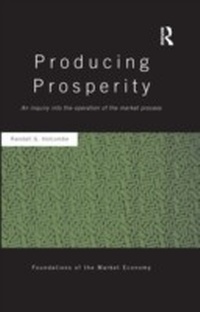
Producing Prosperity
An Inquiry into the Operation of the Market Process
1. Auflage
Erschienen am 3. Januar 2013
272 Seiten
978-1-136-16230-5 (ISBN)
Beschreibung

The substantial prosperity that characterizes market economies at the beginning of the twenty-first century is relatively recent in human history. Prior to the Industrial Revolution, economic progress was so slow that people would not have been able to recognize it in their lifetimes, whereas today, economic progress is so much a part of people's lives that they take it for granted.
In this new volume, Randall G. Holcombe argues that economic analysis, as it developed through the twentieth century, relies heavily on concepts of economic equilibrium, and is not descriptive of the dynamic real-world economy that is characterized by economic progress. Even in dynamic settings, economic models focus on income growth, leaving out the entrepreneurial forces that generate economic progress, resulting in the introduction of new goods and services and new production processes. Economic analysis focuses on the forces that lead to an economic equilibrium, not the forces that produce prosperity.
This characterization of economic analysis describes a substantial component of economics as it has developed over the past century. However, there are also economists who have analyzed the factors that lead to an entrepreneurial and innovative economy, generating progress rather than equilibrium. This volume does not question the value of past research, but argues that, looking ahead, economics should build on its past to focus on factors that create an entrepreneurial and innovative economy that is characterized by progress and prosperity. This would make economic analysis more consistent with the remarkable progress and prosperity that characterizes the modern economy. This volume lays out a framework for economic analysis that consistently incorporates the real-world factors that produce prosperity.
In this new volume, Randall G. Holcombe argues that economic analysis, as it developed through the twentieth century, relies heavily on concepts of economic equilibrium, and is not descriptive of the dynamic real-world economy that is characterized by economic progress. Even in dynamic settings, economic models focus on income growth, leaving out the entrepreneurial forces that generate economic progress, resulting in the introduction of new goods and services and new production processes. Economic analysis focuses on the forces that lead to an economic equilibrium, not the forces that produce prosperity.
This characterization of economic analysis describes a substantial component of economics as it has developed over the past century. However, there are also economists who have analyzed the factors that lead to an entrepreneurial and innovative economy, generating progress rather than equilibrium. This volume does not question the value of past research, but argues that, looking ahead, economics should build on its past to focus on factors that create an entrepreneurial and innovative economy that is characterized by progress and prosperity. This would make economic analysis more consistent with the remarkable progress and prosperity that characterizes the modern economy. This volume lays out a framework for economic analysis that consistently incorporates the real-world factors that produce prosperity.
Rezensionen / Stimmen
'It is an outstanding book and Holcombe should be celebrated for the clarity of his argument and the profound insights he provides about entrepreneurship, wealth creation, and the institutional environment that enables them' - Peter Boettke, George Mason University, USAWeitere Details
Reihe
Sprache
Englisch
Verlagsort
London
Großbritannien
Verlagsgruppe
Taylor & Francis Ltd
Zielgruppe
Für höhere Schule und Studium
Produkt-Hinweis
Reflowable
Dateigröße
0,54 MB
ISBN-13
978-1-136-16230-5 (9781136162305)
Copyright in bibliographic data and cover images is held by Nielsen Book Services Limited or by the publishers or by their respective licensors: all rights reserved.
Schweitzer Klassifikation
Weitere Ausgaben
Andere Ausgaben
Buch
03/2015
1. Auflage
Routledge
85,80 €
Versand in 10-20 Tagen
Buch
12/2012
1. Auflage
Routledge
231,90 €
Versand in 15-20 Tagen
Person
Randall G. Holcombe is DeVoe Moore Professor of Economics at Florida State University, USA.
Inhalt
Preface 1. Producing Prosperity: The Subject Matter of Economics 2. Economic Models: A Framework for Analysis 3. The Market Process 4. Market-Clearing Forces in the Economy 5. The Innovative Nature of Firms 6. The Role of Firms in the Market 7. The Trajectory of the Economy: Growth and Progress 8. Economic Welfare: Theory and Policy 9. Rent Seeking in a Creative Economy 10. The Coordination of Economic Activity 11. Agglomeration Economies and Economic Progress 12. The Evolution of the Economy: Differentiation, Selection, Replication 13. Producing Prosperity
