

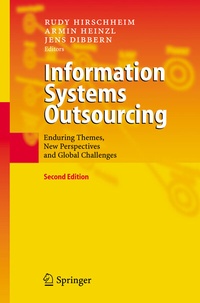
Information Systems Outsourcing
Enduring Themes, New Perspectives and Global Challenges
2. Auflage
Erschienen am 13. Juni 2007
X, 704 Seiten
978-3-540-34877-1 (ISBN)
Beschreibung

Four years have been passed away since the first edition of this book has been published. While certain key issues on IS sourcing like determinants and application service provision have become more mature from an academic and industry perspective, additional topics have arisen on the horizon. In particular, offshoring and business process outsourcing have led to numerous insightful publications which offer a valuable and indispensable holistic sourcing persp- tive. Thus, the second edition of our outsourcing book deals with enduring themes, new perspectives, and global challenges. In addition to classical themes like Sourcing Determinants (Part I), Relationship Aspects (Part II), and Experiences (Part III), we felt it worthwhile to add three new parts. They cover information systems outsourcing from a Vendor and Individual Perspective (Part IV), Application Service Providing (Part V) as well as Offshoring and Global Outsoucing (Part VI). Again we have thoughtfully tried to arrange a compilation of contemporary outsourcing research as a primer and a platform for scientific discourse. In contrast to the first edition, this book is not the outcome of an International Conference, but rather an update of important and relevant perspectives. Since the Third International Conference on Outsourcing of Information Services will take place 2007 in Heidelberg, Germany, it may be considered as an epilogue for further interactions and discussions.
Weitere Details
Weitere Ausgaben
Nachauflagen
Rudy Hirschheim | Armin Heinzl | Jens Dibbern
Information Systems Outsourcing
Enduring Themes, Global Challenges, and Process Opportunities
E-Book
03/2009
3. Auflage
Springer
106,99 €
Als Download verfügbar
Andere Ausgaben
Rudy Hirschheim | Armin Heinzl | Jens Dibbern
Information Systems Outsourcing
Enduring Themes, New Perspectives and Global Challenges
Buch
09/2006
2. Auflage
Springer
106,95 €
Artikel ist vergriffen; siehe Neuauflage
Vorauflage
Rudy Hirschheim | Armin Heinzl | Jens Dibbern
Information Systems Outsourcing
Enduring Themes, Emergent Patterns and Future Directions
E-Book
03/2013
1. Auflage
Springer
85,59 €
Als Download verfügbar
Personen
Inhalt
Overview.- Information Technology Outsourcing in the New Economy - An Introduction to the Outsourcing and Offshoring Landscape.- Determinants of the IS Outsourcing Decision.- Costs, Transaction-Specific Investments and Vendor Dominance of the Marketplace: The Economics of IS Outsourcing.- Selective Outsourcing of Information Systems in Small and Medium Sized Enterprises.- Antecedents of Information Systems Backsourcing.- IT Sourcing a Dynamic Phenomena: Forming an Institutional Theory Perspective.- Outsourcing Relationship Issues.- Legal and Tax Considerations in Outsourcing.- Measuring and Managing IT Outsourcing Risk: Lessons Learned.- Governance of Remotely Outsourced Software Development: A Comparison of Client and Vendor Perspectives.- Spiraling Effect of IS Outsourcing Contract Interpretations.- Experiences and Outcome of IS Outsourcing.- The Normative Value of Transaction Cost Economics: What Managers Have Learned About TCE Principles in the IT Context.- Success of IS Outsourcing as a Predictor of IS Effectiveness: Does IT Governance Matter?.- Four Stories of Information Systems Insourcing.- Capabilities for Information Systems Outsourcing Success: Insights from the Resource-based View of the Firm.- Vendor View and Individual Level Perspective.- Vendor Strategies in the German Market for Information Technology and Business Process Outsourcing.- Work Outcomes and Job Design for Contract Versus Permanent Information Systems Professionals on Software Development Teams.- When Subordinates Become IT Contractors: Persistent Managerial Expectations in IT Outsourcing.- Application Service Providing and Business Process Outsourcing.- Understanding the 'Service' Component of Application Service Provision: An Empirical Analysis of Satisfaction with ASP Services.-Developing a Sustainable Value Proposition in Web Services: Lessons from Strategic Management.- Business Process Outsourcing, Knowledge and Innovation - A Study of Enterprise Partnership.- Business Process Outsourcing: The Hysteresis Effect and Other Lessons.- Offshoring and Global Outsourcing.- Business Process Offshoring to India: An verview.- The Maturation of Offshore Sourcing of Information Technology Work.- Managing Cross-Cultural Issues in Global Software Outsourcing.- Knowledge Management in Offshore Software Development.- Offshore Outsourcing: Challenge to the Information Systems Discipline.
Costs, Transaction-Specific Investments and Vendor Dominance of the Marketplace: The Economics of IS Outsourcing (p. 26-27)
Soon Ang
School of Accountancy and Business, Nanyang Technological University, Nanyang Avenue 2263, Republic of Singapore, asang@ntuvax.ntu.ac.sg, FAX: (65) 792-2313
Detmar Straub
Robinson College of Business, Computer Information Systems Department, Georgia State University, University Plaza, Atlanta, GA 30303-4012, dstraub@gsu.edu, 404-651-3880, FAX: 404-651-3842
1 Introduction
The strategic importance of information systems (IS) in banking is widely substantiated (Steiner and Teixeira 1990, OECD 1992, Office of Technology Assessment 1984, Office of Technology Assessment 1987, Apte et al 1990, McFarlan and McKenney 1983). Yet, in spite of this, some banks have outsourced their entire information services function (American Bankers Association 1981, 1986, 1990). On the surface, it seems counterintuitive that banks should potentially erode their competence in the design and delivery of strategic financial services relying heavily on information technology (IT). Part of the explanation lies in past behaviors and long standing theories about how organizations respond to their environment. According to classical theories of the firm, organizations strive toward autonomy (Gouldner 1959, Burt 1982). They maintain independence by integrating as many business activities as possible within their hierarchical control. By means of backward and forward integration, organizations secure access to markets, safeguard suppliers to raw materials, and prevent competitors from obtaining such access.
While corporations overall have demonstrated many of these tendencies in the post World War II era, a reversal of this trend had begun to emerge by the mid- 1980s (Harrison and St. John 1996). Described as "hollowing out of the corporation," organizations began to relinquish internal control and depend more heavily on external service-providers. Outsourcing prompted firms to abandon internal production bases and rely on others for manufacturing, distribution, and other business functions.
The growing practice of outsourcing in modern corporations has led both academics and practitioners to theorize and speculate about the underlying momentum towards outsourcing. The intriguing question is: If organizations are "dependence-avoiders" (Gouldner 1959), why expose oneself to inter-organizational dependencies in outsourcing arrangements? In addition to external dependencies, outsourcing brings on costly and radical changes. It creates upheavals in existing organizational structure and redefines organizational roles. Organizations must hire and terminate employees, sell off fixed assets, and plan for geographical relocation of firm operations.
The evolving literature on information technology (IT) outsourcing offers a variety of explanations for why outsourcing occurs. Many of these arguments have a basis in economic theories and models. One of the most commonly cited reasons, for example, is that managers feel that they can gain cost advantages by hiring outsiders to perform certain services and produce certain products (Alpar and Sharia 1995, Loh and Venkatraman 1992a). Transaction cost theory offers another economic perspective (Nam, Rajagopalan, Rao, and Chaudhury 1996) that typically frames outsourcing as a decision about drawing firm boundaries (Pisano 1990, Mosakowski 1991) or as vertical integration (Anderson and Schmittlein 1984, Monteverde and Teece 1982, Harrigan 1985). Financial slack and firm size are other factors which can be conceptualized, at least in part, as economic constructs.
This study argues that we can improve our ability to explain outsourcing within the larger context of organizational responses to their strategic environment by focusing on such economic considerations. Our findings suggest which factors play into the outsourcing decision and their relative importance in sourcing choices.
Soon Ang
School of Accountancy and Business, Nanyang Technological University, Nanyang Avenue 2263, Republic of Singapore, asang@ntuvax.ntu.ac.sg, FAX: (65) 792-2313
Detmar Straub
Robinson College of Business, Computer Information Systems Department, Georgia State University, University Plaza, Atlanta, GA 30303-4012, dstraub@gsu.edu, 404-651-3880, FAX: 404-651-3842
1 Introduction
The strategic importance of information systems (IS) in banking is widely substantiated (Steiner and Teixeira 1990, OECD 1992, Office of Technology Assessment 1984, Office of Technology Assessment 1987, Apte et al 1990, McFarlan and McKenney 1983). Yet, in spite of this, some banks have outsourced their entire information services function (American Bankers Association 1981, 1986, 1990). On the surface, it seems counterintuitive that banks should potentially erode their competence in the design and delivery of strategic financial services relying heavily on information technology (IT). Part of the explanation lies in past behaviors and long standing theories about how organizations respond to their environment. According to classical theories of the firm, organizations strive toward autonomy (Gouldner 1959, Burt 1982). They maintain independence by integrating as many business activities as possible within their hierarchical control. By means of backward and forward integration, organizations secure access to markets, safeguard suppliers to raw materials, and prevent competitors from obtaining such access.
While corporations overall have demonstrated many of these tendencies in the post World War II era, a reversal of this trend had begun to emerge by the mid- 1980s (Harrison and St. John 1996). Described as "hollowing out of the corporation," organizations began to relinquish internal control and depend more heavily on external service-providers. Outsourcing prompted firms to abandon internal production bases and rely on others for manufacturing, distribution, and other business functions.
The growing practice of outsourcing in modern corporations has led both academics and practitioners to theorize and speculate about the underlying momentum towards outsourcing. The intriguing question is: If organizations are "dependence-avoiders" (Gouldner 1959), why expose oneself to inter-organizational dependencies in outsourcing arrangements? In addition to external dependencies, outsourcing brings on costly and radical changes. It creates upheavals in existing organizational structure and redefines organizational roles. Organizations must hire and terminate employees, sell off fixed assets, and plan for geographical relocation of firm operations.
The evolving literature on information technology (IT) outsourcing offers a variety of explanations for why outsourcing occurs. Many of these arguments have a basis in economic theories and models. One of the most commonly cited reasons, for example, is that managers feel that they can gain cost advantages by hiring outsiders to perform certain services and produce certain products (Alpar and Sharia 1995, Loh and Venkatraman 1992a). Transaction cost theory offers another economic perspective (Nam, Rajagopalan, Rao, and Chaudhury 1996) that typically frames outsourcing as a decision about drawing firm boundaries (Pisano 1990, Mosakowski 1991) or as vertical integration (Anderson and Schmittlein 1984, Monteverde and Teece 1982, Harrigan 1985). Financial slack and firm size are other factors which can be conceptualized, at least in part, as economic constructs.
This study argues that we can improve our ability to explain outsourcing within the larger context of organizational responses to their strategic environment by focusing on such economic considerations. Our findings suggest which factors play into the outsourcing decision and their relative importance in sourcing choices.
