

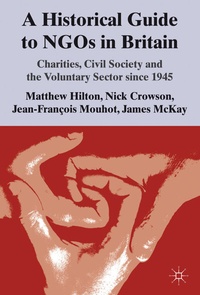
A Historical Guide to NGOs in Britain
Beschreibung
Rezensionen / Stimmen
'The wealth of statistical data and extensive descriptions of activities make this a useful work for anyone interested in an overview of NGOs in Britain.' - Recommended by Choice
Weitere Details
Weitere Ausgaben
Personen
MATTHEW HILTON Professor of Social History at the University of Birmingham, UK. He is the author of
Smoking in British Popular Culture
(Manchester, 2000),
Consumerism in Twentieth-Century Britain
(Cambridge, 2003), and
Prosperity for All: Consumer Activism in an Era of Globalisation
(Cornell, 2009). Most recently, he is the joint author, with Nicholas Crowson, Jean-Francois Mouhot & James McKay, of
The Politics of Expertise: How NGOs Shaped Modern Britain
(Oxford, 2012).
NICK CROWSON Reader in Contemporary British History at the University of Birmingham, UK. He is the author of
Facing Fascism: The Conservative Party and the European Dictators 1935-40
(London, 1997),
The Conservative Party and European Integration since 1945: At the Heart of Europe?
(Abingdon, 2006), and
Britain and Europe: A Political History since 1918
(Abingdon, 2010). Most recently, he is the joint author, with Matthew Hilton, Jean-Francois Mouhot & James McKay, of
The Politics of Expertise: How NGOs Shaped Modern Britain
(Oxford, 2012).
JAMES MCKAY Post-doctoral Research Fellow at the University of Birmingham, UK. He is the co-editor of two volumes on NGOs and the voluntary sector: with Matthew Hilton and Nick Crowson, NGOs in
Contemporary Britain: Non-state Actors in Society and Politics since 1945
(Palgrave, 2009); and, with Matthew Hilton,
The Ages of Voluntarism: How We Got to the Big Society
(Oxford, 2011). Along with Matthew Hilton, Nicholas Crowson and Jean-Francois Mouhot, he is the co-author of
The Politics of Expertise: How NGOs Shaped Modern Britain
(Oxford, 2012).
JEAN-FRANCOIS MOUHOT was a Post-doctoral Research Fellow at the University of Birmingham, UK, until May 2011. He is currently a Marie Curie Research Fellow at Georgetown University and the EHESS in Paris. He is the author of
Les Réfugiés acadiens en France
(1758-1785):
l'impossible réintégration?
(Québec: Septentrion, 2009),
Des Esclaves Energétiques: Réflexions sur le changement climatique
(Seysel, Champ Vallon, 2011) andco-editor (with Charles-François Mathis) of
Une Protection de l'Environnement à la Française?
(XIXe-XXe siècles) (Seysel: Champ Vallon, forthcoming 2012). Most recently, he is the joint author, with Matthew Hilton Nicholas Crowson, & James McKay, of
The Politics of Expertise: How NGOs Shaped Modern Britain
(Oxford, 2012).
