

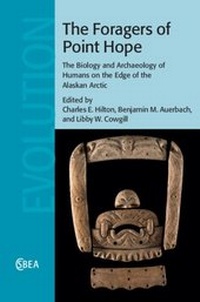
The Foragers of Point Hope
The Biology and Archaeology of Humans on the Edge of the Alaskan Arctic
1. Auflage
Erschienen am 9. Juli 2014
978-1-139-98978-7 (ISBN)
Beschreibung
On the edge of the Arctic Ocean, above the Arctic Circle, the prehistoric settlements at Point Hope, Alaska, represent a truly remarkable accomplishment in human biological and cultural adaptations. Presenting a set of anthropological analyses on the human skeletal remains and cultural material from the Ipiutak and Tigara archaeological sites, The Foragers of Point Hope sheds new light on the excavations from 1939-41, which provided one of the largest sets of combined biological and cultural materials of northern latitude peoples in the world. A range of material items indicated successful human foraging strategies in this harsh Arctic environment. They also yielded enigmatic artifacts indicative of complex human cultural life filled with dense ritual and artistic expression. These remnants of past human activity contribute to a crucial understanding of past foraging lifeways and offer important insights into the human condition at the extreme edges of the globe.
Rezensionen / Stimmen
'This volume represents a true anthropological reconstruction of life among the prehistoric foragers from Point Hope, Alaska. It includes important perspectives regarding the ecological realities of adaptation in this harsh environment that are integrated into the perception of this landscape by the Ipiutak and Tigara people themselves. The work is a must-read for all who find interest in hunter-gatherer populations, and scholars who value integrated anthropological research.' Daniel H. Temple, University of North Carolina, Wilmington 'Point Hope, a narrow spit of land on the Arctic Ocean, is something of an enigma in Alaskan prehistory. Since the pre-WWII excavations of its varied habitation and cemetery sites the archaeology has been well chronicled, though not with unqualified acceptance. In addition, with exceptions, the ancient inhabitants themselves received little attention - as in the lack of research on some 500 recovered Ipiutak and Tigara skeletons. Finally, after 70+ years this superbly edited volume addresses that neglect. Between up-to-date accounts of the archaeological context and thoughtful comment by highly respected circumpolar researchers, a series of comprehensive yet highly readable chapters by biological anthropologists and bioarchaeologists give insight into the origins, affinities, and everyday lives of people who once called Point Hope home. Though long overdue, this much-needed biocultural insight was worth the wait.' Joel D. Irish, Liverpool John Moores University 'This volume provides the reader with almost everything one would want to know about the archaeology and skeletal biology of the prehistoric Ipiutak and Tigara samples from a tiny, but important strip of land in Point Hope, Alaska. With a wide array of well-written chapters on topics as diverse as the Ipiutak 'spirit-scape' to dental microwear to paleopathology, from growth and development to the samples' genetic affinities inferred from cranial morphology, this book provides much-needed contextual knowledge on this fascinating skeletal sample, and will be a go-to resource for those interested in the bioarchaeology of circumpolar peoples.' Trenton W. Holliday, Tulane UniversityWeitere Details
Reihe
Sprache
Englisch
Verlagsort
Cambridge
Großbritannien
Verlagsgruppe
Cambridge University Press
Zielgruppe
Für Beruf und Forschung
Illustrationen
42 Halftones, unspecified; 42 Halftones, black and white; 7 Line drawings, black and white
Dateigröße
9513,71 MB
ISBN-13
978-1-139-98978-7 (9781139989787)
Copyright in bibliographic data and cover images is held by Nielsen Book Services Limited or by the publishers or by their respective licensors: all rights reserved.
Schweitzer Klassifikation
Weitere Ausgaben
Personen
Charles E. Hilton is an Assistant Professor in the Department of Anthropology at Grinnell College, Iowa. As a biological anthropologist with a background in human skeletal biology, functional morphology, human evolutionary ecology, and epidemiology, his research focuses on how small-scale human groups, particularly foragers, develop and evolve both short- and long-term biological and cultural responses within environmental settings offering limited resources. Benjamin M. Auerbach is an Assistant Professor in the Department of Anthropology at the University of Tennessee, Knoxville. A functional anatomist, skeletal biologist and evolutionary biologist, he has spent fifteen years collecting osteometric and anthropometric data to document morphological variation among modern humans within the context of evolutionary forces. Libby W. Cowgill is an Assistant Professor in the Anthropology Department at the University of Missouri, Columbia. Her research interests include human growth, development, and functional morphology as well as Late Pleistocene human evolution. Her current research program explores the relationship between childhood behaviour and selection pressure and the formation of adult skeletal morphology.
Inhalt
List of contributors; Acknowledgements; Foreword; Preface; 1. Introduction: humans on the edge of the Alaskan Arctic Charles E. Hilton, Benjamin M. Auerbach and Libby W. Cowgill; Part I. Regional Archaeological and Biological Context: 2. The archaeology of north Alaska: Point Hope in context Anne M. Jensen; 3. The Ipiutak cult of Shamans and its warrior protectors: an archaeological context Owen K. Mason; 4. Ancestor-descendant affinities between the Ipiutak and Tigara at Point Hope, AK in the context of North American Arctic cranial variation Blaine Maley; Part II. Biological Variation among the Foragers of Point Hope: 5. Contrasting of the Ipiutak and Tigara: evidence from incisor microwear texture analysis Kristin L. Krueger; 6. The diets of the Ipiutak and Tigara (Point Hope, Alaska): evidence from occlusal molar microwear texture analysis Sireen El Zaatari; 7. Postcranial pathological lesions in precontact Ipiutak and Tigara skeletal remains of Point Hope, Alaska Charles E. Hilton, Marsha D. Ogilvie, Megan Latchaw Czarniecki and Sarah Gossett; 8. Bone strength and subsistence activities at Point Hope Laura L. Shackelford; 9. Postcranial growth and development of immature skeletons from Point Hope, Alaska Libby W. Cowgill; Part III. Contexts, Conclusions and Commentaries: 10. Morphologies from the edge: perspectives on biological variation among the Late Holocene inhabitants of the northwestern North American Arctic Benjamin M. Auerbach; 11. The Ipiutak spirit-scape: an archaeological phenomenon William W. Fitzhugh; 12. Point Hope in certain contexts: a comment Don E. Dumond; References; Index.
