

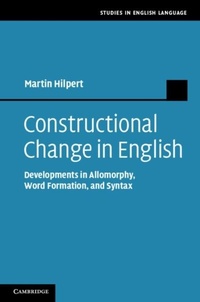
Constructional Change in English
Developments in Allomorphy, Word Formation, and Syntax
Erschienen am 26. Februar 2013
978-1-107-30243-3 (ISBN)
Beschreibung

Martin Hilpert combines construction grammar and advanced corpus-based methodology into a new way of studying language change. Constructions are generalizations over remembered exemplars of language use. These exemplars are stored with all their formal and functional properties, yielding constructional generalizations that contain many parameters of variation. Over time, as patterns of language use are changing, the generalizations are changing with them. This book illustrates the workings of constructional change with three corpus-based studies that reveal patterns of change at several levels of linguistic structure, ranging from allomorphy to word formation and to syntax. Taken together, the results strongly motivate the use of construction grammar in research on diachronic language change. This new perspective has wide-ranging consequences for the way historical linguists think about language change. It will be of particular interest to linguists working on morpho-syntax, sociolinguistics and corpus linguistics.
Rezensionen / Stimmen
'A rigorous and lucidly-written application of quantitative corpus linguistics to language change from the perspective of Construction Grammar, this book is a must-read for anyone interested in historical linguistics.' Stefan Th. Gries, University of California, Santa Barbara 'Hilpert's scholarly, engaging monograph is essential reading for those working in historical and cognitive linguistics. The compelling arguments and the quantitative methodology adopted establish new directions for related research.' Graeme Trousdale, University of Edinburgh 'Hilpert's study is a milestone in the historical linguistics of English. Maintaining due respect for the philological tradition, the author breaks new ground in methodology, through the application of sophisticated corpus-statistical tools (some of them developed by himself), and in theory, through demonstrating how construction grammar helps us understand diachronic processes.' Christian Mair, University of Freiburg 'In this stimulating book, Hilpert combines the theoretical approach of Construction Grammar with sophisticated corpus methodology to investigate the processes of language change ... The book will provide thought-provoking reading for scholars and advanced students concerned with language variation and change, constructional approaches to language, and corpus methodology.' Jill Bowie, English Language and LinguisticsWeitere Details
Reihe
Sprache
Englisch
Verlagsort
Cambridge
Großbritannien
Zielgruppe
Für Beruf und Forschung
Illustrationen
17 Tables, black and white; 46 Line drawings, unspecified
Dateigröße
4,62 MB
ISBN-13
978-1-107-30243-3 (9781107302433)
Copyright in bibliographic data and cover images is held by Nielsen Book Services Limited or by the publishers or by their respective licensors: all rights reserved.
Schweitzer Klassifikation
Weitere Ausgaben
Andere Ausgaben
Martin Hilpert
Constructional Change in English
Developments in Allomorphy, Word Formation, and Syntax
Buch
02/2013
Cambridge University Press
133,50 €
Versand in 15-20 Tagen
Person
Martin Hilpert is Assistant Professor of English Linguistics at the University of Neuchatel.
Inhalt
1. Introduction; 2. Data and methodology; 3. Constructional change in allomorphy; 4. Constructional change in word formation; 5. Constructional change in syntax; 6. Conclusions.
