

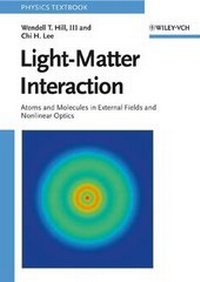
Light-Matter Interaction
Atoms and Molecules in External Fields and Nonlinear Optics
1. Auflage
Erschienen am 25. Juni 2008
XVI, 309 Seiten
978-3-527-61902-3 (ISBN)
Beschreibung

This book draws together the principal ideas that form the basis of atomic, molecular, and optical science and engineering. It covers the basics of atoms, diatomic molecules, atoms and molecules in static and electromagnetic fields and nonlinear optics. Exercises and bibliographies supplement each chapter, while several appendices present such important background information as physics and math definitions, atomic and molecular data, and tensor algebra.
Accessible to advanced undergraduates, graduate students, or researchers who have been trained in one of the conventional curricula of physics, chemistry, or engineering but who need to acquire familiarity with adjacent areas in order to pursue their research goals.
Accessible to advanced undergraduates, graduate students, or researchers who have been trained in one of the conventional curricula of physics, chemistry, or engineering but who need to acquire familiarity with adjacent areas in order to pursue their research goals.
Weitere Details
Weitere Ausgaben
Andere Ausgaben
Wendell T. Hill | Chi H. Lee
Light-Matter Interaction
Atoms and Molecules in External Fields and Nonlinear Optics
Buch
11/2006
1. Auflage
Wiley-VCH
102,00 €
Artikel ist vergriffen; siehe andere Ausgabe
Personen
Wendell Hill holds the rank of Professor at the University of Maryland, College Park, with appointments in the Institute for Physical Science and Technology and the Department of Physics. He received a B.A. in physics from the University of California, Irvine, in 1974 and a Ph.D. in physics from Stanford University in 1980. He is a guest worker at NIST, where he was a postdoc before joining the faculty of the University of Maryland in 1982, and has held visiting positions with Instituto Venezalano de Investigaciones (Venezuela), Université de Paris-Sud, Orsay France and JILA. Professor Hill's research interests are broad with publications ranging from high-energy particle physics to atom optics. His current investigations are centered around ultrafast dynamics, coherent control, strong-field laser-matter interaction, atom optics and quantum information.
Chi H. Lee received his B.S. degree in electrical engineering from the National Taiwan University in 1959, and his M.S. and Ph.D. degrees in applied physics from Harvard University in 1962 and 1968, respectively. Since 1968 he has been with the University of Maryland, where he is now a Professor Emeritus of the Electrical and Computer Engineering Department. His areas of research include ultrafast optoelectronics, lasers, electro-optic devices and microwave photonics. Professor Lee is a Fellow of the IEEE, the Optical Society of America and the Photonic Society of Chinese Americans. He served as the Chairman of the IEEE MTT-technical committee for lightwave technology and the Microwave Photonics committee of the IEEE LEOS.
Chi H. Lee received his B.S. degree in electrical engineering from the National Taiwan University in 1959, and his M.S. and Ph.D. degrees in applied physics from Harvard University in 1962 and 1968, respectively. Since 1968 he has been with the University of Maryland, where he is now a Professor Emeritus of the Electrical and Computer Engineering Department. His areas of research include ultrafast optoelectronics, lasers, electro-optic devices and microwave photonics. Professor Lee is a Fellow of the IEEE, the Optical Society of America and the Photonic Society of Chinese Americans. He served as the Chairman of the IEEE MTT-technical committee for lightwave technology and the Microwave Photonics committee of the IEEE LEOS.
Inhalt
Preface
Part 1: Light-Matter Interaction: Atoms, Molecules and External Fields
1. Hydrogen-Like Ion: An Atom (Ion) with One Electron
2. The Structure of the Multielectron Atom
3. Atoms in Static Fields
4. Atoms in AC Fields
5. Diatomic Molecules
6. Molecules in External Fields
Part 2: Light-Matter Interaction: Nonlinear Optics
7. Nonlinear Optics
8. Wave Propagation
9. Quantum Theory
10. Applications
Appendices
A. Atomic Physics Definitions
B. Mathematics Related to AMO Calculations
C. Atomic and Molecular Data
D. Coupling Angular Momenta
E. Tensor Algebra
References
Index
Part 1: Light-Matter Interaction: Atoms, Molecules and External Fields
1. Hydrogen-Like Ion: An Atom (Ion) with One Electron
2. The Structure of the Multielectron Atom
3. Atoms in Static Fields
4. Atoms in AC Fields
5. Diatomic Molecules
6. Molecules in External Fields
Part 2: Light-Matter Interaction: Nonlinear Optics
7. Nonlinear Optics
8. Wave Propagation
9. Quantum Theory
10. Applications
Appendices
A. Atomic Physics Definitions
B. Mathematics Related to AMO Calculations
C. Atomic and Molecular Data
D. Coupling Angular Momenta
E. Tensor Algebra
References
Index
