

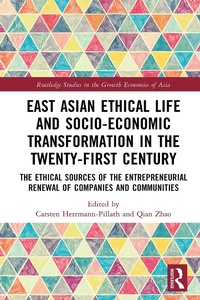
East Asian Ethical Life and Socio-Economic Transformation in the Twenty-First Century
The Ethical Sources of the Entrepreneurial Renewal of Companies and Communities
1. Auflage
Erschienen am 25. Juni 2024
286 Seiten
978-1-040-05109-2 (ISBN)
Beschreibung
This book considers ethical culture in East Asia, examines the impact it has had on economic and social transformation, and explores what effect it might have on solving current problems. It views the ethical culture of East Asia, that is, the beliefs, values, and practices that define East Asian societies' conceptions of ethics in everyday life, as different from what pertains in the West, with more emphasis in East Asia on respect for ancestors, concern about propriety of behaviour, and notions of community. The book discusses how these particular East Asian values are being applied, for example, in family businesses, and how they might further be applied to solve current crucial challenges for humanity, such as climate change, ageing, and persistent inequality, challenges that are not being solved by an exclusive focus on economic growth alone. The book includes a consideration of ethical innovation, for example, distinct forms of ecological ethics enshrined in newly emerging economic organizations, such as social entrepreneurship.
Weitere Details
Reihe
Auflage
1. Auflage
Sprache
Englisch
Verlagsort
London
Großbritannien
Verlagsgruppe
Taylor & Francis Ltd
Zielgruppe
Für Beruf und Forschung
Produkt-Hinweis
Reflowable
Illustrationen
6 Tables, black and white; 9 Line drawings, black and white; 9 Illustrations, black and white
ISBN-13
978-1-040-05109-2 (9781040051092)
Copyright in bibliographic data and cover images is held by Nielsen Book Services Limited or by the publishers or by their respective licensors: all rights reserved.
Schweitzer Klassifikation
Weitere Ausgaben
Personen
Carsten Herrmann-Pillath is Professor and Permanent Fellow at the Max Weber Centre for Advanced Cultural and Social Studies, University of Erfurt, Germany, and Distinguished Visiting Professor at Bejing Normal University, China.
Qian Zhao is Postdoctoral Researcher at the University of Erfurt, Germany.
Qian Zhao is Postdoctoral Researcher at the University of Erfurt, Germany.
Inhalt
Foreword
List of Figures
List of Tables
1. Introduction (Carsten Herrmann-Pillath and Qian Zhao)
Part 1: Intellectual and spiritual sources of ethical life in East Asia
2. IE-MURA-SEKEN and Japanese ethical life in the Tokugawa economy (Kiichiro Yagi)
3. Spiritual origins of ethical life in China's Late Imperial market society: A relational moral universe (Qian Zhao)
4. Ethical life, merchants and the state in Korean society during the Joseon dynasty (Eun-Jeung Lee)
Part 2: Religion, traditional values and ethical life in the economy
5. Cultural entrepreneurship and cooperative enterprises as sustainable and responsible businesses in South Korea (Seungkwon Jang)
6. Re-integration of ethics and economy: Shrines, community, and social entrepreneurship in Japan (Yoshinori Hiroi and Sigrun Caspary)
7. Shareholding cooperatives in Shenzhen and the revival of 'filial piety' as a core value of Chinese ethical life (Jing Cheng, Carsten Herrmann-Pillath, Ling Li and Man Guo)
Part 3: Community, resilience, and ecology as settings of ethical entrepreneurship
8. Corporate Social Entrepreneurship in times of crisis: Giving back to community in Japan (Masaatsu Doi)
9. Public-minded ethical life of family businesses in Japan and the management of natural resource commons (Toshio Goto)
10. Social Enterprises and the Ecological Revival of Rural Communities in China (Tiejun Wen)
Part 4: Corporate Social responsibility, Government and ethical life in business
11. Corporate Social Responsibility and ethical life of Chinese family business (Xingyuan Feng)
12. Investment, Sustainability Reporting and Evolving Ethical Influences in the Shaping of Social Responsibility: Evidence from South Korea (Hannah Jun)
13. Demographic decline and migrant workers in Taiwan: Social entrepreneurship enacting cultural change (Chun-Hsiao Wang)
Epilogue - Cultural Entrepreneurship in East Asia and the West: A practitioner's perspective (Peter Heller)
Index
List of Figures
List of Tables
1. Introduction (Carsten Herrmann-Pillath and Qian Zhao)
Part 1: Intellectual and spiritual sources of ethical life in East Asia
2. IE-MURA-SEKEN and Japanese ethical life in the Tokugawa economy (Kiichiro Yagi)
3. Spiritual origins of ethical life in China's Late Imperial market society: A relational moral universe (Qian Zhao)
4. Ethical life, merchants and the state in Korean society during the Joseon dynasty (Eun-Jeung Lee)
Part 2: Religion, traditional values and ethical life in the economy
5. Cultural entrepreneurship and cooperative enterprises as sustainable and responsible businesses in South Korea (Seungkwon Jang)
6. Re-integration of ethics and economy: Shrines, community, and social entrepreneurship in Japan (Yoshinori Hiroi and Sigrun Caspary)
7. Shareholding cooperatives in Shenzhen and the revival of 'filial piety' as a core value of Chinese ethical life (Jing Cheng, Carsten Herrmann-Pillath, Ling Li and Man Guo)
Part 3: Community, resilience, and ecology as settings of ethical entrepreneurship
8. Corporate Social Entrepreneurship in times of crisis: Giving back to community in Japan (Masaatsu Doi)
9. Public-minded ethical life of family businesses in Japan and the management of natural resource commons (Toshio Goto)
10. Social Enterprises and the Ecological Revival of Rural Communities in China (Tiejun Wen)
Part 4: Corporate Social responsibility, Government and ethical life in business
11. Corporate Social Responsibility and ethical life of Chinese family business (Xingyuan Feng)
12. Investment, Sustainability Reporting and Evolving Ethical Influences in the Shaping of Social Responsibility: Evidence from South Korea (Hannah Jun)
13. Demographic decline and migrant workers in Taiwan: Social entrepreneurship enacting cultural change (Chun-Hsiao Wang)
Epilogue - Cultural Entrepreneurship in East Asia and the West: A practitioner's perspective (Peter Heller)
Index
