

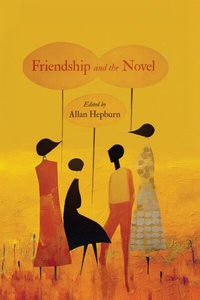
Friendship and the Novel
1. Auflage
Erschienen am 13. Februar 2024
312 Seiten
978-0-2280-2008-0 (ISBN)
Beschreibung

Friends are at the centre of novels by everyone from George Eliot to Elena Ferrante. It is nearly impossible to name a work of fiction that is not enriched by the tensions and magnetisms of friendship.
Friendship and the Novel focuses on the affective and narrative possibilities created by friendship in fiction. Friendship enables plots about rivalry, education, compassion, pity, deceit, betrayal, animosity, and breakup. It crosses boundaries of gender, class, nationality, disposition, race, age, and experience. Some novels offer lessons about distinguishing good friends from bad. In a Bildungsroman, friends contribute to the development of the protagonist through example or advice, as if novels were manuals for making and keeping friends. Sometimes sparks fly between friends and friendship swerves into sexual intimacy. Sally Rooney and other contemporary writers take friendship online.
The essays in Friendship and the Novel illustrate how friendship, in its many forms - short or lifelong, intense or circumstantial - is a central problem and an abiding mystery in fiction as in life, a subject that continues to shape the novel as a literary form and, in turn, its readers.
Contributors include Robert L. Caserio (Penn State), Maria DiBattista (Princeton), Jay Dickson (Reed), Brian Gingrich (Texas), Jonathan Greenberg (Montclair State), Barry McCrea (Notre Dame), Deborah Epstein Nord (Princeton), Erwin Rosinberg (Emory), Jacqueline Shin (Towson), Lisa Sternlieb (Penn State), and Emily Wittman (Alabama).
Friendship and the Novel focuses on the affective and narrative possibilities created by friendship in fiction. Friendship enables plots about rivalry, education, compassion, pity, deceit, betrayal, animosity, and breakup. It crosses boundaries of gender, class, nationality, disposition, race, age, and experience. Some novels offer lessons about distinguishing good friends from bad. In a Bildungsroman, friends contribute to the development of the protagonist through example or advice, as if novels were manuals for making and keeping friends. Sometimes sparks fly between friends and friendship swerves into sexual intimacy. Sally Rooney and other contemporary writers take friendship online.
The essays in Friendship and the Novel illustrate how friendship, in its many forms - short or lifelong, intense or circumstantial - is a central problem and an abiding mystery in fiction as in life, a subject that continues to shape the novel as a literary form and, in turn, its readers.
Contributors include Robert L. Caserio (Penn State), Maria DiBattista (Princeton), Jay Dickson (Reed), Brian Gingrich (Texas), Jonathan Greenberg (Montclair State), Barry McCrea (Notre Dame), Deborah Epstein Nord (Princeton), Erwin Rosinberg (Emory), Jacqueline Shin (Towson), Lisa Sternlieb (Penn State), and Emily Wittman (Alabama).
Rezensionen / Stimmen
"Friendship and the Novel is not just a pleasure to read; it is a well-argued and engagingly written book that opens up new insights into a variety of authors. Its cumulative effect is to demonstrate that friendship and the novel is such an important, indeed inevitable, topic that it leaves one surprised such a book did not already exist." J. Russell Perkin, Saint Mary's University and author of Politics and the British Novel in the 1970sWeitere Details
Sprache
Englisch
Verlagsort
Montreal
Kanada
Zielgruppe
Für höhere Schule und Studium
Für Beruf und Forschung
Dateigröße
1,19 MB
ISBN-13
978-0-2280-2008-0 (9780228020080)
Copyright in bibliographic data and cover images is held by Nielsen Book Services Limited or by the publishers or by their respective licensors: all rights reserved.
Schweitzer Klassifikation
Weitere Ausgaben
Andere Ausgaben

Allan Hepburn
Friendship and the Novel
Buch
02/2024
McGill-Queen's University Press
130,37 €
Versand in 15-20 Tagen
Allan Hepburn
Friendship and the Novel
Buch
02/2024
McGill-Queen's University Press
40,50 €
Versand in 15-20 Tagen
Person
Allan Hepburn is professor of English at McGill University.
Inhalt
- Friendship and the Novel
- Cover
- Half Title Page
- Title Page
- Copyright
- Dedication
- Contents
- Acknowledgments
- Introduction: Friendship and the Novel: Plot, Feeling, Form
- Thinking Friendship
- The Friendship Plot
- Betrayal and Forgiveness
- Part One: Patterns
- 1 Between Women and Men: George Eliot's Friendships
- Remaking the Novel
- Intellectual Sympathy and Desire: The Mill on the Floss
- Sororal Love
- Love and Friendship: Middlemarch
- Between Men: Daniel Deronda
- Between Eliot and Us
- 2 Faux Amis in Charlotte Brontë's Villette
- Unfriendly Readers
- False Friends
- Hiding from Friends
- 3 Friendship, Liberalism, and the Novel: A Passage to India
- Part Two: American Examples
- 4 Henry James's Ficelles as Friends
- 5 Willa Cather and the Posterity of Friendship
- Novel and Epic
- The Posterity of Friendship
- Time
- Part Three: Modern Instances
- 6 The Friendship of Joseph Conrad and André Gide: From Admiration to Disillusion and Back
- 7 The Elusive Figure of Friendship in Virginia Woolf's Novels
- Night and Day: "Yes, the world looks something like that to me, too"
- The Waves: The Six-Sided Flower
- 8 Charles Ryder's Sentimental Education: The Lessons of Friendship in Brideshead Revisited
- 9 Muriel Spark's Ensembles
- Characters in a Novel: The Comforters
- Spark's Ensembles: The Prime of Miss Jean Brodie
- Fellow Survivors: The Girls of Slender Means
- Fellow Cross-Dressers: The Abbess of Crewe
- Imagined Friendship
- Part Four: Contemporary Friendships
- 10 Critical Distance, Reparative Proximity: Changing Representations of Queer Friendship
- Prefatory: Attachments, Alignments, Sex
- Critical Distance 1: Another Country
- Reparative Proximity 1: The Inheritance
- Reparative Proximity 2: A Little Life
- Critical Distance 2: The Group
- 11 The European Generation X Novel
- Knausgaard or Ferrante?
- Class, Friendship, and the Novel
- European Generation X Epic
- Gen X Expectations
- Friendship and the Gen X Novel
- Afterword: Friendship: A Coda
- Contributors
- Index
