

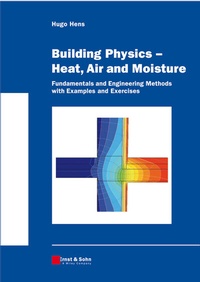
Building Physics - Heat, Air and Moisture
Fundamentals and Engineering Methods with Examples and Exercises
1. Auflage
Erschienen am 9. Januar 2012
XIV, 270 Seiten
978-3-433-60130-3 (ISBN)
Beschreibung

Note: New editions of this book have been published: the 2nd edition in 2012, the 3rd edition in 2017, and the 4th edition in September 2023.
Bad experiences with construction quality, the energy crises of 1973 and 1979, complaints about 'sick buildings', thermal, acoustical, visual and olfactory discomfort, the move towards more sustainability, have all accelerated the development of a field, which until 35 years ago was hardly more than an academic exercise: building physics.
Through the application of existing physical knowledge and the combination with information coming from other disciplines, the field helps to understand the physical performance of building parts, buildings and the built environment, and translates it into correct design and construction.
This book is the result of thirty years teaching, research and consultancy activity of the author.
The book discusses the theory behind the heat and mass transport in and through building components. Steady and non steady state heat conduction, heat convection and thermal radiation are discussed in depth, followed by typical building-related thermal concepts such as reference temperatures, surface film coefficients, the thermal transmissivity, the solar transmissivity, thermal bridging and the periodic thermal properties. Water vapour and water vapour flow and moisture flow in and through building materials and building components is analyzed in depth, mixed up with several engineering concepts which allow a first order analysis of phenomena such as the vapour balance, the mold, mildew and dust mites risk, surface condensation, sorption, capillary suction, rain absorption and drying. In a last section, heat and mass transfer are combined into one overall model staying closest to the real hygrothermal response of building components, as observed in field experiments.
The book combines the theory of heat and mass transfer with typical building engineering applications. The line from theory to application is dressed in a correct and clear way. In the theory, oversimplification is avoided.
This book is the result of thirty years teaching, research and consultancy activity of the author.
Bad experiences with construction quality, the energy crises of 1973 and 1979, complaints about 'sick buildings', thermal, acoustical, visual and olfactory discomfort, the move towards more sustainability, have all accelerated the development of a field, which until 35 years ago was hardly more than an academic exercise: building physics.
Through the application of existing physical knowledge and the combination with information coming from other disciplines, the field helps to understand the physical performance of building parts, buildings and the built environment, and translates it into correct design and construction.
This book is the result of thirty years teaching, research and consultancy activity of the author.
The book discusses the theory behind the heat and mass transport in and through building components. Steady and non steady state heat conduction, heat convection and thermal radiation are discussed in depth, followed by typical building-related thermal concepts such as reference temperatures, surface film coefficients, the thermal transmissivity, the solar transmissivity, thermal bridging and the periodic thermal properties. Water vapour and water vapour flow and moisture flow in and through building materials and building components is analyzed in depth, mixed up with several engineering concepts which allow a first order analysis of phenomena such as the vapour balance, the mold, mildew and dust mites risk, surface condensation, sorption, capillary suction, rain absorption and drying. In a last section, heat and mass transfer are combined into one overall model staying closest to the real hygrothermal response of building components, as observed in field experiments.
The book combines the theory of heat and mass transfer with typical building engineering applications. The line from theory to application is dressed in a correct and clear way. In the theory, oversimplification is avoided.
This book is the result of thirty years teaching, research and consultancy activity of the author.
Rezensionen / Stimmen
Das Buch Building Physics von Hugo Hens ist ein englischsprachiges Fachbuch, das sich mit den Themen Wärme, Luft und Feuchtigkeit befasst. Die Tatsache, dass der Autor Professor an einer europäischen Universität ist (K.U. Leuven), kommt dem Lesen des englischsprachen Textes sehr entgegen. Die Kapitel sind -wenn auch sehr wissenschaftlich -dennoch gut verständlich. Damit bieten sie eine gute Grundlage, insbesondere für Studenten, die englischen Fachbegriffe zu den genannten Themen aufzunehmen. Der Spagat zwischen wissenschaftlichen Grundlagen und der Erläuterung bauphysikalischer Praxisprobleme gelingt dem Autor gut. Für eine Neuauflage wäre zur Vervollständigung des Gebietes der Bauphysik eine Ergänzung der bau- und raumakustischen Themen wünschenswert.Dr. Normen Langner, Bauhaus Universität Weimar
---------------------------------------------------------
Weitere Details
Weitere Ausgaben
Andere Ausgaben
Hugo S. L. C. Hens
Building Physics and Applied Building Physics.. Fundamentals of Heat,... / Building Physics - Heat, Air and Moisture
Fundamentals and Engineering Methods with Examples and Exercises
Buch
05/2007
1. Auflage
Ernst & Sohn
61,90 €
Artikel ist vergriffen; siehe Neuauflage
Person
Hugo S.L.C Hens is professor at the University of Louvain (C.U.Leuven), Belgium. After four year of activity as a structural engineer and site supervisor, he returned to the university to receive a PhD in Building Physics. He taught Building Physics from 1975 to 2003 and Performance Based Building Design from 1970 to 2005 and still teaches building services. Dr. Hens is the author of several text books in Dutch on Building Physics, Performance Based Building Design and Building Services. He has authored and co-authored over 150 articles and conference papers, wrote hundreds of reports on building damage cases and their solution, introduced upgraded, research-based concepts for highly insulated roof and wall construction and directed several programs on building-energy related topics.
For ten years he has been coordinator of the international working group CIB W40 on Heat and Mass Transfer in Buildings. At present he is operating agent of the International Energy Agency's EXCO on Energy Conservation in Buildings and Community Systems, Annex 41 Whole Building Heat, Air and Moisture Response.
For ten years he has been coordinator of the international working group CIB W40 on Heat and Mass Transfer in Buildings. At present he is operating agent of the International Energy Agency's EXCO on Energy Conservation in Buildings and Community Systems, Annex 41 Whole Building Heat, Air and Moisture Response.
Inhalt
PREFACE
THE THEORY OF HEAT TRANSFER
Overview
Conduction
Convection
Radiation
Applications
Problems
References and Literature
THE THEORY OF MASS TRANSFER
Overview
Air transfer
Vapour transfer
Moisture transfer
Problems
References and Literature
COMBINED HEAT, AIR AND MOISTURE TRANSFER
Overview
Assumptions
Solution
Conservation Laws
Flow equations
Equations of state
Starting, boundary and contact conditions
Two examples of simplified models
References and Literatur
THE THEORY OF HEAT TRANSFER
Overview
Conduction
Convection
Radiation
Applications
Problems
References and Literature
THE THEORY OF MASS TRANSFER
Overview
Air transfer
Vapour transfer
Moisture transfer
Problems
References and Literature
COMBINED HEAT, AIR AND MOISTURE TRANSFER
Overview
Assumptions
Solution
Conservation Laws
Flow equations
Equations of state
Starting, boundary and contact conditions
Two examples of simplified models
References and Literatur
