

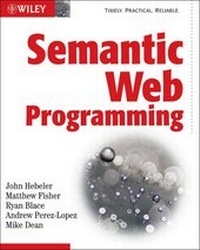
Semantic Web Programming
Valuation, Exploitation, and Infringement Damages
Erschienen am 15. April 2009
652 Seiten
978-0-470-50044-6 (ISBN)
Beschreibung

The next major advance in the Web?Web 3.0?will be built on semanticWeb technologies, which will allow data to be shared and reusedacross application, enterprise, and community boundaries. Writtenby a team of highly experienced Web developers, this book explainsexamines how this powerful new technology can unify and fullyleverage the ever-growing data, information, and services that areavailable on the Internet. Helpful examples demonstrate how to usethe semantic Web to solve practical, real-world problems while youtake a look at the set of design principles, collaborative workinggroups, and technologies that form the semantic Web. The companionWeb site features full code, as well as a reference section, a FAQsection, a discussion forum, and a semantic blog.
Weitere Details
Weitere Ausgaben
Andere Ausgaben
John Hebeler | Matthew Fisher | Ryan Blace
Semantic Web Programming
Buch
04/2009
Wiley
Preis leider unbekannt
Artikel ist vergriffen; siehe andere Ausgabe
Personen
John Hebeler has more than two decades of large-scale software development experience. Matt Fisher has more than fifteen years in software and systems development. Ryan Blace is a Semantic Web developer and has worked on multiple large-scale Semantic Web-based knowledge management systems. Andrew Perez-Lopez is a software developer with several years of experience with Semantic Web information systems.
Inhalt
- Semantic Web Programming
- About the Authors
- About The Technical Editors
- Credits
- Acknowledgments
- Contents
- Foreword
- Introduction
- Overview of the Book and Technology
- How This Book Is Organized
- Who Should Read This Book
- Tools You Will Need
- What's on the Website
- Summary (From Here, Up Next, and So On)
- Part I: Introducing Semantic Web Programming
- Chapter 1: Preparing to Program a Semantic Web of Data
- Defining the Semantic Web
- Identifying the Major Programming Components
- Determining Impacts on Programming
- Avoiding the Roadblocks, Myths, and Hype
- Understanding Semantic Web Origins
- Exploring Semantic Web Examples
- Summary and Onward
- Notes
- Chapter 2: Hello Semantic Web World
- Setting Up Your Semantic Web Development Environment
- Programming the Hello Semantic Web World Application
- Summary
- Part II: Foundations of Semantic Web Programming
- Chapter 3: Modeling Information
- Modeling Information in Software
- The Semantic Web Information Model: The Resource Description Framework (RDF)
- Exchanging Information with RDF
- Summary
- Chapter 4: Incorporating Semantics
- Semantics on the Web
- Introduction to Ontologies
- Elements of an Ontology
- Summary
- Chapter 5: Modeling Knowledge in the Real World
- Exploring the Components of the Semantic Web
- Exploring the Profiles of OWL
- Demonstrating OWL Inference
- Working with Ontologies
- Summary
- Chapter 6: Discovering Information
- Navigating the Semantic Web
- Searching the Semantic Web
- Querying the Semantic Web
- Summary
- Chapter 7: Adding Rules
- What Are Rules?
- Reasons for Rules
- Rule Languages
- SWRL Essentials
- Jena Rules
- Rule Interchange Format
- Summary
- Part III: Building Semantic Web Applications
- Chapter 8: Applying a Programming Framework
- Framing the Semantic Web
- The Jena Semantic Web Framework
- Programming with Jena
- Common App Overview: FriendTracker
- Summary
- Chapter 9: Combining Information
- Combining Information
- Exposing XML-Based Web Services as RDF
- Exposing Relational Databases as RDF
- Exposing Other Sources of Data
- Summary
- Chapter 10: Aligning Information
- Data Source, Domain, and Application Ontologies
- Aligning Ontologies
- FriendTracker
- Record Linkage
- Summary
- Chapter 11: Sharing Information
- Microformats
- eRDF
- RDFa
- Tools and Frameworks
- FriendTracker in RDFa
- Summary
- Part IV: Expanding Semantic Web Programming
- Chapter 12: Developing and Using Semantic Services
- Background
- Implementing Semantic Services
- Semantic Markup for Web Services
- Web Service Modeling Ontology
- Semantic Annotations for WSDL
- Summary
- Chapter 13: Managing Space and Time
- Space and Time in Software
- Representing Spatiotemporal Data on the Semantic Web
- Spatial and Temporal Software with Jena
- Summary
- Notes
- Chapter 14: Semantic Web Patterns and Best Practices
- Aggregating Disparate Data Sources
- Annotating Unstructured Data
- Coordinating Semantic Services
- Applying Semantic Web Best Practices
- Summary
- Chapter 15: Moving Forward
- Advancing Ontologies
- Advancing Integration
- Advancing Reasoning
- Advancing Visualization
- Summary
- Appendix A: RDF
- Reification
- Containers
- Appendix B: The OWL Web Ontology Language
- Annotation Properties
- Individuals
- Classes
- Properties
- Datatypes
- Property Restrictions
- Appendix C: SWRL
- SWRL Examples
- Namespaces
- Built-ins
- Keywords
- Appendix D: SPARQL
- SPARQL Examples
- Operators
- Keywords
- Appendix E: Jena Reference Guide
- Key Jena Classes
- Main Programming Steps
- Appendix F: Installation Reference Guide
- D2RQ: Conversion from Relational Database to Jena Model
- Eclipse Integrated Development Environment
- Java Classpath
- JAXB-RI
- Jena Semantic Web Framework
- JDBC Driver for MySQL
- Pellet Reasoner
- Protege Ontology Editor
- Tar/Gzipped Files
- Velocity: GUI Templates
- Index
