

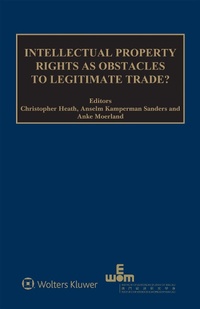
Intellectual Property Rights as Obstacles to Legitimate Trade?
Erschienen am 20. September 2018
228 Seiten
978-94-035-0205-2 (ISBN)
Beschreibung

Intellectual Property Rights as Obstacles to Legitimate Trade helps to understand one of the underlying rationales of the TRIPS Agreement in light of some of the most pertinent IP issues. The WTO/TRIPS Agreement for the first time put IP rights in the context of trade rules, such as when does the exercise of IP rights become an unjustified burden to legitimate trade? Cases have arisen where IP rights are conferred, used, or enforced in a manner that arguably impedes trade, both in domestic and international contexts. This groundbreaking book is the first comprehensive assessment of this controversial area of trade law, shedding important new light on the underlying rationales of the TRIPS Agreement.
With contributions by both practitioners and academics working in a range of countries, this book considers thorny issues in such areas as the following:
- - interpretation of 'obstacles to legitimate trade' in the context of GATT/ WTO jurisprudence;
- - separating markets by preventing parallel importation in the context of patents;
- - geoblocking - territorial separation of digital markets;
- - using trademarks to prevent competition;
- - geographical indications - protection of terms that are considered generic in certain domestic markets;
- - seizure of goods in transit;
- - 'evergreening' patents - attempts to extend the duration of patents;
- - rights to second-hand digital goods or content;
- - unjustified threats - towards appropriate standards of liability.
Focusing on topical and under-researched areas of IP law, the contributors stimulate a discussion on an overarching concern that is not often addressed - how to assess whether the protection and enforcement of certain IP rights in particular situations should be classified as trade barriers. As an incisive analysis of the desirable balance between the exercise of IP rights and the demands of legitimate trade, this book will be welcomed by practitioners, lawmakers, policy advisers, and academics in both trade law and IP law.
With contributions by both practitioners and academics working in a range of countries, this book considers thorny issues in such areas as the following:
- - interpretation of 'obstacles to legitimate trade' in the context of GATT/ WTO jurisprudence;
- - separating markets by preventing parallel importation in the context of patents;
- - geoblocking - territorial separation of digital markets;
- - using trademarks to prevent competition;
- - geographical indications - protection of terms that are considered generic in certain domestic markets;
- - seizure of goods in transit;
- - 'evergreening' patents - attempts to extend the duration of patents;
- - rights to second-hand digital goods or content;
- - unjustified threats - towards appropriate standards of liability.
Focusing on topical and under-researched areas of IP law, the contributors stimulate a discussion on an overarching concern that is not often addressed - how to assess whether the protection and enforcement of certain IP rights in particular situations should be classified as trade barriers. As an incisive analysis of the desirable balance between the exercise of IP rights and the demands of legitimate trade, this book will be welcomed by practitioners, lawmakers, policy advisers, and academics in both trade law and IP law.
Weitere Details
Weitere Ausgaben
Andere Ausgaben
Christopher Heath | Anselm Kamperman Sanders | Anke Moerland
Intellectual Property Rights as Obstacles to Legitimate Trade?
Buch
10/2018
Kluwer Law International
149,80 €
Versand in 15-20 Tagen
Inhalt
- Intro
- Part 1 - Historical Introduction
- Chapter 1Avoiding Barriers to Legitimate Trade: Objectives and Obligations
- Part 2 - Intellectual Property Rights as Obstacles to International Trade?
- Chapter 2Parallel Imports of Patented Goods
- Chapter 3Geoblocking and 'Legitimate Trade'
- Chapter 4The Registration of Descriptive Terms in International Trade
- Chapter 5The Seizure of Goods in Transit - Can EU Trade Mark Legislation Serve as a Model?
- Part 3 - Obstacles to Domestic Trade
- Chapter 6The Green, Green Grass of Evergreening Patents
- Chapter 7Exhaustion and Second-Hand Digital Goods/Contents
- Chapter 8Unjustified Threats and the Repression of Unfair Competition
- Summary of Contents
- Preface
- Authors and Editors
- A. Introduction
- B. TRIPS Preamble
- I. Punta del Este Declaration
- II. Section 337 and Certain Aramid Fiber
- III. Some Implications of US - Section 337 Tariff Act
- C. TRIPS Enforcement Obligations
- I. General Obligations
- II. Specific Enforcement Procedures
- III. Performance Standards
- D. GATT 1994 and Other WTO Agreements
- I. Non-discrimination
- II. Freedom of Transit
- III. Transparency and Procedural Fairness
- IV. Quantitative Prohibitions and Restrictions
- V. General Exceptions
- VI. Unnecessary Obstacles to International Trade
- VII. Trade in Services
- E. Conclusion
- I. The Legal Context
- II. The Factual Context
- B. The GATT 1994 context
- I. Free Trade and the Protection of 'Patents, Trade Marks and Copyrights'
- II. The Case Law of the ECJ on Free Trade and the Protection of Patent Rights
- III. Free Trade and Patent Rights in the GATT Context
- C. The Paris Convention Context
- I. Territoriality as a Fundamental Principle of the Paris Convention
- II. Territoriality and Trade
- D. The WTO/TRIPS Context
- E. Analysis
- I. Free Trade and Arbitrary Obstacles Thereto
- II. Obstacles to a WTO Dispute Settlement
- III. Result
- B. Territorialisation of the Internet and the Tools of Territorialisation
- I. The Territorialisation Trend
- II. Geolocation
- III. Geoblocking
