

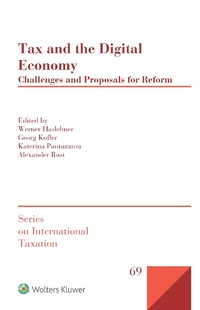
Tax and the Digital Economy
Challenges and Proposals for Reform
1. Auflage
Erschienen am 1. Mai 2019
370 Seiten
978-94-035-0335-6 (ISBN)
Beschreibung

The increasingly digitalized global economy is undermining the usefulness of many traditional tax concepts. In addition to issues of double taxation and double non-taxation, important questions arise concerning the allocation of taxing rights in respect of income from cross-border digital transactions. This is the first book to analyse what changes are possible, necessary and feasible in order to forestall the unravelling of the existing international tax framework. Focusing in turn on the legal framework, specific proposals for adapting tax concepts for the digital economy, types of transactions and administrative issues such as those around data protection and digital currencies, the expert contributors discuss such challenges to taxation as the following: - the pervasiveness of intangible assets;
- new value creation models;
- the ascendance of the sharing economy and digital services;
- virtual currencies;
- the importance of user participation for digital platforms;
- cloud computing;
- the impact of Big Data on tax enforcement;
- virtual business presence; and
- the influence of robotization.
Throughout, the authors describe and analyse proposals made by the Organisation for Economic Co-operation and Development (OECD), the European Union (EU) and individual countries and their likely impact going forward. They also attend to the limits imposed on reform possibilities by public international law, EU law and constitutional law. It is generally acknowledged that there is a need to monitor how the digital transformation may be impacting value creation. This book is a key milestone toward developing a durable, long-term solution to the tax challenges posed by the digitalization of the economy. With its thorough scrutiny of proposals for digital services tax and virtual permanent establishments, insightful analysis of digital services and detailed description of the impact of big data on tax administration and taxpayer protection, it will quickly prove indispensable for tax practitioners and the international tax community more generally.
- new value creation models;
- the ascendance of the sharing economy and digital services;
- virtual currencies;
- the importance of user participation for digital platforms;
- cloud computing;
- the impact of Big Data on tax enforcement;
- virtual business presence; and
- the influence of robotization.
Throughout, the authors describe and analyse proposals made by the Organisation for Economic Co-operation and Development (OECD), the European Union (EU) and individual countries and their likely impact going forward. They also attend to the limits imposed on reform possibilities by public international law, EU law and constitutional law. It is generally acknowledged that there is a need to monitor how the digital transformation may be impacting value creation. This book is a key milestone toward developing a durable, long-term solution to the tax challenges posed by the digitalization of the economy. With its thorough scrutiny of proposals for digital services tax and virtual permanent establishments, insightful analysis of digital services and detailed description of the impact of big data on tax administration and taxpayer protection, it will quickly prove indispensable for tax practitioners and the international tax community more generally.
Weitere Details
Weitere Ausgaben
Andere Ausgaben
Werner Haslehner | Georg Kofler | Katerina Pantazatou
Tax and the Digital Economy
Challenges and Proposals for Reform
Buch
05/2019
1. Auflage
Kluwer Law International
164,45 €
Versand in 15-20 Tagen
Inhalt
- Intro
- Half Title
- Series on International Taxation
- Title Page
- Copyright Page
- Editors
- Contributors
- Summary of Contents
- Table of Contents
- Preface and Acknowledgements
- Chapter 1 The 2018 OECD Interim Report
- §1.01 INTRODUCTION
- §1.02 THE OECD/G20 BEPS PROJECT AND THE 2015 OECD BEPS ACTION 1 REPORT
- §1.03 RENEWED G20 INTEREST AND THE 2018 OECD INTERIM REPORT
- [A] Value Creation and Business Models
- [B] Positive Impacts of BEPS Implementation
- [C] Towards a Global Consensus-Based Reform of the International Income Tax System
- [D] Interim Measures
- [E] Beyond International Income Tax Rules
- §1.04 THE ROAD AHEAD
- Chapter 2 The 'Genuine Link' Requirement for Source Taxation in Public International Law
- §2.01 INTRODUCTION
- §2.02 DEFINITIONS
- [A] The Genuine Link under Public International Law
- [1] The Lotus Case and the Principle of Territoriality
- [2] The Nottebohm Case and the 'Genuine' Link
- [3] The Reasonable Exercise of Jurisdiction
- [B] Links/Nexus in Tax Law
- [1] Residence Taxation
- [2] Source Taxation
- §2.03 THE GENUINE LINK REQUIREMENT FOR SOURCE TAXATION
- [A] Lack of Adequate Rules
- [B] Virtual Establishments, Place of Consumption, and the Destination Principle
- [1] Redefining Territoriality
- [2] A Broader Understanding of Nexus
- §2.04 THE FUTURE: APPORTIONMENT OR MOVE TOWARDS INDIRECT TAXATION?
- [A] Apportionment
- [B] Move Towards Indirect Taxation
- §2.05 CONCLUSIONS
- Chapter 3 EU and WTO Law Limits on Digital Business Taxation
- §3.01 INTRODUCTION
- §3.02 DIGITAL BUSINESS TAXATION REFORM: BACKGROUND
- [A] Tax Policy Challenges Arising from Digitalization
- [B] Tax Policy Responses
- §3.03 EU LAW LIMITS
- [A] Limits on EU Member States
- [1] Member States Legislative Competence
- [2] Internal Market Rules
- [3] Secondary EU Law
- [B] Limits on the EU Legislature
- [1] EU Legislative Competence
- [2] Internal Market Rules
- [3] Public International Law
- §3.04 WTO LAW LIMITS
- [A] The WTO Legal Framework: Application to Tax Law
- [B] Potential Application to Digital Tax Proposals
- §3.05 CONCLUSION
- Chapter 4 Fairness of the Taxation of the Digital Economy
- §4.01 INTRODUCTION
- §4.02 THE (SLIPPERY) MEANINGS OF TAX FAIRNESS
- [A] Tax Fairness in the Economic and Legal Literature: A Review
- [1] The Roots: The Principle of Tax Equality
- [2] The Two Versions of the Benefit Principle
- [3] The Ability-to-Pay Principle
- [B] The International Scenario
- §4.03 TAX FAIRNESS AND THE PROPOSALS FOR THE TAXATION OF THE DIGITAL ECONOMY
- [A] The Meaning of Tax Fairness Raised by the OECD and EU Documents on Digital Economy Taxation
- §4.04 DO THE PROPOSED SOLUTIONS COMPLY WITH TRADITIONAL CONCEPTS OF TAX FAIRNESS?
- [A] Introduction: A Brief Summary of the Proposed Solutions
- §4.05 ARE THE SOLUTIONS AND THE PROPOSALS FOR DIGITAL ECONOMY TAXATION FAIR? A PRELIMINARY CONCLUSION
- §4.06 CONCLUSIONS
- Chapter 5 Tax Policy for the Digitalized Economy under Benjamin Franklin's Rule for Decision-Making
- §5.01 INTRODUCTION AND SCOPE
- §5.02 DESCRIBING THE PROPOSED TAX POLICY OPTIONS
- [A] A New Tax 'Nexus' Concept: SEP
- [B] A WHT on Certain Types of (Digital) Transactions
- [C] A Digital Equalization Levy
- §5.03 OUR PROPOSAL TO ESTABLISH A STAND-ALONE GROSS-BASIS FINAL WHT ON (CROSS-BORDER) SERVICES IN B2B CONTEXTS
- [A] A Stand-Alone Final WHT
- [B] A WHT on (Cross-Border) B2B Services
- [1] The Exclusion of Goods
- [2] A Mere Reference to Services
- [3] Cross-Border (or Also Domestic) Services
- [4] Exclusion of B2C Services
- §5.04 A WHT SOLUTION VIS-À-VIS OTHER POLICY ALTERNATIVES
- [A] Design and Implementation Issues
- [1] Definition and Control of Thresholds
- [2] Profit Attribution
- [3] Digital and Non-digital Transactions, B2B and B2C Transactions and Domestic and Cross-Border Transactions
- [a] Digital and Non-digital Transactions
- [b] B2B and B2C Transactions
- [c] Domestic and Cross-Border Transactions
- [d] Method of Taxation (Net Versus Gross Taxation)
- [e] Compliance and Enforcement
- [B] Legal Consistency Issues
- [1] Double Taxation Conventions (DTCs)
- [2] WTO Law
- [3] EU Law
- §5.05 CONCLUSIONS
- Chapter 6 Equalization Taxes and the EU's 'Digital Services Tax'
- §6.01 INTRODUCTION AND BACKGROUND
- [A] Tax Challenges of the Digital Economy
- [B] Potential Approaches: OECD and EU
- [C] EU Directive Proposals: SDP and DST
- §6.02 THE IDEA OF EQUALIZATION TAXES: ASSESSMENT AND CRITICISM
- [A] Equalization Taxes in OECD BEPS Action 1
- [B] Policy and Technical Challenges of Equalization Levies
- [1] Broader Economic Risks and Challenges
- [2] Necessary Design Features of Equalization Taxes
- [a] Compliance with International Obligations (Tax Treaties, EU Law, and WTO Law)
- [b] Temporary Nature of an Equalization Tax as an Interim Measure
- [c] Targeted Scope of an Equalization Tax
- [d] Minimizing Overtaxation
- [e] Minimizing Impact on Start-Ups, Business Creation, and Small Businesses
- [f] Minimizing Cost and Complexity
- §6.03 THE EU'S DST
- [A] Policy Objectives
- [B] Legal Basis
- [C] The DST's Characteristics
- [1] Tax Rate, Taxable Persons, and the Tax Base
- [2] Taxable Transactions and Place of Taxation
- [3] Tax Collection and Enforcement
- [D] DST Challenges and Practical Issues
- [1] Incompatibility and Lack of Coordination with Existing Legal Frameworks
- [a] Relationship with Double Tax Conventions: Double Taxation
- [b] Interference with EU Law
- [c] Interference with WTO Law
- [2] Selected Policy Objections
- [3] Broader Practical Issues
- §6.04 SUMMARY AND CONCLUSIONS
- Chapter 7 Digital Permanent Establishments on Its Way to Becoming a Reality? The EU Commission's Proposal on Taxing 'Significant Digital Presence'
- §7.01 INTRODUCTION
- §7.02 THE QUESTIONABLE RATIONALE BEHIND DIGITAL PES'
- [A] The Changed Stance Towards 'Physical Presence': Still Physical after All
- [B] Shifting Income Taxation to the Demand Side of Business Operations?
- [C] 'Value Creation' as Substantial Counterargument to Demand Orientation?
- [D] The True Background: Tax Policy and the Sentiment of Revenue Lost by 'Importers' of Digital Services
- §7.03 SDP: THE DIGITAL PE' AS CONCRETELY PROPOSED BY THE EUROPEAN COMMISSION
- [A] Legal Framework
- [B] Territorial Scope
- [C] Material Scope: 'Digital Services Through Digital Interfaces'
- [D] Thresholds for Establishing a SDP
- [E] Profit Attribution to an Established SDP
- §7.04 RÉSUMÉ
- Chapter 8 Tax Treatment of Digital Currencies
- §8.01 WHAT ARE DIGITAL CURRENCIES?
- §8.02 THE BLOCKCHAIN TECHNOLOGY BEHIND CRYPTOCURRENCIES
- §8.03 QUESTIONS RELATED TO THE TAX TREATMENT OF DIGITAL CURRENCIES
- §8.04 DIGITAL CURRENCIES AS A MEANS OF PAYMENT
- §8.05 PRIVATE INVESTMENTS IN DIGITAL CURRENCIES
- §8.06 VERIFICATION OF TRANSACTIONS OF DIGITAL CURRENCIES
- §8.07 MINING OF DIGITAL CURRENCIES
- §8.08 INCOME TAX QUESTIONS
- §8.09 CONCLUSION
- Chapter 9 Taxing Remote Digital Supplies
- §9.01 'DIGITAL SUPPLIES': A CONCEPTUAL CHALLENGE FOR THE VAT SYSTEM
- §9.02 ELECTRONICALLY SUPPLIED SERVICES: EU VAT DIRECTIVE PLACE OF SUPPLY AND RELATED COLLECTION RULES
- [A] B2B Electronically Supplied Services
- [1] Destination-Based Taxation and Reverse Charge
- [2] Customer Identification
- [3] Customer Location
- [4] Changes to Come with the Adoption of the E-Commerce Package?
- [B] B2C Electronically Supplied Services
- [1] Destination-Based Taxation and the MOSS System
- [2] Customer Location
- [3] A Deeming Provision for Platforms
- [4] Changes to Come with the Adoption of the E-Commerce Package?
- [a] An 'E-Commerce Package for All B2C E-Commerce Transactions'
- [b] Availability of the Non-union Scheme for Non-EU Suppliers with an EU VAT Number
- [c] A First Threshold of EUR 10,000 (as of 2019)
- [d] Home Country Rules for Invoicing and Record-Keeping
- [e] Relaxed Customer Identification Requirement below a Second Threshold of EUR 100,000
- [f] Longer Deadlines to Submit MOSS Returns and Easier Procedure to Correct VAT Returns
- [g] Final Comments on the E-commerce Package
- §9.03 ELECTRONICALLY SUPPLIED SERVICES: EU VAT DIRECTIVE PROVISIONS ON REDUCED RATES AND RECENT EC PROPOSAL
- [A] Current Rules
- [B] EC Proposal: Possibility to Apply Reduced Rates in the Future?
- §9.04 CONCLUSIONS AND FINAL COMMENTS
- Chapter 10 The Taxation of the Sharing Economy
- §10.01 INTRODUCTION
- §10.02 WHAT IS THE SHARING ECONOMY?
- §10.03 TAXING THE PLATFORM AND THE SERVICE PROVIDERS: RECURRING ISSUES
- [A] The Platform
- [1] VAT
- [2] Enforcement/Collection
- [B] The Service Provider
- [1] Legal Relationship
- [2] VAT
- [3] What Kind of Taxes?
- [4] Enforcement/Collection
- [5] Effective Lower Taxation?
- §10.04 THE 2018 EU PROPOSALS
- §10.05 CONCLUSION
- Chapter 11 Effective Taxation Versus Effective Data Protection?
- §11.01 INTRODUCTION
- §11.02 ENSURING EFFECTIVE TAXATION: INCREASING DATA COLLECTION
- §11.03 TAXPAYERS' RIGHTS IN THE AREA OF EXCHANGE OF INFORMATION
- §11.04 DATA PROTECTION IN THE EU
- §11.05 SCOPE OF EU DATA PROTECTION SAFEGUARDS
- §11.06 REQUIREMENTS STEMMING FROM EU DATA PROTECTION
- [A] Requirements under Article 8 ECHR
- [B] Requirements under Charter Article 8 and the GDPR
- [1] Lawfulness, Fairness and Transparency
- [2] Purpose Limitation
- [3] Data Minimization
- [4] Accuracy
- [5] Storage Limitation
- [6] Integrity and Confidentiality
- §11.07 PROCEDURAL RIGHTS STEMMING FROM EU DATA PROTECTION
- [A] Right to Be Informed about Exchange of Information
- [B] Right of Access to the Data
- [C] Right to Rectification and Erasure
- §11.08 CONCLUSION
- Chapter 12 Digitalization and the Future of National Tax Systems: Taxing Robots?
- §12.01 INTRODUCTION
- §12.02 ROBOTS AS TAXABLE PERSONS
- [A] Income Tax
- [B] Value Added Tax/Goods and Services Tax
- §12.03 TAXING THE USE OF ROBOTS
- [A] As a Fiscal Substitute for Wage and Payroll Taxes
- [1] . Justified as a Tax on Imputed Income?
- [2] . Justified as an Equalization Levy?
- [3] Restraints Imposed by International Tax Competition
- [B] As an Optimal Income Redistribution Instrument?
- [C] As a Pigouvian Tax
- §12.04 A COMMON CHALLENGE: DEFINING THE SCOPE OF A ROBOT TAX'
- §12.05 OTHER TAX IMPLICATIONS OF THE INCREASING USE OF INTELLIGENT ROBOTS
- §12.06 CONCLUSIONS
- Chapter 13 Big Data in Tax Collection and Enforcement
- §13.01 INTRODUCTION
- §13.02 TAX COLLECTION AND ENFORCEMENT
- [A] Information Asymmetry and Personal Autonomy
- [B] Traditional Tax Collection and Enforcement
- [C] Change of the Game: New Tools
- [D] Legal Constraints of Tax Collection and Enforcement
- [1] Rule of Law
- [2] Right to Respect for Private and Family Life and Correspondence
- [3] Right to Protection of Personal Data
- [4] Rights of the Defence
- [E] Conclusion
- §13.03 BIG DATA ANALYTICS IN TAX MATTERS
- [A] Definition of Big Data
- [B] Purpose, Use and Benefits of Big Data
- [1] Purpose
- [2] Use of Big Data
- [3] Benefits of Big Data
- [C] Big Data in Tax Matters: Really in Use?
- §13.04 LEGAL CONCERNS
- [A] Introduction
- [B] The OECD's Vision of Big Data Benefits in Tax Matters
- [C] Position 1: Big Data Analytics Do Not Raise Any Legal Concerns
- [D] Position 2: Big Data Analytics Raise Legal Concerns
- [1] Concerns Related to the Technical Functioning of Big Data Algorithms
- [a] Preliminary Remarks
- [b] Technical Specificities of Big Data Algorithms
- [c] Prediction
- [d] Opacity
- [e] Algorithms Magnify Programmed Biases
- [2] Input Data-Related Concerns
- [a] Origin of the Data
- [b] Accuracy of the Data
- [c] Cross-Checking of Data
- [3] Concerns Related to the Psychological Impact of Big Data Algorithms
- [4] Conclusion
- §13.05 LEGAL ACTIONS TO TAKE
- [A] Introduction
- [B] Rule of Law, Principle of Equality, Rights of the Defence
- [1] Basic Requirements on Big Data Analytics
- [2] Origin of the Data
- [3] Accuracy of the Data
- [4] Procedural Regularity
- [C] Privacy
- [1] Preliminary Remarks
- [2] Taxpayer Monitoring
- [a] Justifying Interferences with the Right to Privacy in General
- [b] Legitimacy of Taxpayer Monitoring
- [c] Secret Surveillance for Tax Purposes?
- [d] Conclusion
- [3] Taxpayer Profiling and GDPR
- [a] Big Data Analytics as Taxpayer Profiling
- [b] Rights and Obligations with Regard to Profiling
- [c] Limitations
- [d] Conclusion
- [D] Conclusion
- §13.06 USE AND PURPOSE OF TAX BIG DATA ANALYTICS
- [A] Data Storage
- [B] Real-Time Monitoring Through IoT
- [C] Audit Selection
- [D] 'Targeted Advertising' of Taxpayers
- [1] By Nudges
- [2] By Legal Statutes
- §13.07 FINAL CONCLUSIONS
- Index
- SERIES ON INTERNATIONAL TAXATION
