

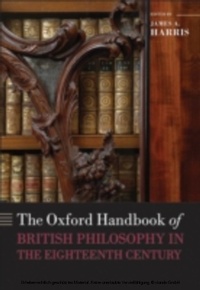
The Oxford Handbook of British Philosophy in the Eighteenth Century
1. Auflage
Erschienen am 3. Oktober 2013
978-0-19-150269-9 (ISBN)
Beschreibung

Philosophy in eighteenth-century Britain was diverse, vibrant, and sophisticated. This was the age of Hume and Berkeley and Reid, of Hutcheson and Kames and Smith, of Ferguson and Burke and Wollstonecraft. Important and influential works were published in every area of philosophy, from the theory of vision to theories of political resistance, from the philosophy of language to accounts of ways of governing the passions. The philosophers of eighteenth-century Britain were enormously influential, in France, in Italy, in Germany, and in America. Their ideas and arguments remain a powerful presence in philosophy three centuries later.
This Oxford Handbook is the first book ever to provide comprehensive coverage of the full range of philosophical writing in Britain in the eighteenth century. It provides accounts of the writings of all the major figures, but also puts those figures in the context provided by a host of writers less well known today. The book has five principal sections: 'Logic and Metaphysics', 'The Passions', 'Morals', 'Criticism', and 'Politics'. Each section comprises four chapters, providing detailed coverage of all of the important aspects of its subject matter. There is also an introductory section, with chapters on the general character of philosophizing in eighteenth-century Britain, and a concluding section on the important question of the relation at this time between philosophy and religion.
The authors of the chapters are experts in their fields. They include philosophers, historians, political theorists, and literary critics, and they teach in colleges and universities in Britain, in Europe, and in North America.
Weitere Details
Weitere Ausgaben
Andere Ausgaben
Buch
10/2013
Oxford University Press
214,20 €
Versand in 15-20 Tagen
Person
James A. Harris is Senior Lecturer in Philosophy at the University of St Andrews. He is the author of Of Liberty and Necessity: The Free Will Debate in Eighteenth-Century British Philosophy (OUP, 2005), and of articles on Hume, Hutcheson, Reid, Beattie, Priestley, and a number of themes in eighteenth-century British thought. He has edited texts by Reid, Beattie, Kames, and Abraham Tucker. He is writing an intellectual biography of Hume for Cambridge University Press, and also the eighteenth-century British philosophy volume of the new Oxford History of Philosophy.
Inhalt
- Introduction
- PART 1: THE LANGUAGES OF PHILOSOPHY IN EIGHTEENTH-CENTURY BRITAIN
- 1: TIMOTHY STANTON: Locke and his legacy
- 2: ERIC SCHLIESSER: Newton and Newtonianism in eighteenth-century British thought
- 3: JACQUELINE TAYLOR: The idea of a science of human nature
- 4: PADDY BULLARD: Rhetoric and eloquence: the language of persuasion
- PART 2: LOGIC AND METAPHYSICS
- 5: REBECCA COPENHAVER: Perception and the Language of Nature
- 6: LAURENT JAFFRO: Language and thought
- 7: JOHN P. WRIGHT: The understanding
- 8: AARON GARRETT: Mind and matter
- PART 3: THE PASSIONS
- 9: AMY SCHMITTER: Passions, affections, sentiments: taxonomy and terminology
- 10: TERENCE CUNEO: Reason and the passions
- 11: SEAN GREENBERG: Liberty and necessity
- 12: JAMES A. HARRIS: The government of the passions
- PART 4: MORALS
- 13: CHRISTIAN MAURER: Self-interest and sociability
- 14: P. J. E. KAIL: Moral judgment
- 15: Dario Perinetti: The nature of virtue
- 16: COLIN HEYDT: Practical ethics
- PART 5: CRITICISM
- 17: PAUL GUYER: The pleasures of the imagination and the objects of taste
- 18: TIMOTHY M. COSTELLOE: The faculty of taste
- 19: EVA DADLEZ: The pleasures of tragedy
- 20: PETER KIVY: Genius and the creative imagination
- PART 6: POLITICS
- 21: DARIO CASTIGLIONE: The origin of civil government
- 22: CRAIG SMITH: Forms of government
- 23: NEIL McARTHUR: Reform and revolution
- 24: RICHARD WHATMORE: Luxury, commerce, and the rise of political economy
- PART 7: PHILOSOPHY AND RELIGION
- 25: PAUL RUSSELL: Causation, cosmology, and the limits of philosophy: the early eighteenth-century British debate
- 26: ALEXANDER BROADIE: Philosophy, revealed religion, and 'The Enlightenment'
- 27: THOMAS AHNERT: Religion and morality
