

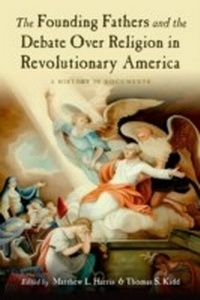
The Founding Fathers and the Debate over Religion in Revolutionary America
A History in Documents
1. Auflage
Erschienen am 11. November 2011
207 Seiten
978-0-19-990942-1 (ISBN)
Beschreibung

Whether America was founded as a Christian nation or as a secular republic is one of the most fiercely debated questions in American history. Historians Matthew Harris and Thomas Kidd offer an authoritative examination of the essential documents needed to understand this debate. The texts included in this volume - writings and speeches from both well-known and obscure early American thinkers - show that religion played a prominent yet fractious role in the era of the American Revolution.
Weitere Details
Weitere Ausgaben
Andere Ausgaben
Matthew Harris | Thomas Kidd
The Founding Fathers and the Debate over Religion in Revolutionary America
A History in Documents
Buch
12/2011
Oxford University Press Inc
103,71 €
Versand in 15-20 Tagen
Matthew Harris | Thomas Kidd
The Founding Fathers and the Debate over Religion in Revolutionary America
A History in Documents
Buch
12/2011
Oxford University Press Inc
48,20 €
Versand in 15-20 Tagen
Inhalt
- Cover
- Contents
- Acknowledgments
- Introduction: The Founding Fathers and Religion
- 1. Religion and the Continental Congress
- 1. A day of prayer and fasting, 1776
- 2. Reverend Jacob Duché's invocation at a day of prayer and fasting, 1775
- 3. Alexander Hamilton on God-given rights, 1775
- 4. Declaration of Independence, 1776
- 5. A resolution for true religion and good morals, 1778
- 6. Robert Aitken's Bible, 1781-1782
- 7. Designing a National Seal, 1782
- 8. The Northwest Ordinance, 1787
- 2. Religion and State Governments
- 1. State Constitutions, 1776-1778
- 2. Isaac Backus argues for religious freedom, 1773
- 3. Massachusett s Constitution of 1780
- 4. Boston supports the establishment, 1780
- 5. Granville, Massachusetts, opposes the establishment, 1780
- 6. Benjamin Franklin on the Massachusetts Constitution, 1780
- 7. Virginia Declaration of Rights, 1776
- 8. Bill for a General Assessment for Religion, 1784
- 9. James Madison, Memorial and Remonstrance, 1785
- 10. Bill for Establishing Religious Freedom, 1786
- 11. Criticism of the Bill for Establishing Religious Freedom, 1786
- 12. An act for suppressing vice and immorality in Maryland, 1786
- 3. Constitution and Ratification
- 1. Benjamin Franklin's prayer request at the Constitution Convention-and the response, 1787
- 2. Luther Martin Questions why there is no religious oath in the Constitution, 1787
- 3. Was the Constitution an inspired document?
- 4. James Madison and Patrick Henry on human nature, 1788
- 5. Oliver Ellsworth and William Williams debate the absence of a religious oath in the constitution, 1787-1788
- 6. Benjamin Rush wishes God was mentioned in the Constitution, 1789
- 7. Debates on the religion clauses of the First Amendment, 1789
- 8. First Amendment of the U.S. Constitution, 1791
- 9. Ministers lament the "Godless" Constitution, 1812, 1815
- 10. James Madison's "Detached Memoranda," circa 1817-1832
- 4. Religion and the Federal Government
- 1. Congressional Chaplains, 1789
- 2. George Washington's Thanksgiving Proclamation, 1789
- 3. George Washington's Farewell Address, 1796
- 4. Treaty of Tripoli, 1797
- 5. John Adams proclaims a day of fasting and prayer, 1798
- 6. Thomas Jefferson's First Inaugural Address as President, 1801
- 7. Treaty between the United States and the Kaskaskia Indians, 1803
- 8. Dorothy Ripley Remembers her sermon in the House of Representatives, 1806
- 5. Disestablishment and the Separation of Church and State
- 1. William Linn opposes Thomas Jefferson's candidacy for President, 1800
- 2. George Washington on religious liberty, 1789-1790
- 3. John Leland and the Baptist case for religious liberty, 1791
- 4. Thomas Jefferson and the Danbury Baptists, 1801-1802
- 5. Thomas Jefferson refuses to declare days of prayer and fasting, 1808
- 6. John Adams on the "national government meddling with religion," 1812
- 6. The Founding Fathers' Own Views on Religion
- 1. Thomas Jefferson, 1787, 1803
- 2. John Adams, 1810, 1813
- 3. Benjamin Franklin, 1771, 1790
- 4. Thomas Paine, 1776
- 5. Patrick Henry, 1796
- 6. Samuel Adams, 1780, 1802
- 7. Roger Sherman, 1789
- 8. William Livingston, 1786
- 9. Elias Boudinot, 1815
- Selected Bibliography
- Index
- A
- B
- C
- D
- E
- F
- G
- H
- I
- J
- L
- M
- N
- O
- P
- Q
- R
- S
- T
- V
- W
