

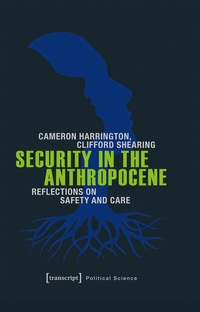
Security in the Anthropocene
Reflections on Safety and Care
1. Auflage
Erschienen am 15. August 2017
196 Seiten
978-3-8394-3337-9 (ISBN)
Beschreibung

The belief that »Nature« exists as a blank, stable stage upon which humans act out tragic performances of international relations is no longer tenable. In a world defined by human action, we must reorient our understanding of ourselves, of our environment, and our security.This book considers how decentred and reflexive approaches to security are required to cope with the Anthropocene - the Human Age. Drawing from various disciplines, this bold reinterpretation explores the possibilities for understanding and preparing a future that will look vastly different than the past. The book asks to dig deeper into what it means to be human and secure in an age of ecological exception."In a growing field of interdisciplinary work on the Anthropocene, >Security in the Anthropocene< sets itself apart. It blends ideas from criminology, international security studies and the environmental humanities to provide unique interdisciplinary insight into the challenges of living on an increasingly turbulent earth."- Audra Mitchell, Balsillie School of International Affairs/Wilfrid Laurier University"This essential, groundbreaking book offers a new conceptual framework that recalibrates what security means in the Anthropocene. Not content on simply highlighting the state of crisis fostered by existential risks in this new era, Cameron Harrington and Clifford Shearing invite us to imagine a more positive and caring form of security."- Benoit Dupont, University of Montreal"Harrington and Shearing's fine book explores evocatively how humans might cope with a world that is fundamentally changed through a critical appraisal of how new impacts on the Earth system shift the conditions of security. This is a tour de force of how our concepts of security create the world that afflicts us. The authors argue, convincingly, that there can be no security in the Anthropocene without an expanded vision of care."- John Braithwaite, Australian National University
Rezensionen / Stimmen
Besprochen in:ACUNS, 09.01.2018, Simon DalbyWeitere Details
Weitere Ausgaben
Andere Ausgaben
Buch
07/2017
1. Auflage
transcript
79,99 €
Versand in 7-9 Tagen
Personen
Cameron Harrington is an Assistant Professor in the School of Government and International Affairs at Durham University. He holds a Ph.D. in political science from Western University, Canada.
Clifford Shearing (Prof.) holds professorships at the Universities of Cape Town, Griffith and Montreal and positions at the University of New South Wales and the Durban University of Technology.
Clifford Shearing (Prof.) holds professorships at the Universities of Cape Town, Griffith and Montreal and positions at the University of New South Wales and the Durban University of Technology.
Inhalt
- Cover
- Contents
- Note on Authorship
- Preface
- Chapter One: Security in the Anthropocene
- Bringing deep time into security
- The Pleistocene
- The Holocene
- The Anthropocene
- Security in the Anthropocene
- Chapter Two: More-Than-Human Worlds
- Lineages
- The return of the Great Man
- Posthuman security
- Safety politics in the posthuman age
- Conclusion
- Chapter Three: Postnatural Security
- Creating nature
- Nature as purity
- Nature as instrumental value
- Nature as threat
- Niche construction and postnatural security
- Conclusion
- Chapter Four: The Horizon of Holocene Security
- Confronting the new Human Age: securitization and the horizon of Holocene Security
- Reading Schmitt in the Anthropocene
- The dawn of Anthropocene security
- Conclusion
- Chapter Five: Towards a Security of Care in the Anthropocene
- The impossible past
- Can security be careful?
- Care and the Anthropocene
- The limits of care
- Risk and uncertainty
- Towards a micro-politics of care
- Conclusion
- Chapter Six: Conclusions
- Constructing the World
- Defenses and new directions
- Omissions and critiques
- Future directions
- References
- Register
