

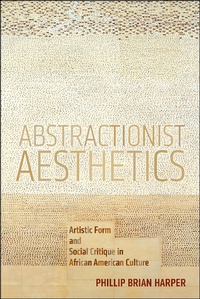
Abstractionist Aesthetics
Artistic Form and Social Critique in African American Culture
Erschienen am 25. Dezember 2015
277 Seiten
978-1-4798-6798-1 (ISBN)
Beschreibung
An artistic discussion on the critical potential of African American expressive culture
In a major reassessment of African American culture, Phillip Brian Harper intervenes in the ongoing debate about the "proper" depiction of black people. He advocates for African American aesthetic abstractionism-a representational mode whereby an artwork, rather than striving for realist verisimilitude, vigorously asserts its essentially artificial character. Maintaining that realist representation reaffirms the very social facts that it might have been understood to challenge, Harper contends that abstractionism shows up the actual constructedness of those facts, thereby subjecting them to critical scrutiny and making them amenable to transformation.
Arguing against the need for "positive" representations, Abstractionist Aesthetics displaces realism as the primary mode of African American representational aesthetics, re-centers literature as a principal site of African American cultural politics, and elevates experimental prose within the domain of African American literature. Drawing on examples across a variety of artistic production, including the visual work of Fred Wilson and Kara Walker, the music of Billie Holiday and Cecil Taylor, and the prose and verse writings of Ntozake Shange, Alice Walker, and John Keene, this book poses urgent questions about how racial blackness is made to assume certain social meanings. In the process, African American aesthetics are upended, rendering abstractionism as the most powerful modality for Black representation.
In a major reassessment of African American culture, Phillip Brian Harper intervenes in the ongoing debate about the "proper" depiction of black people. He advocates for African American aesthetic abstractionism-a representational mode whereby an artwork, rather than striving for realist verisimilitude, vigorously asserts its essentially artificial character. Maintaining that realist representation reaffirms the very social facts that it might have been understood to challenge, Harper contends that abstractionism shows up the actual constructedness of those facts, thereby subjecting them to critical scrutiny and making them amenable to transformation.
Arguing against the need for "positive" representations, Abstractionist Aesthetics displaces realism as the primary mode of African American representational aesthetics, re-centers literature as a principal site of African American cultural politics, and elevates experimental prose within the domain of African American literature. Drawing on examples across a variety of artistic production, including the visual work of Fred Wilson and Kara Walker, the music of Billie Holiday and Cecil Taylor, and the prose and verse writings of Ntozake Shange, Alice Walker, and John Keene, this book poses urgent questions about how racial blackness is made to assume certain social meanings. In the process, African American aesthetics are upended, rendering abstractionism as the most powerful modality for Black representation.
Rezensionen / Stimmen
"[C]ompelling. It shows how art can be a powerful instrument for reflecting how a social identity can be made to assume a certain social meaning and how it can be used to question the identity in this way making it malleable to transformation. Anyone interested in identity representation and culture, particularly of an ethnic or racial nature, will find much to inform and challenge them in Harpers tightly argued and well-referenced book." (Ethnic and Racial Studies) "Opens up possibilities for revising our notions of representation.Abstractionist Aestheticsis a valuable contribution to ongoing conversations about race, politics, and aesthetics." (ASAP/Journal) "A riveting polemic on the politics of abstraction in black art. Moving among examples in a range of medialiterature, music, visual art, and filmwith fine-tuned readings,Abstractionist Aestheticsis a devastating critique of the all-too-common presumption that variants of realism are the only effective option for a black art that would respond to the history of racial deprivation." - Brent Hayes Edwards,author of The Practice of Diaspora: Literature,Translation, and the Rise of Black Internationalis "Beautifully argued with unexpected twists and turns, Phillip Brian Harper exposes how our prefabricated notions of the sounds, sights, and feeling of blackness dictate our often parochial reactions to artistic efforts to engage and broaden the places assigned to black Americans. A momentous and magnificent book." - Michael Awkward, Gayl Jones Professor of Afro-American Literature and Culture, University of MichiganWeitere Details
Reihe
Sprache
Englisch
Verlagsort
New York
USA
Zielgruppe
Für Beruf und Forschung
Illustrationen
41 Illustrations, color
ISBN-13
978-1-4798-6798-1 (9781479867981)
Copyright in bibliographic data and cover images is held by Nielsen Book Services Limited or by the publishers or by their respective licensors: all rights reserved.
Schweitzer Klassifikation
Weitere Ausgaben
Person
Phillip Brian Harper is Erich Maria Remarque Professor of Literature at New York University, where he teaches in the Departments of Social and Cultural Analysis and of English. He is the author of the books Private Affairs (NYU Press, 1999), Are We Not Men? and Framing the Margins.
