

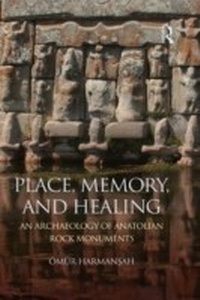
Place, Memory, and Healing
An Archaeology of Anatolian Rock Monuments
1. Auflage
Erschienen am 5. Dezember 2014
218 Seiten
978-1-317-57572-6 (ISBN)
Beschreibung

Place, Memory, and Healing: An Archaeology of Anatolian Rock Monuments investigates the complex and deep histories of places, how they served as sites of memory and belonging for local communities over the centuries, and how they were appropriated and monumentalized in the hands of the political elites. Focusing on Anatolian rock monuments carved into the living rock at watery landscapes during the Late Bronze and Early Iron Ages, this book develops an archaeology of place as a theory of cultural landscapes and as an engaged methodology of fieldwork in order to excavate the genealogies of places.
Advocating that archaeology can contribute substantively to the study of places in many fields of research and engagement within the humanities and the social sciences, this book seeks to move beyond the oft-conceived notion of places as fixed and unchanging, and argues that places are always unfinished, emergent, and hybrid. Rock cut monuments of Anatolian antiquity are discussed in the historical and micro-regional context of their making at the time of the Hittite Empire and its aftermath, while the book also investigates how such rock-cut places, springs, and caves are associated with new forms of storytelling, holy figures, miracles, and healing in their post-antique life. Anybody wishing to understand places of cultural significance both archaeologically as well as through current theoretical lenses such as heritage studies, ethnography of landscapes, social memory, embodied and sensory experience of the world, post-colonialism, political ecology, cultural geography, sustainability, and globalization will find the case studies and research within this book a doorway to exploring places in new and rewarding ways.
Advocating that archaeology can contribute substantively to the study of places in many fields of research and engagement within the humanities and the social sciences, this book seeks to move beyond the oft-conceived notion of places as fixed and unchanging, and argues that places are always unfinished, emergent, and hybrid. Rock cut monuments of Anatolian antiquity are discussed in the historical and micro-regional context of their making at the time of the Hittite Empire and its aftermath, while the book also investigates how such rock-cut places, springs, and caves are associated with new forms of storytelling, holy figures, miracles, and healing in their post-antique life. Anybody wishing to understand places of cultural significance both archaeologically as well as through current theoretical lenses such as heritage studies, ethnography of landscapes, social memory, embodied and sensory experience of the world, post-colonialism, political ecology, cultural geography, sustainability, and globalization will find the case studies and research within this book a doorway to exploring places in new and rewarding ways.
Rezensionen / Stimmen
"For scholars interested in recent work by members of the Theoretical Archaeological Group, this book may be a welcome addition. Harmansah's emphasis on the "place" in the study of Late Bronze Age rock-cut reliefs from the Hittite world can be thought provoking...Summing Up: Recommended." - D. A. Slane, University of Maryland University College, CHOICE ReviewWeitere Details
Sprache
Englisch
Verlagsort
London
Großbritannien
Verlagsgruppe
Taylor & Francis Ltd
Zielgruppe
Für höhere Schule und Studium
Dateigröße
8,37 MB
ISBN-13
978-1-317-57572-6 (9781317575726)
Copyright in bibliographic data and cover images is held by Nielsen Book Services Limited or by the publishers or by their respective licensors: all rights reserved.
Schweitzer Klassifikation
Weitere Ausgaben
Andere Ausgaben
Buch
04/2018
1. Auflage
Routledge
72,20 €
Versand in 10-20 Tagen
Buch
12/2014
1. Auflage
Routledge
231,50 €
Versand in 15-20 Tagen
Person
OEmuer Harmansah is Associate Professor of Art History at the School of Art and Art History at the University of Illinois at Chicago.
Inhalt
Preface 1. Archaeology of Place 2. Plato's Spring, Tudhaliya's Pool: Water, Place and Storytelling in Hittite Landscapes 3. The Cultural Life of Caves 4. Rock Reliefs Are Never Finished 5. Places of healing and miracles: the afterlife of Anatolian rock monuments 6. Conclusions: Stories of Place Bibliography
