

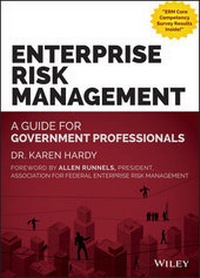
Enterprise Risk Management
A Guide for Government Professionals
Erschienen am 22. September 2014
336 Seiten
978-1-118-91112-9 (ISBN)
Beschreibung

Winner of the 2017 Most Promising New Textbook Award by Textbook & Academic Authors Association (TAA)!
Practical guide to implementing Enterprise Risk Management processes and procedures in government organizations
Enterprise Risk Management: A Guide for Government Professionals is a practical guide to all aspects of risk management in government organizations at the federal, state, and local levels. Written by Dr. Karen Hardy, one of the leading ERM practitioners in the Federal government, the book features a no-nonsense approach to establishing and sustaining a formalized risk management approach, aligned with the ISO 31000 risk management framework. International Organization for Standardization guidelines are explored and clarified, and case studies illustrate their real-world application and implementation in US government agencies. Tools, including a sample 90-day action plan, sample risk management policy, and a comprehensive implementation checklist allow readers to immediately begin applying the information presented.
The book also includes results of Hardy's ERM Core Competency Survey for the Public Sector; which offers an original in-depth analysis of the Core Competency Skills recommended by federal, state and local government risk professionals. It also provides a side-by-side comparison of how federal government risk professionals view ERM versus their state and local government counterparts.
Enterprise Risk Management provides actionable guidance toward creating a solid risk management plan for agencies at any risk level. The book begins with a basic overview of risk management, and then delves into government-specific topics including:
* U.S. Federal Government Policy on Risk Management
* Federal Manager's Financial Integrity Act
* GAO Standards for internal control
* Government Performance Results Modernization Act
The book also provides a comparative analysis of ERM frameworks and standards, and applies rank-specific advice to employees including Budget Analysts, Program Analysts, Management Analysts, and more. The demand for effective risk management specialists is growing as quickly as the risk potential. Government employees looking to implement a formalized risk management approach or in need of increasing their general understanding of this subject matter will find Enterprise Risk Management a strategically advantageous starting point.
Weitere Details
Weitere Ausgaben
Nachauflagen
E-Book
01/2014
2. Auflage
Wiley
84,99 €
Als Download verfügbar
Andere Ausgaben
Buch
12/2014
Jossey-Bass
66,00 €
Versand in 15-20 Tagen
Personen
KAREN HARDY is an expert risk management professionalwith extensive experience in the public sector. Dr. Hardy is aco-founder of the Association for Federal Enterprise RiskManagement and serves on the U.S. Technical Advisory Group for ISO31000. She also worked at Citibank and The White House Office ofManagement and Budget. She has published articles in numerousnational and international publications, including Canada'sPublic Sector Digest.
Inhalt
- Intro
- Enterprise Risk Management: A Guide for Government Professionals
- Copyright
- Contents
- Figures, Tables, and Exhibits
- Foreword
- Preface: Managing Risk in the Current Federal Environment
- Environmental Factors
- Policies, Laws, and Regulations
- Culture
- Challenges for Public Administrators
- The Political and Budget Environment
- The Upside of Risk
- Introduction
- State of Risk Management in Government
- How This Book Should Be Used
- Emerging Risks Today
- Top Government Risks
- Criteria
- Profiles of Select High-Risk Areas in Government
- Chapter One: Why Enterprise Risk Management?
- Status of ERM in the Government
- Limitations to ERM
- Risk Management: What It Is and Why It Matters
- What Is Risk?
- Evolution of Risk Management
- Traditional Risk Management versus Enterprise Risk Management
- U.S. Federal Government Policy on Risk Management
- Establishing an Agency Risk Management Policy
- ERM Policy and Practice in Canada
- Linking ERM and Internal Control
- What Are the Standards for Internal Control?
- Assessing Internal Control Structures
- Overall Internal Control Summaries
- Chapter Two: Examples of Risk Management in the Federal Government
- Health Risks
- Security Risks
- Financial Risks
- Transportation Safety Risks
- External Risks
- Case Study: Applying Risk Management in Government: National Institutes of Health
- Background
- Aligning Risk Management Program Designs with GAO's Framework
- Insights for Program Enhancements
- Case Study Best Practices
- Case Study: National Archives and Records Administration
- Identified Risks and Best Practices
- Best Practices for Risk Management
- Performance Audit Conclusions
- Recommendations for Executive Action
- Chapter Three: Managing and Communicating Risk
- Writing Risk Statements
- Developing a Risk Statement
- Inventory of Risk Statements
- Risk Assessment Techniques
- Assessing Key Risks
- Key Risk Matrix
- Mapping Risks to Strategic Outcomes
- Chapter Four: Risk Management Frameworks and Standards
- Why Voluntary Standards? A Look at OMB Circular A-119
- GAO Risk Management Framework
- ISO 31000: International Risk Management Standard
- COSO ERM Integrated Framework
- OCEG Red Book 2.0: 2009
- FERMA: 2002
- BS 31100: 2008
- An Expanded View of ISO 31000
- Chapter Five: Risk and Performance Management
- Risk and Performance: Government
- Managing Risk to Performance
- An Expanded View of Strategic Risk Management
- Risk and Performance: Private Sector
- Standard & Poor's ERM Analysis
- Chapter Six: Building a Risk Culture
- Risk Culture Survey
- Chapter Seven: ERM Maturity and Assessment
- ERM Maturity Models
- SEI Capability Maturity Model for Software
- RIMS Risk Maturity Model
- Aon Risk Maturity Index
- State of Washington ERM Maturity
- The Role of the Internal Auditor in ERM
- Case Study: The Public Safety Canada Audit of Integrated Risk Management
- Summary of Findings
- Public Service Canada Audit Criteria: Lines of Inquiry
- Audit Findings, Recommendations, and Management Responses
- Identifying Strategic Risks
- Assessing Strategic Risks
- Specific-Use Risk Tools
- Governance
- Integration: Risk-Informed Decision Making and Culture
- Preliminary Audit Risks
- Chapter Eight: ERM Core Competencies
- ERM Core Competency Survey
- Conceptual, Technical, and Core Competency Skills
- Summary of Survey Results
- Survey Highlights
- Skills for Career Success in Enterprise Risk Management
- Summary of Skill Recommendations-All Respondents
- Federal versus State and Local Government Views of ERM
- State and Local Government View of ERM-Survey Results
- State and Local Government View of Skills for Career Success
- Federal Government View of ERM-Survey Results
- Federal Government View of Skills for Career Success
- Core Competency Skills
- Chapter Nine: ERM Best Practices of Federal Agencies
- Ninety-Day Action Plan
- Sample Implementation Plan
- Words of Wisdom
- Chapter Ten: Conclusion
- Notes
- Appendix: Index of Survey Questions and Responses
- About the Author
- Index
- End User License Agreement
