

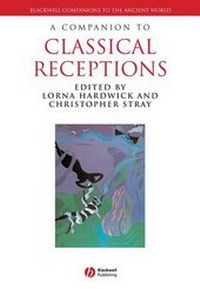
A Companion to Classical Receptions
Beschreibung

Rezensionen / Stimmen
"This variegated and sizeable volume has for me been stimulatingand informative, a pleasure to read for review . . . The'future paths' he proposes seem to me to amount to differentconfigurations of intellectual history, so no surprises there; buthis clear statement of the opportunities offered by receptionstudies in the classroom is admirable, and his call for 'anew kind of classicist-academic: the engaged public intellectual'is visionary. " (Translation and Literature, 2011) "It is impossible in a short review to do justice to everysingle contribution of this multifaceted volume. One of the manyattractive features of this collection is that it offers not onlyinnovative essays about the reception and translation of the mostread authors of antiquity ... but also expands the horizon ofthe reception studies by introducing into the discussionuntraditional themes and providing original approaches to theconcepts frequently discussed in the context of reception."(The Classical Outlook, Fall 2008) "This volume is an essential introduction to reception studiesfor both school and university students ... .Written in anaccessible and engaging manner with useful sections for furtherreading." (Journal of Classics Teaching, Autumn 2008) "...importantly, this volume exemplifies the recent boom inreception studies, and its potential to critique our subject andmethodology." (Greece and Rome, Vol 55 No. 2 2008) "The scale of this enterprise is such that the completecollection will compete with established reference works ...and should prove useful." (Scholia Reviews, 2008) "Hardwick and Stray's Companion pushes lingering worries aboutelitism and irrelevance right off the table. Companion offers boldreasons to treat classical studies as the cosmopolitan glue of thepostmodern world. The book sparkles with the excitement that makesA Companion to Classical Receptions such an eye-opening delight."(Times Literary Supplement, October 2008) "Bursting-at-the-seams ... An eye-opening delight."(Times Literary Supplement) "A spectacular volume from the massive series of 'BlackwellCompanions to the Ancient World' ... The editors have pulled ina wider splay of trades and topics than any of their companions'companions or their own now mushrooming rivals can boast." (BrynMawr Classical Review) "There is sufficient careful scholarship, critical analysis, andcontextualisation in this collection to warrant the claim that itprovides a sophisticated and far-ranging overview of thisburgeoning and dynamic field." (Scholia)Weitere Details
Weitere Ausgaben
Andere Ausgaben

Personen
Inhalt
List of Figures ix
Notes on Contributors xi
Acknowledgements xviii
Introduction: Making Connections 1
Lorna Hardwick and Christopher Stray
Part I Reception within Antiquity and Beyond 11
1 Reception and Tradition 13
Felix Budelmann and Johannes Haubold
2 The Ancient Reception of Homer 26
Barbara Graziosi
3 Poets on Socrates' Stage: Plato's Reception of Dramatic Art 38
Chris Emlyn-Jones
4 'Respectable in Its Ruins': Achaemenid Persia, Ancient and Modern 50
Thomas Harrison
5 Basil of Caesarea and Greek Tragedy 62
Ruth Webb
Part II Transmission, Acculturation and Critique 73
6 'Our Debt to Greece and Rome': Canon, Class and Ideology 75
Seth L. Schein
7 Gladstone and the Classics 86
David W. Bebbington
8 Between Colonialism and Independence: Eric Williams and the Uses of Classics in Trinidad in the 1950s and 1960s 98
Emily Greenwood
9 Virgilian Contexts 113
Stephen Harrison
Part III Translation 127
10 Colonization, Closure or Creative Dialogue?: The Case of Pope's Iliad 129
David Hopkins
11 Translation at the Intersection of Traditions: The Arab Reception of the Classics 141
Ahmed Etman
12 'Enough Give in It': Translating the Classical Play 153
J. Michael Walton
13 Lost in Translation? The Problem of (Aristophanic) Humour 168
James Robson
Part IV Theory and Practice 183
14 'Making It New': André Gide's Rewriting of Myth 185
Cashman Kerr Prince
15 'What Difference Was Made?': Feminist Models of Reception 195
Vanda Zajko
16 History and Theory: Moses and Monotheism and the Historiography of the Repressed 207
Miriam Leonard
17 Performance Reception: Canonization and Periodization 219
Pantelis Michelakis
Part V Performing Arts 229
18 Iphigénie en Tauride and Elektra: 'Apolline' and 'Dionysiac' Receptions of Greek Tragedy into Opera 231
Michael Ewans
19 Performance Histories 247
Fiona Macintosh
20 'Body and Mask' in Performances of Classical Drama on the Modern Stage 259
Angeliki Varakis
21 The Nomadic Theatre of the Socìetas Raffaello Sanzio: A Case of Postdramatic Reworking of (the Classical) Tragedy 274
Freddy Decreus
22 Aristophanes between Israelis and Palestinians 287
Nurit Yaari
Part VI Film 301
23 Working with Film: Theories and Methodologies 303
Joanna Paul
24 The Odyssey from Homer to NBC: The Cyclops and the Gods 315
Hanna M. Roisman
25 A New Hope: Film as a Teaching Tool for the Classics 327
Marianne McDonald
Part VII Cultural Politics 343
26 Possessing Rome: The Politics of Ruins in Roma capitale 345
Catharine Edwards
27 'You unleash the tempest of tragedy': The 1903 Athenian Production of Aeschylus' Oresteia 360
Gonda Van Steen
28 Multicultural Reception: Greek Drama in South Africa in the Late Twentieth and Early Twenty-first Centuries 373
Betine van Zyl Smit
29 Putting the Class into Classical Reception 386
Edith Hall
Part VIII Changing Contexts 399
30 Reframing the Homeric: Images of the Odyssey in the Art of Derek Walcott and Romare Bearden 401
Gregson Davis
31 'Plato's Stepchildren': SF and the Classics 415
Sarah Annes Brown
32 Aristotle's Ethics, Old and New 428
Rosalind Hursthouse
33 Classicizing Bodies in the Male Photographic Tradition 440
Bryan E. Burns
34 Homer in British World War One Poetry 452
Elizabeth Vandiver
Part IX Reflection and Critique 467
35 Reception Studies: Future Prospects 469
James I. Porter
Bibliography 482
Index 533
