

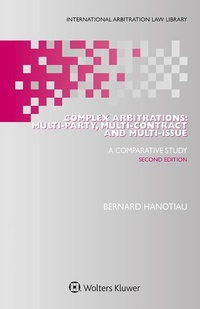
Complex Arbitrations
Multi-party, Multi-contract and Multi-issue
Erschienen am 10. Juli 2020
632 Seiten
978-94-035-1262-4 (ISBN)
Beschreibung

Complex Arbitrations: Multi-party, Multi-contract and Multi-issue A Comparative Study Second Edition Bernard Hanotiau Arbitrations involving more than two parties and complex multi-contractual issues are becoming more and more prevalent every year in every major jurisdiction worldwide. This fully updated, extensively revised edition of a far-seeing 2006 book that has been greatly valued and widely used remains the only comprehensive analysis of all the issues arising from multi-partymulti-contract arbitrations, including those involving States and groups of companies. The numerous factors and problems analysed in depth include the following: theories on the basis of which various courts and tribunals determine who are parties to the arbitration clause and whether a non-signatory may be part of the proceedings; to what extent one can bring to a single arbitration proceeding the various parties who have participated in a single economic transaction through several contracts; reasoning to follow when it comes to deciding whether another company of the group can be joined to the arbitration; whether a party to a complex contractual structure can intervene voluntarily in the proceedings; under what conditions arbitrations may be consolidated; to what extent res judicata applies when a second arbitration is initiated between the same parties on different legal grounds; how and to what extent one can overcome the inconveniences that arise from having several parallel proceedings; and enforcement of multi-partymulti-contract awards. Features of particular value to the practitioner include in-depth analysis of ad hoc and institutional awards rendered under the auspices of numerous arbitral institutions; analysis of relevant national case law based on hundreds of court decisions from all over the world; and appendices specifying multi-partymulti-contract arbitration clauses, provisions of international conventions and relevant national legislative and institutional rules. The first edition has been used all over the world, frequently referred to by courts and tribunals when one of its topics is addressed. The second edition, with its increased volume of arbitral awards and cases from many more jurisdictions, its new scenarios, its updates on new legislation and rules, and its newly researched jurisprudence will help lawyers and corporate counsel solve the increasingly complex procedural issues confronting them in dealing with multi-partymulti-contract disputes. Law professors and students of dispute resolution have here a powerfully authoritative consideration of one of the most salient aspects of current international practice.
Weitere Details
Weitere Ausgaben
Andere Ausgaben

Buch
07/2020
2. Auflage
Kluwer Law International
259,86 €
Versand in 15-20 Tagen
Inhalt
- Intro
- Half-Title Page
- Title Page
- Copyright Page
- Table of Contents
- Acknowledgements for the First Edition
- Acknowledgements for the Second Edition
- Introduction
- Chapter 1 Who Are the Parties to the Contract(s) or to the Arbitration Clause(s) Contained Therein? The Theories Applied by Courts and Arbitral Tribunals
- Section I: Introduction
- Section II: Representation and Agency
- Section III: Third-Party Beneficiaries and Guarantee Clauses (Clauses De Porte-For)
- Section IV: Universal and Individual Transfers
- Section V: Estoppel
- Section VI: Incorporation by Reference
- Section VII: Consent or Conduct as an Expression of Implied Consent or as an Alternative to Consent
- Section VIII: Existence Between the Parties of a Community of Rights and Interests
- Section IX: Confusion and Fraud
- Alter Ego and Piercing the Corporate Veil
- Section X: Equity and Good Administration of Justice
- Chapter 2 May an Arbitration Clause Be Extended to Non-signatories: Individuals, States or Other Companies of the Group?
- Section I: Introduction: The So-Called Group of Companies Doctrine
- Section II: The Impact of the Requirement That the Arbitration Clause Be in Writing
- Section III: Analysis of Case Law
- Subsection I: The Factual Schemes
- Subsection II: Extension to One or More Non-signatories as Additional Defendant(s)
- I. Extension to the Parent Company or to the Parent Company and Another Company of the Group
- II. Extension to a State and/or One or More State Entities
- III. Extension to One or More Subsidiaries or One or More Companies of the Group That Are Not Subsidiaries
- IV. Extension to a Sister Corporation and an Employee
- V. Extension to an Affiliated Entity
- VI. Extension to Another Company or an Individual, Unrelated to the Signatory's Group
- VII. Extension to a Director or General Manager or CEO or to the Owner of the Group
- VIII. Extension to an Individual (Possibly a Majority Shareholder of the Group)
- Subsection III: Extension to One or More Non-signatories as Additional Claimant(s)
- I. Extension to the Parent Company
- II. Extension to a State
- III. Extension to an Individual (Possibly a Majority Shareholder of the Group) and/or Other Companies Within the Group or Affiliated Entities
- IV. Extension to One or More Subsidiaries or One or More Companies Within the Group That Are Not Subsidiaries
- Section IV: Conclusions
- Chapter 3 The Possibility of Bringing Together in One Single Proceeding all the Parties Who Have Participated in the Performance of One Economic Transaction Through Interrelated Contracts
- Section I: Introduction
- Section II: Groups of Contracts
- Subsection I: The Issues and the Various Contractual Schemes
- Subsection II: General Remarks
- Subsection III: Basic Principles
- Section III: Analysis of Case Law
- Subsection I: The Parties Are Different or Not All the Same but the Contracts Contain the Same Arbitration Clause or the Clauses Are Compatible
- I. Awards Refusing Consolidated Jurisdiction and Eventually Taking the Connected Contract into Consideration
- II. Awards and Decisions Accepting Consolidated Jurisdiction
- Subsection II: The Parties Are Different or Not All the Same and the Contracts Contain One or More Identical or Compatible Arbitration Clause(s) and One or More Contracts Do Not Contain an Arbitration Clause
- Subsection III: The Parties Are Different or Not All the Same and the Contracts Do Not Contain Identical or Compatible Dispute Resolution Clauses, and in Some Cases One or Several of Them Do Not Contain an Arbitration Clause
- I. Incompatible Arbitration Clauses
- II. Arbitration Clause(s) and Jurisdiction Clause(s)
- III. Even If an Arbitral Tribunal Does Not Have Jurisdiction on a Contract, It May Take It into Consideration
- Subsection IV: The Issue of Guarantees (Bank Guarantees and Guarantee Agreements)
- Subsection V: The Parties Are the Same and They Have Concluded Two or More Contracts, One or Several of Them Without an Arbitration Clause, or Containing a Clause That Gives Jurisdiction to National Courts, or Another Incompatible Arbitration Clause (Court Decisions)
- I. Connected Agreements. Absence of an Arbitration Clause in One of Them
- II. Incompatible Arbitration Clauses
- III. One or More Contracts Containing an Arbitration Clause and One or More Contracts Containing a Jurisdiction Clause
- Subsection VI: May an Arbitral Tribunal Hearing a Dispute That Arises Principally from a Specific Contract Decide Issues Arising from Connected Agreements Entered into by the Same Parties When One of them Does Not Contain an Arbitration Clause or Contains a Clause Which Gives Jurisdiction to National Courts, or Another Incompatible Arbitration Clause? Arbitral Awards
- I. Identical Arbitration Clauses
- II. One or More Contracts Contain an Arbitration Clause (Identical or Compatible)
- the Other(s) Does (Do) Not
- III. One Contract Containing an Arbitration Clause, Another One Containing a Jurisdiction Clause
- IV. Incompatible Arbitration Clauses and the Difference Between Giving Effect to an Agreement and Taking This Agreement into Consideration
- V. Different Wording of the Clauses: Are They Incompatible?
- Subsection VII: Conclusions
- Section IV: To What Extent Is It Possible to Start One Arbitration Procedure on the Basis of Various Separate Agreements?
- Subsection I: General Principles
- Subsection II: Institutional Rules
- I. ICC
- II. CEPANI
- III. LCIA
- IV. Stockholm Chamber of Commerce
- V. SIAC
- VI. HKIAC
- VII. CIETAC
- VIII. ICSID
- Chapter 4 Joinder of Parties and Joinder of Claims: Voluntary and Compelled Intervention of Third Parties, Cross-Claims and Consolidation
- Section I: Who Are the Parties to the Arbitral Proceedings?
- Section II: May a Non-party to the Arbitration Intervene in the Proceedings?
- Section III: May a Party to the Arbitration Proceedings Join a Non-party in the Course of the Procedure?
- Subsection I: Ad Hoc Arbitration
- Subsection II: Institutional Arbitration
- I. ICC Arbitration
- A. The Old Approach
- B. The Subsequent Evolution Before the 2012 Rules
- C. The 2012 and 2017 Rules
- II. Other Institutions
- A. CEPANI
- B. LCIA
- C. SIAC
- D. HKIAC
- E. CIETAC
- F. The Stockholm Chamber of Commerce
- G. The Swiss Rules
- H. The American Arbitration Association ICDR Rules
- I. UNCITRAL
- Section IV: May a Respondent to the Arbitration Procedure File a Cross-Claim Against Another Respondent in the Same Arbitration?
- Section V: To What Extent Is It Possible to Consolidate Two Related Arbitration Proceedings?
- Subsection I: Overview
- Subsection II: Consolidation by the Institution
- I. The ICC Rules
- II. CEPANI Rules
- III. LCIA Rules
- IV. SIAC Rules
- V. HKIAC Rules
- VI. Stockholm Rules
- VII. CIETAC Rules
- VIII. The Swiss Chambers Rules
- IX. The American Arbitration Association ICDR Rules
- Subsection III: Consolidation by the Court
- Subsection IV: ICSID and NAFTA
- Section VI: Is There a Duty to Bring into the Arbitration Proceedings All the Parties to the Agreement?
- Section VII: Briefs Amicus Curiae
- Subsection I: NAFTA
- Subsection II: ICSID
- Subsection III: Other Conventions
- Chapter 5 Setting in Motion of Arbitral Proceedings and Appointment of Arbitrators
- Section I: Setting in Motion of Arbitral Proceedings in Cases Involving Non-signatories
- Subsection I: Decisions Involving Multiple Respondents
- Subsection II: Decisions Involving Multiple Claimants
- Section II: Appointment of Arbitral Tribunal
- Chapter 6 Arbitration Proceedings
- Section I: Specific Issues That May Arise in the Course of the Arbitral Proceedings
- Subsection I: Opposability of the Name-Borrowing Provision
- Subsection II: Pass-Through Claims
- Subsection III: Direct Action of the Subcontractor Against the Employer
- Subsection IV: Determination of the Law Applicable to the Various Contracts of the Contractual Chain
- Subsection V: Joint Responsibility for Debts Incurred by a Company of the Group and Set-Off
- Section II: How to Minimise the Difficulties That Can Arise from Separately Conducted Parallel Arbitral Hearings
- Subsection I: Appointment of the Same Arbitrators
- Subsection II: Communication of Information or Documents Obtained in Another Arbitration
- Subsection III: Independence and Impartiality of the Arbitrator Appointed in Parallel Cases
- Subsection IV: How to Alleviate the Inconveniences That Can Result from the Existence of Parallel Arbitrations
- Chapter 7 Enforcement of the Arbitral Award
- Section I: General Principles
- Section II: Decisions Refusing Enforcement
- Section III: Decisions Confirming Enforcement or Refusing Setting Aside
- Section IV: Enforcement Against a Third Party
- Chapter 8 The Res Judicata Effect of an Award Rendered in a Connected Arbitration Arising from the Same Project
- Section I: Res Judicata, A General Principle of International Law Recognised by Civilised Nations
- Subsection I: The Principle of Res Judicata in International Law
- Subsection II: Res Judicata in National Legal Systems
- I. Res Judicata in English Law
- II. Res Judicata in Civil Law Legislation
- Section II: Res Judicata Applied to Arbitral Awards
- Subsection I: General Principles
- Subsection II: The Law Applicable to the Res Judicata Issue
- Subsection III: The Various Issues Raised by Res Judicata
- I. Under What Conditions Does Res Judicata Apply?
- II. The Scope of Res Judicata
- III. If an Award Is Not Res Judicata, What Value Should Be Given to It By Other Arbitrators?
- Section III: Towards a Broad Conception of Res Judicata
- Section IV: Res Judicata and the Could Have Been Claims
- Appendix 1: A Selection of Provisions on Multiparty Arbitration in International Conventions, National Legislations and Institutional Rules
- Appendix 2: A Selection of Multiparty-Multicontract Arbitration Clauses
- Appendix 3: The New York Convention on the Recognition and Enforcement of Foreign Arbitral Awards
- Bibliography
- Table of Cases
- Subject Index
- INTERNATIONAL ARBITRATION LAW LIBRARY
