
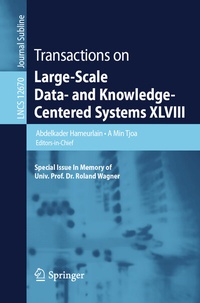
Transactions on Large-Scale Data- and Knowledge-Centered Systems XLVIII
Beschreibung
The LNCS journal Transactions on Large-Scale Data- and Knowledge-Centered Systems focuses on data management, knowledge discovery, and knowledge processing, which are core and hot topics in computer science. Since the 1990s, the Internet has become the main driving force behind application development in all domains. An increase in the demand for resource sharing (e.g., computing resources, services, metadata, data sources) across different sites connected through networks has led to an evolution of data- and knowledge management systems from centralized systems to decentralized systems enabling large-scale distributed applications providing high scalability.
This, the 48th issue of Transactions on Large-Scale Data- and Knowledge-Centered Systems, contains 8 invited papers dedicated to the memory of Prof. Dr. Roland Wagner. The topics covered include distributed database systems, NewSQL, scalable transaction management, strong consistency, caches, data warehouse, ETL, reinforcement learning, stochastic approximation, multi-agent systems, ontology, model-driven development, organisational modelling, digital government, new institutional economics and data governance.

Weitere Details
Weitere Ausgaben
Inhalt
Systemvoraussetzungen
Dateiformat: PDF
Kopierschutz: Wasserzeichen-DRM (Digital Rights Management)
Systemvoraussetzungen:
- Computer (Windows; MacOS X; Linux): Verwenden Sie zum Lesen die kostenlose Software Adobe Reader, Adobe Digital Editions oder einen anderen PDF-Viewer Ihrer Wahl (siehe E-Book Hilfe).
- Tablet/Smartphone (Android; iOS): Installieren Sie bereits vor dem Download die kostenlose App Adobe Digital Editions oder die App PocketBook (siehe E-Book Hilfe).
- E-Book-Reader: Bookeen, Kobo, Pocketbook, Sony, Tolino u.v.a.m.
Das Dateiformat PDF zeigt auf jeder Hardware eine Buchseite stets identisch an. Daher ist eine PDF auch für ein komplexes Layout geeignet, wie es bei Lehr- und Fachbüchern verwendet wird (Bilder, Tabellen, Spalten, Fußnoten). Bei kleinen Displays von E-Readern oder Smartphones sind PDF leider eher nervig, weil zu viel Scrollen notwendig ist. Mit Wasserzeichen-DRM wird hier ein „weicher” Kopierschutz verwendet. Daher ist technisch zwar alles möglich – sogar eine unzulässige Weitergabe. Aber an sichtbaren und unsichtbaren Stellen wird der Käufer des E-Books als Wasserzeichen hinterlegt, sodass im Falle eines Missbrauchs die Spur zurückverfolgt werden kann.
Weitere Informationen finden Sie in unserer E-Book Hilfe.