

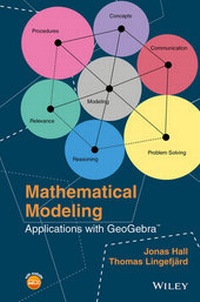
Mathematical Modeling
Beschreibung

Weitere Details
Weitere Ausgaben
Andere Ausgaben
Personen
Inhalt
Preface xi
Introduction xiii
About the Companion Website xxx
1 Some Introductory Problems 1
1.1 Ticket Prices, 3
1.2 How Long Will the Pasture Last in a Field?, 7
1.3 A Bit of Chemistry, 10
1.4 Sydney Harbor Bridge, 16
1.5 Perspective, 19
1.6 Lake Erie's Area, 21
1.7 Zebra Crossing, 25
1.8 The Security Case, 31
1.9 Personal Measurements, 34
1.10 Height of the Body, 34
1.11 Lamp Pole, 35
1.12 The Skyscraper, 35
1.13 The Fence, 35
1.14 The Corridor, 35
1.15 Bird Feeders, 35
1.16 Golf, 36
2 Linear Models 37
2.1 Are Women Faster Than Men?, 38
2.2 Taxi Companies, 40
2.3 Crime Development, 47
2.4 The Metal Wire, 52
2.5 Options Trading, 57
2.6 Flying Foxes, 62
2.7 Knots on a Rope, 66
2.8 The Candle, 66
2.9 Hooke's Law, 66
2.10 Ranking, 67
2.11 Dolbear's Law, 67
2.12 Man at Office, 68
2.13 A Stack of Paper, 68
2.14 Milk Production in Cows, 69
3 Nonlinear Empirical Models I 70
3.1 Galaxy Rotation, 71
3.2 Olympic Pole Vaulting, 73
3.3 Kepler's Third Law, 79
3.4 Density, 83
3.5 Yeast, 87
3.6 Cooling I, 88
3.7 Modeling the Population of Ireland, 93
3.8 The Rule of 72, 96
3.9 The Fish Farm I, 100
3.10 New Orleans Temperatures, 104
3.11 The Record Mile, 107
3.12 The Rocket, 107
3.13 Stopping Distances, 107
3.14 A Bottle with Holes, 108
3.15 The Pendulum, 108
3.16 Radio Range, 108
3.17 Running 400 Meters, 108
3.18 Blue Whale, 109
3.19 Used Cars, 109
3.20 Texts, 110
4 Nonlinear Empirical Models II 111
4.1 Cooling II, 112
4.2 Body Surface Area, 116
4.3 Warm?]Blooded Animals, 120
4.4 Control of Insect Pests, 123
4.5 Selling Magazines for Christmas, 125
4.6 Tumor, 136
4.7 Free Fall, 141
4.8 Concentration, 145
4.9 Air Current, 150
4.10 Tides, 153
4.11 Fitness, 156
4.12 Life Expectancy versus Average Income, 157
4.13 Stockholm Center, 157
4.14 Workforce, 157
4.15 Population of Sweden, 158
4.16 Who Killed the Lion?, 158
4.17 AIDS in United States, 159
4.18 Thermal Comfort, 159
4.19 Watts and Lumen, 159
4.20 The Beaufort Scale, 160
4.21 The von Bertalanffy Growth Equation, 161
5 Modeling with Calculus 162
5.1 The Fish Farm II, 163
5.2 Titration, 169
5.3 The Bowl, 176
5.4 The Aircraft Wing, 180
5.5 The Gateway Arch in St. Louis, 182
5.6 Volume of a Pear, 187
5.7 Storm Flood, 190
5.8 Exercise, 193
5.9 Bicycle Reflectors, 202
5.10 Cardiac Output, 206
5.11 Medication, 210
5.12 New Song on Spotify, 215
5.13 Temperature Change, 221
5.14 Tar, 224
5.15 Bicycle Reflectors Revisited, 229
5.16 Gas Pressure, 229
5.17 Airborne Attacks, 229
5.18 Railroad Tracks, 230
5.19 Cobb-Douglas Production Functions, 230
5.20 Future Carbon Dioxide Emissions, 231
5.21 Overtaking, 232
5.22 Population Dynamics of India, 232
5.23 Drag Racing, 232
5.24 Super Eggs, 233
5.25 Measuring Sticks, 234
5.26 The Lecture Hall, 234
5.27 Progressive Braking Distances, 234
5.28 Cylinder in a Cone, 235
6 Using Differential Equations 236
6.1 Cooling III, 237
6.2 Moose Hunting, 241
6.3 The Water Container, 247
6.4 Skydiving, 250
6.5 Flu Epidemics, 256
6.6 USA's Population, 263
6.7 Predators and Prey, 274
6.8 Smoke, 285
6.9 Alcohol Consumption, 289
6.10 Who Killed the Mathematics Teacher, 292
6.11 River Clams, 297
6.12 Contamination, 297
6.13 Damped Oscillation, 297
6.14 The Potassium-Argon Method, 298
6.15 Barium, Lanthanum, and Cerium, 298
6.16 Iodine, 298
6.17 Endemic Epidemics, 299
6.18 War, 299
6.19 Farmers, Bandits, and Rulers, 299
6.20 Epidemics Without Immunity, 300
6.21 Zombie Apocalypse I, 300
6.22 Zombie Apocalypse II, 300
7 Geometrical Models 301
7.1 The Looping Pen, 302
7.2 Comparing Areas, 304
7.3 Crossing Lines, 307
7.4 Points in a Triangle, 310
7.5 Trisected Area, 316
7.6 Spirograph, 320
7.7 Connected LP Players, 326
7.8 Folding Paper, 332
7.9 The Locomotive, 336
7.10 Maximum Volume, 340
7.11 Pascal's Snail or Limaçon, 340
7.12 Equilateral Triangle Dissection, 341
7.13 Dividing the Sides of a Triangle, 341
7.14 The Pedal Triangle, 342
7.15 The Infinity Diagram, 343
7.16 Dissecting a Circular Segment, 344
7.17 Neuberg Cubic Art, 344
7.18 Phase Plots for Triangles, 345
7.19 The Joukowski Airfoil, 347
8 Discrete Models 348
8.1 The Cabinetmaker, 349
8.2 Weather, 358
8.3 Squirrels, 362
8.4 Chlorine, 365
8.5 The Deer Farm, 369
8.6 Analyzing a Number Sequence, 373
8.7 Inner Areas in a Square, 376
8.8 Inner Areas in a Triangle, 382
8.9 A Climate Model Based on Albedo, 387
8.10 Traffic Jam, 392
8.11 Wildfire, 399
8.12 A Modern Carpenter, 408
8.13 Conway's Game of Life, 409
8.14 Matrix Taxis, 409
8.15 The Car Park, 409
8.16 Selecting a Collage, 410
8.17 Apportionment, 410
8.18 Steiner Trees for Regular Polygons, 410
8.19 Hugs and High Fives, 411
8.20 Pythagorean Triples, 411
8.21 Credits, 412
8.22 The Piano, 413
9 Modeling in the Classroom 415
9.1 The Teacher Creating Diagrams, 416
9.2 Student's Lab Reports, 416
9.3 Making Screencast Instructions, 417
9.4 Demonstrations, 417
9.5 Students Investigating Constructions, 418
9.6 Working in Groups, 418
9.7 Students Constructing Models, 419
9.8 Broader Assignments, 420
9.9 The Same or Different Assignments, 421
9.10 Previous Assignments, 421
9.11 The Consultancy Bureau, 422
10 Assessing Modeling 425
10.1 To Evaluate Mathematical Modeling Assignments, 426
10.2 Concretizing Grading Criteria, 426
10.3 Evaluating Students' Work, 431
11 Assessing Models 434
11.1 Relative Error, 435
11.2 Correlation, 435
11.3 Sum of Squared Errors, 436
11.4 Simple Linear Regression, 436
11.5 Multiple Regression Analysis, 438
11.6 Nonlinear Regression, 438
11.7 Confidence Intervals, 439
11.8 2D Confidence Interval Tools, 441
12 Interpreting Models 443
12.1 Mathematical Representations, 443
12.2 Graphical Representations, 444
12.3 A Sample Model Interpreted, 445
12.4 Creating the Model, 446
Appendix A: Introduction to GeoGebra 448
Appendix B: Function Library 485
Integer Properties 509
Index 523
Index of Problems by Name 535
INTRODUCTION
ABOUT THIS BOOK
This book is written primarily for teachers of mathematical modeling in upper secondary schools or in high schools. Students in a teacher training program at a university or studying mathematical modeling in an introductory course at the university may also want to explore the possibilities that GeoGebra can afford. The book was conceived from the standpoint of the Swedish curriculum, which regards mathematical modeling competence to be one of seven competencies that should be taught and assessed in upper secondary school.
As a school subject, mathematics is no longer only about calculation. Some parts of mathematics, of course, relate strongly to procedures and counting, but altogether this part of the curriculum has less emphasis today than it used to have. Today, mathematics is treated as a tool, as an aid, as a language, and as logic. The curriculum in many countries is nowadays expressed in terms of competency objectives. The competencies are general and not related to a specific mathematical content. Yet, the competencies are developed in levels by students' processing specific content. The modeling competency is one of these competencies that draw heavily on functions and differential equations.
Mathematical models and other mathematical representations such as diagrams, histograms, functions, graphs, tables, and symbols normally make it easier for abstract mathematical concepts to be understood and for other phenomena to be described in mathematical terms. Educators today are facing a world that is shaped by increasingly complex, dynamic, and powerful systems of information that are meet through various media. Being able to interpret, understand, and work with mathematical models and other complex systems involves important mathematical processes that become discernible and obvious when teaching mathematical modeling.
In mathematics education, as seen from the K-12 perspective, teachers work with different representations in order to help students understand mathematical objects and concepts. Models such as geometrical constructions, graphs of functions, and a variety of diagrams are used to introduce new concepts and to show relationships, dependency, and change. Mathematical models, structures, and constructions are also used in different scientific fields, such as in physics and the social sciences. To be able to construct, interpret, and understand mathematical models is becoming increasingly important for students all over the world.
Our main academic position is that once modeling competency is acquired in the classroom, all other competencies will be addressed automatically. With training in mathematical modeling, instead of always asking "Why are we doing this?" students will find classroom work to be interesting and related to reality, and then concepts, procedures, problem solving, reasoning, communication, and relevance will follow without much effort. If you, the teacher, try to do it the other way around, you may soon discover that in sticking with too many routine calculations you will end up without time to address the modeling and reasoning competencies.
There were some basic considerations that we needed to address in writing this text on mathematical modeling. We could have chosen to only focus on the process of constructing and developing models or instead on the evaluation of already produced mathematical models. We decided to try and address both situations in this book. However, for those of you teaching mathematical modeling in upper secondary school, it may be a good idea to start with existing and well-developed models. Then, as students become familiar with the mathematical modeling concept, they could be started on constructing their own mathematical models.
To place mathematical modeling into a particular branch of mathematics, one could consider it as applied problem solving using data that have already been gathered in some way. We try to address the many different data that can be used in our selection of modeling examples in order to show how mathematical models are applied everywhere in our society. In some instances, however, we investigate purely geometrical models.
In today's schools, teachers have the possibility to allow every student to use powerful mathematical instruments that help them learn and do mathematics in a way that humans once only could dream about. Students can tackle difficult problems a lot earlier with these tools, so they can connect concepts and procedures to more realistic situations and open up their minds to a more nuanced communications.
In this book we decided to mainly work with GeoGebra, but other tools, primarily Wolfram Alpha, can be used as well. GeoGebra was created in 2001 by Marcus Hohenwarter, and as a tool, it could be considered a mathematical laboratory, or even an environment. GeoGebra is free and platform independent, and it handles algebra, plane geometry, 3D geometry, functions, statistics, spreadsheet calculations, and symbolic algebra. GeoGebra has been translated to over 50 languages and is used all over the world. In this book we show how to use GeoGebra for mathematical modeling as well as how to apply it to teaching mathematics in general.
We have organized the mathematical modeling examples in the following order:
- Chapter 1: Some Introductory Problems
- Chapter 2: Linear Models
- Chapter 3: Nonlinear Empirical Models I
- Chapter 4: Nonlinear Empirical Models II
- Chapter 5: Modeling with Calculus
- Chapter 6: Using Differential Equations
- Chapter 7: Geometrical Models
- Chapter 8: Discrete Models
Then we have added four more chapters on the teaching and assessing of mathematical modeling, in accord with the methodology of the teaching profession:
- Chapter 9: Modeling in the Classroom
- Chapter 10: Assessing Modeling
- Chapter 11: Assessing Models
- Chapter 12: Interpreting Models
For those of you who are new to GeoGebra, we have added an introduction to this interactive, dynamic platform. We have further added a function library that can be browsed for different functions to fit data.
Appendix A: Introduction to GeoGebra
Appendix B: Function Library
In trying to model different phenomena, you will soon discover that you need different prerequisites in mathematics. We address this issue with different mathematical modeling examples at different levels of learning. In this regard the mathematical hierarchy we present is probably much the same in your school system as it is around the world. If you have previous experience with GeoGebra, we recommend that you study the chapters in sequence. If you have no previous experience at all, we suggest that you study Appendix A first, and thereafter the chapters in order.
Chapter 1-8 contain the modeling tasks. In each of these chapters there are a number of solved modeling tasks with at least one, sometimes several, thorough solution suggestions. The solutions are very detailed, both mathematically and technically. By reading-and doing-these solutions, your students will learn mathematics, mathematical modeling, and GeoGebra techniques, and so become good modelers and problem solvers. Each chapter also has a number of unsolved tasks at the end.
Each task may be varied in a number of ways. Sometimes it may be that only a value should be calculated, sometimes several different models could be created, sometimes an error estimate could be included, and sometimes it may be better to write a report. These different ways to work out a solution can be applied to all tasks. We have varied the tasks somewhat randomly and encourage you to adapt them to your students' needs and current levels.
The modeling tasks, both those we have solved and those left to be solved are often quite comprehensive and cannot be fitted in just one lesson. We think of them as requiring students to have at least a few lessons before starting the assignment or a week to work on the assignment. You, the teacher, may choose to do nothing else for a week or so, but we prefer to think about the tasks as parallel assignments that allow the student to work on them for long time periods while learning new concepts, asking questions, discussing the tasks with classmates, and so forth. This way they will learn and progress in reasoning, communication, conceptual growth, and more.
We also believe that students need to see many examples of written mathematical reasoning in order for them to be able to start producing written mathematical reports. The typical syllabus mentions detailed and nuanced reasoning, and this competency needs to be discussed so that students know what is expected of them. It is our hope that the many solved examples in this book will be one such source of wisdom for students and serve as an inspiration for teachers to help students develop their competencies.
Chapter 9 addresses how to organize everyday work in the classroom, and it gives some examples of different approaches to that task. Teachers can easily turn into coaches when introducing and maintaining modeling processes, so they do need to assume that students have certain inner motivation and experience together with a desire to learn. The learning that takes place is built on the assumption that the students get continual opportunities to test, validate, and rebuild their previous knowledge. Moreover in the classroom students will learn from each other, so their social...
