
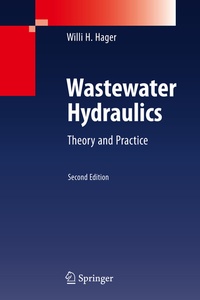
Wastewater Hydraulics
Beschreibung
Alles über E-Books | Antworten auf Fragen rund um E-Books, Kopierschutz und Dateiformate finden Sie in unserem Info- & Hilfebereich.
The second, enlarged edition of this established reference integrates many new insights into wastewater hydraulics. This work serves as a reference for researchers but also is a basis for practicing engineers. It can be used as a text book for graduate students, although it has the characteristics of a reference book. It addresses mainly the sewer hydraulician but also general hydraulic engineers who have to tackle many a problem in daily life, and who will not always find an appropriate solution. Each chapter is introduced with a summary to outline the contents. To illustrate application of the theory, examples are presented to explain the computational procedures. Further, to relate present knowledge to the history of hydraulics, some key dates on noteworthy hydraulicians are quoted. A historical note on the development of wastewater hydraulics is also added. References are given at the end of each chapter, and they are often helpful starting points for further reading. Each notation is defined when introduced, and listed alphabetically at the end of each chapter.
This new edition includes in particular sideweirs with throttling pipes, drop shafts with an account on the two-phase flow features, as well as conduit choking due to direct or undular hydraulic jumps.
Weitere Details
Weitere Ausgaben
Andere Ausgaben

Inhalt
Systemvoraussetzungen
Dateiformat: PDF
Kopierschutz: Wasserzeichen-DRM (Digital Rights Management)
Systemvoraussetzungen:
- Computer (Windows; MacOS X; Linux): Verwenden Sie zum Lesen die kostenlose Software Adobe Reader, Adobe Digital Editions oder einen anderen PDF-Viewer Ihrer Wahl (siehe E-Book Hilfe).
- Tablet/Smartphone (Android; iOS): Installieren Sie bereits vor dem Download die kostenlose App Adobe Digital Editions oder die App PocketBook (siehe E-Book Hilfe).
- E-Book-Reader: Bookeen, Kobo, Pocketbook, Sony, Tolino u.v.a.m.
Das Dateiformat PDF zeigt auf jeder Hardware eine Buchseite stets identisch an. Daher ist eine PDF auch für ein komplexes Layout geeignet, wie es bei Lehr- und Fachbüchern verwendet wird (Bilder, Tabellen, Spalten, Fußnoten). Bei kleinen Displays von E-Readern oder Smartphones sind PDF leider eher nervig, weil zu viel Scrollen notwendig ist. Mit Wasserzeichen-DRM wird hier ein „weicher” Kopierschutz verwendet. Daher ist technisch zwar alles möglich – sogar eine unzulässige Weitergabe. Aber an sichtbaren und unsichtbaren Stellen wird der Käufer des E-Books als Wasserzeichen hinterlegt, sodass im Falle eines Missbrauchs die Spur zurückverfolgt werden kann.
Weitere Informationen finden Sie in unserer E-Book Hilfe.