

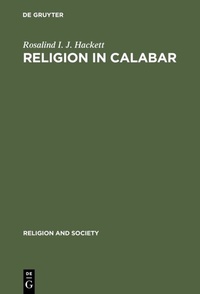
Religion in Calabar
The Religious Life and History of a Nigerian Town
1. Auflage
Erschienen am 6. Februar 2013
XVIII, 481 Seiten
978-3-11-084673-7 (ISBN)
Beschreibung

No detailed description available for "Religion in Calabar".
Weitere Details
Reihe
Auflage
Reprint 2013
Sprache
Englisch
Verlagsort
Berlin/Boston
Deutschland
Zielgruppe
Für Beruf und Forschung
US School Grade: College Graduate Student
Illustrationen
5 Ktn, 9 s/w Tabellen
9 b/w tbl., 5 maps
Dateigröße
10,21 MB
ISBN-13
978-3-11-084673-7 (9783110846737)
Schweitzer Klassifikation
Weitere Ausgaben
Andere Ausgaben
Buch
11/1988
1. Auflage
De Gruyter
169,95 €
Versand in 7-9 Tagen
Buch
01/1988
1. Auflage
De Gruyter
239,00 €
Artikel ist vergriffen; siehe andere Ausgabe
Inhalt
- Intro
- Preface
- Introduction
- Part One: Historical Ethnography
- Chapter One: Old Calabar
- 1.1 Background to Calabar
- 1.2 Traditional religion
- Chapter Two: Missionary Beginnings
- 2.1 Introduction
- 2.2 Early Christian contacts
- 2.3 Early religious pluralization
- 2.4 Roman Catholic Mission
- 2.5 Wesleyan Methodists
- 2.6 Lutheran Church
- 2.7 Qua Iboe Mission
- 2.8 Presbyterian developments
- Chapter Three: Religious Pluralization
- 3.1 Introduction
- 3.2 The heyday of Calabar: 1910-1929
- 3.3 The witchcraft scare: 1930-39
- 3.4 World War II and its effect on Calabar: 1940-1949
- 3.5 Political independence approaches: 1950-1959
- 3.6 Independence and civil war: 1960-1969
- 3.7 The post-civil war revival: 1970-1974
- 3.8 The "oil boom" churches: 1975-1979
- 3.9 Concluding remarks
- Part Two: Contemporary Religion
- Chapter Four: Non-Indigenous and Institutional Religion
- 4.1 Introduction
- 4.2 From mission to mainline churches - and after
- 4.3 Islam
- 4.4 Exogenous religious institutions
- Chapter Five: Indigenous and Institutional Religion
- 5.1 Introduction
- 5.2 Traditional religion
- 5.3 Spiritual self-determination - the hallmark of the new churches
- 5.4 New trends and developments
- 5.5 Concluding remarks
- Chapter Six: Institutional Distribution
- 6.1 The religious mapping of Calabar
- 6.2 Concluding remarks
- Chapter Seven: Institutional Interaction
- 7.1 Interaction and interdependence
- 7.2 Conferences, councils and chaplaincies
- 7.3 Non-denominational revivals and crusades
- 7.4 The Bible and music as common denominators
- 7.5 Civic interaction
- 7.6 Negotiations and affiliations
- 7.7 Negative interaction
- 7.8 Concluding remarks
- Chapter Eight: Popular Religion
- 8.1 Introduction
- 8.2 The human condition
- 8.3 "Why die in silence?"
- 8.4 Power and protection
- 8.5 Festivals
- 8.6 Freelance evangelism
- 8.7 Music
- 8.8 Spiritual experience
- 8.9 Names and mottoes
- 8.10 A kaleidoscope of religious activity
- Chapter Nine: Religion in the Media
- 9.1 Introduction
- 9.2 Newspaper religion
- 9.3 Television religion
- 9.4 Radio religion
- 9.5 Concluding remarks
- Chapter Ten: Unity in Diversity: Themes and Developments in Calabar Religion
- 10.1 Introduction
- 10.2 Religion as transformative power
- 10.3 Religion as sustaining force
- 10.4 Spiritualization
- 10.5 Institutionalization
- 10.6 Secularization
- 10.7 Privatization
- 10.8 Religious self-determination
- 10.9 Homogenization
- 10.10 Religious conversion and mobility
- Conclusion
- Appendix 1: Methods
- Appendix 2: Chronology
- Appendix 3: Data File on the Religious Institutions of Calabar
- Bibliography
- Primary Sources
- Books and Articles Relating to Calabar
- Comparative and Theoretical Works
- Index
