

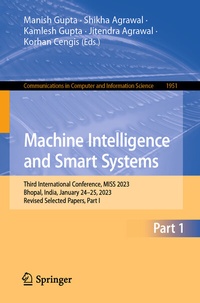
Machine Intelligence and Smart Systems
Beschreibung

The two-volume set CCIS 1951 and 1952 constitutes the refereed post-conference proceedings of the Third International Conference on Machine Intelligence and Smart Systems, MISS 2023, Bhopal, India, during January 24-25, 2023.
The 58 full papers included in this book were carefully reviewed and selected from 203 submissions. They were organized in topical sections as follows: Language processing; Recent trends; AI defensive schemes; Principle components; Deduction and prevention models.
Weitere Details
Weitere Ausgaben
Andere Ausgaben
Personen
Inhalt
.- Machine Intelligence.
.- Deep Learning based Novel Approach for Mammogram Classification using Densenet-169.
.- Attribute Based Federated-Reinforcement Learning Approach for Drone Authorization.
.- Chronic Kidney Disease prediction and interpretation using Explainable AI.
.- Systematic review and analysis of Artificial intelligence based breast cancer classification and detection.
.- War of Tweets: Sentiment Analysis on Ukraine Russia Conflict.
.- Implementing HRRN for evaluating Cloud performance using Reinforcement Learning.
.- Using Machine Learning for Prediction of Obstructions for Indoor Location Systems.
.- Privacy Threats and Protection in Artificial Intelligence and Machine Learning.
.- Combining linguistic information with BERT for Span based End-to-End Aspect Based Sentiment Analysis.
.- A Dimensionality Reduction Model: A Retrospective Approach on Dementia Triggering Parameters and Feature Ranking.
.- Effective Identification of Lung Diseases using Few-Shot Learning.
.- Comparative Study on Classification based- Data Mining Techniques in Early Diabetes Prediction.
.- Optimize Machine Learning Model for Sentiment Analysis of Online Education during Covid-19 Pandemic.
.- Review on the Challenges and Future Directions of Deep Learning-based Techniques for Advance Prediction of Cardiac Attack.
.- Different Techniques For Detecting Plant Leaf Disease Using Machine Learning.
.- Proposed Framework of Extensive Humanoid Design Cycle and Recent Developments in Bipedal Walk.
.- Natural Language Processing for Waste Management Using Public Opinions in Smart Cities.
.- Prediction of Diabetes during Pregnancy through Fog Environment.
.- Empirical Wavelet Transform grounded poignant ground target recognition and classification by Seismic Signal Processing.
.- A Powered-Up Classification of Disabling Distributed Network Cloud-Based Attacks Using MLPNN-BP and MLPNN-LM.
.- Stroke Prediction Framework Based on Missing Value Information and Outlier Detection by Using Machine Learning Techniques in E-Healthcare.
.- An Artificial Bee Colony Improved Deep Neural Network Prototypical for Controlling Unprovoked Stroke Data in Iot Environment.
.- Magnetic Resonance Imaging Digitization for Brain Abnormality Recognition.
.- Comparative investigation of ELM and No-Prop processes for Clustering and Classification: An Empirical Study.
.- Application of Theory of Nonlinear Dynamics to Study Automated Detection of Epileptic EEG Signals.
.- Writer-autonomous Offline Autograph Detection founded upon Histogram of oriented gradients (HOGs) feature.
.- Analysis & evaluation for segmentation of cancer in multi-parametric.
