

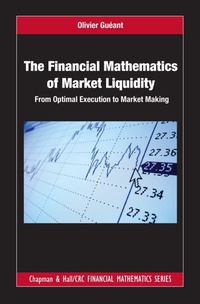
The Financial Mathematics of Market Liquidity
From Optimal Execution to Market Making
1. Auflage
Erschienen am 30. März 2016
302 Seiten
978-1-4987-2548-4 (ISBN)
Beschreibung

This book is among the first to present the mathematical models most commonly used to solve optimal execution problems and market making problems in finance. The Financial Mathematics of Market Liquidity: From Optimal Execution to Market Making presents a general modeling framework for optimal execution problems-inspired from the Almgren-Chriss app
Rezensionen / Stimmen
"This excellent monograph covers the mathematical theory of market microstructure with particular emphasis in models of optimal execution and market making. Gueant's book is a superb introduction to these topics for graduate students in mathematical finance or quants who want to work in execution algorithms or market-making strategies."-Jose A. Scheinkman, Charles and Lynn Zhang Professor of Economics, Columbia University, and Theodore Wells '29 Professor of Economics Emeritus, Princeton University
"This is a very timely book that cuts across various fields (applied mathematics, operations research, and quantitative finance). Execution costs due to market illiquidity can significantly reduce returns on investment strategies and, for this reason, affect asset prices. It is therefore important to design trading strategies minimizing these costs and to account for their effect on prices. In the last decade, 'quants' and researchers in quantitative finance have made considerable progress on these issues, integrating in their models changes in the way financial markets work (e.g., the development of continuous limit order books, market fragmentation, dark pools, the automation of trading, etc.).
"Olivier Gueant's book takes stock of this effort by providing a rigorous and expert presentation of mathematical tools, models, and numerical methods developed in this area. I strongly recommend it for researchers and graduate students interested in how illiquidity costs affect trading strategies and should be accounted for in asset valuation problems."
-Thierry Foucault, HEC Foundation Chair Professor of Finance, HEC, Paris
"This book is a must-have for quantitative analysts working at algorithmic trading desks. Olivier Gueant could have written a sophisticated book dedicated to cutting-edge research. He rather decided to put his talent at the service of a far more difficult task: deliver a clear view of modern algorithmic trading to strats or quants having decent scientific training. Scientists will find here all the needed keys to control the intraday risk of their trading models, improving their overall efficiency. Covering brokerage algorithms, market making, hedging, and share buyback techniques, this book is the definitive reference for algorithm builders.
Moreover, Olivier links algorithmic trading with market microstructure during the first chapter of the book, including interesting thoughts on corporate bonds trading. On the other hand, he provides a nice introduction to mathematical economics in the Appendix. This book is resolutely more than a bunch of equations thrown on blank pages. I consider it an important step forward in the building of the mathematics of market microstructure."
-Charles-Albert Lehalle, Senior Research Advisor, Capital Fund Management
Weitere Details
Reihe
Auflage
1. Auflage
Sprache
Englisch
Verlagsort
Philadelphia, PA
USA
Verlagsgruppe
Taylor & Francis Inc
Zielgruppe
Für höhere Schule und Studium
Für Beruf und Forschung
Illustrationen
31 s/w Abbildungen, 8 s/w Tabellen
31 b/w images and 8 tables
ISBN-13
978-1-4987-2548-4 (9781498725484)
Copyright in bibliographic data and cover images is held by Nielsen Book Services Limited or by the publishers or by their respective licensors: all rights reserved.
Schweitzer Klassifikation
Weitere Ausgaben
Andere Ausgaben
Buch
04/2016
1. Auflage
Chapman & Hall/CRC
141,00 €
Versand in 15-20 Tagen
Person
Olivier Gueant is Professor of Quantitative Finance at Ecole Nationale de la Statistique et de l'Administration Economique (ENSAE), where he teaches many aspects of financial mathematics-from classical asset pricing to advanced option pricing theory, to new topics about execution, market making, and high-frequency trading. Before joining ENSAE, Olivier was Associate Professor of Applied Mathematics at Universite Paris-Diderot, where he taught applied mathematics and financial mathematics to both undergraduate and graduate students. He joined Universite Paris-Diderot after finishing his PhD on mean field games, under the supervision of Pierre-Louis Lions.
He progressively moved to Quantitative Finance through the publication of research papers on optimal execution and market making. Olivier is also a renowned scientific and strategy consultant, who has taken on projects for many hedge funds, brokerage companies, and investment banks, including Credit Agricole, Kepler-Cheuvreux, BNP Paribas, and HSBC. His main current research interests include optimal execution, market making, and the use of big data methods in Finance.
He progressively moved to Quantitative Finance through the publication of research papers on optimal execution and market making. Olivier is also a renowned scientific and strategy consultant, who has taken on projects for many hedge funds, brokerage companies, and investment banks, including Credit Agricole, Kepler-Cheuvreux, BNP Paribas, and HSBC. His main current research interests include optimal execution, market making, and the use of big data methods in Finance.
Inhalt
Introduction. Optimal Liquidation. Liquidity in Pricing Models. Market Making.
