

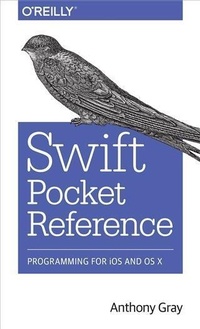
Swift Pocket Reference
1. Auflage
Erschienen am 11. Dezember 2014
186 Seiten
978-1-4919-1545-5 (ISBN)
Beschreibung
Get quick answers for developing and debugging applications with Swift, Apples multi-paradigm programming language. This pocket reference is the perfect on-the-job tool for learning Swifts modern language features, including type safety, generics, type inference, closures, tuples, automatic memory management, and support for Unicode.Designed to work with Cocoa and Cocoa Touch, Swift can be used in tandem with Objective-C, and either of these languages can call APIs implemented in the other. Swift is still evolving, but its clear that Apple sees it as the future language of choice for iOS and OS X software development.Topics include:Swifts Run-Eval-Print-Loop (REPL) and interactive playgroundsSupported data types, such as strings, arrays, and dictionariesVariables and constantsProgram flow: loops and conditional executionClasses, structures, enumerations, functions, and protocolsClosures: similar to blocks in Objective-C and lambdas in C#Optionals: values that can explicitly have no valueOperators, operator overloading, and custom operatorsAccess control: restricting access to types, methods, and propertiesBuilt-in global functions and their parameter requirements
Weitere Details
Weitere Ausgaben
Inhalt
- Intro
- Table of Contents
- Swift Pocket Reference
- Introduction
- Conventions Used in This Book
- Using Code Examples
- Safari® Books Online
- How to Contact Us
- Acknowledgments
- Getting Started with Swift
- The Swift REPL
- Swift as a Scripting Language
- Swift Playgrounds
- A Taste of Swift
- Basic Language Features
- Comments
- Semicolons
- Whitespace
- Importing Code from Other Modules
- Types
- Specific Integer Types
- Numeric Literals
- Character and String Literals
- Type Aliases
- Nested Types
- Other Types
- Variables and Constants
- Computed Variables
- Variable Observers
- Tuples
- Tuple Variables and Constants
- Extracting Tuple Components
- Naming Tuple Components
- Using Type Aliases with Tuples
- Tuples as Return Types
- Operators
- No Implicit Type Conversion
- Arithmetic Operators
- Bitwise Operators
- Assignment Operators
- Comparison Operators
- Logical Operators
- Overflow Operators
- Type Casting Operators
- Range Operators
- Ternary Conditional Operator
- Operator Precedence
- Strings and Characters
- String Properties
- Comparing Strings
- Escaped Characters in Strings
- String Interpolation
- Arrays
- Accessing Array Elements
- Array Properties
- Modifying a Mutable Array
- Iterating Over Arrays
- Array Algorithms
- Dictionaries
- Accessing Dictionary Elements
- Dictionary Properties
- Modifying a Mutable Dictionary
- Iterating Over Dictionaries
- Functions
- Parameter Types
- Returning Optional Values
- Returning Multiple Values by using Tuples
- Local and External Parameter Names
- Default Parameter Values
- Variadic Parameters
- Function Types
- Closures
- Automatic Argument Names
- Trailing Closures
- Capturing Values
- Capturing Values by Reference
- Optionals
- Unwrapping Optionals
- Implicitly Unwrapped Optionals
- Optional Binding
- Optional Chaining
- Program Flow
- Loops
- Conditional Execution
- Classes
- Defining a Base Class
- Instances
- Properties
- Methods
- Subscripts
- Member Protection
- Inheritance: Deriving One Class from Another
- Overriding Superclass Entities
- Preventing Overrides and Subclassing
- Initialization
- Initialization and Inheritance
- Deinitialization
- Structures
- Properties in Structures
- Methods in Structures
- Mutating Methods
- Type Methods for Structures
- Initializers in Structures
- Enumerations
- Raw Member Values
- Associated Values
- Methods in Enumerations
- Type Methods for Enumerations
- Access Control
- Specifying Access Control Levels
- Default Access Control Levels
- Extensions
- Computed Property Extensions
- Initializer Extensions
- Method Extensions
- Subscript Extensions
- Checking and Casting Types
- Any and AnyObject
- Checking Types
- Downcasting Types
- Protocols
- Required Properties
- Required Methods
- Optional Methods and Properties
- Adopting Protocols with Extensions
- Inheritance and Protocols
- Using a Protocol as a Type
- Checking Protocol Conformance
- Built-In Protocols
- Memory Management
- How Reference Counting Works
- Retain Cycles and Strong References
- Weak References
- Unowned References
- Retain Cycles and Closures
- Generics
- Generic Functions
- Generic Types
- Constraining Types
- Generic Protocols
- Operator Overloading
- Overloading Unary Operators
- Custom Operators
- Custom Operator Precedence
- Ranges, Intervals, and Strides
- Ranges
- Intervals
- Strides
- Global Functions
- Index
