

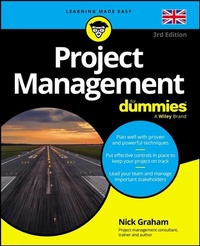
Project Management For Dummies - UK, 3rd UK Edition
3. Auflage
Erschienen am 25. Juli 2023
448 Seiten
978-1-394-20189-1 (ISBN)
Beschreibung

Stay on track and within budget with this accessible guide to project planning
Project Management For Dummies guides you to a thorough understanding of how to successfully manage projects--and the people who work on them--even if you're brand new to the project management field. You'll learn the basic concepts, key tips and tricks for making things go smoothly, and updated information relevant to today's UK business practices. Even if you aren't entering a project management role, you'll need to learn project planning skills to stay competitive in today's employment market. Now revised with fresh content on everything from a project's start to its finish, this friendly Dummies title will teach you to manage projects large and small.
* Learn the must-know concepts in project management
* Discover planning techniques that will enhance your effectiveness
* Manage projects with in-person or virtual teams
* Avoid common mistakes and know what to do when the unexpected happens
This guide is excellent for anyone in a project management role, students with an eye toward a career in project management, and anyone who needs to organize and complete large tasks.
Project Management For Dummies guides you to a thorough understanding of how to successfully manage projects--and the people who work on them--even if you're brand new to the project management field. You'll learn the basic concepts, key tips and tricks for making things go smoothly, and updated information relevant to today's UK business practices. Even if you aren't entering a project management role, you'll need to learn project planning skills to stay competitive in today's employment market. Now revised with fresh content on everything from a project's start to its finish, this friendly Dummies title will teach you to manage projects large and small.
* Learn the must-know concepts in project management
* Discover planning techniques that will enhance your effectiveness
* Manage projects with in-person or virtual teams
* Avoid common mistakes and know what to do when the unexpected happens
This guide is excellent for anyone in a project management role, students with an eye toward a career in project management, and anyone who needs to organize and complete large tasks.
Weitere Details
Weitere Ausgaben
Andere Ausgaben
Buch
10/2023
3. Auflage
Wiley
29,00 €
Versand in 15-20 Tagen
Vorauflage
E-Book
02/2015
2. Auflage
Wiley
17,99 €
Als Download verfügbar
Inhalt
- Intro
- Title Page
- Copyright Page
- Table of Contents
- Introduction
- About This Book
- Foolish Assumptions
- Icons Used in This Book
- Beyond the Book
- Where to Go from Here
- Part 1 Understanding Projects and What You Want to Achieve
- Chapter 1 Success in Project Management
- Taking on a Project
- Avoiding the Pitfalls
- Deciding Whether the Job is a Project
- Understanding the four control areas
- Recognising the diversity of projects
- Understanding the four stages of a project
- Defining the Project Manager's Role
- Looking at the Project Manager's tasks
- Opposing opposition
- Avoiding 'shortcuts'
- Deciding On Your Approach
- Chapter 2 Thinking Through the Life of Your Project
- Using a Set Approach
- Breaking the Project Down into Stages
- Appreciating the advantages of stages
- Deciding on the number of delivery stages
- Understanding the Four Main Stages
- Starting the project
- Understanding the characteristics
- Knowing what to do
- Thinking about management documents
- The planning stage - organising and preparing
- Understanding the characteristics
- Knowing what to do
- Thinking about management documents
- The delivery stages - carrying out the work
- Understanding the characteristics
- Knowing what to do
- Thinking about management documents
- The closure stage
- Understanding the characteristics
- Knowing what to do
- Chapter 3 Defining the Scope and Producing a Business Case
- Defining the Scope
- Managing expectations and avoiding disappointment
- Challenging the scope
- Understanding the dimensions of scope
- Being clear
- Considering the requirements
- Producing a Business Case
- Getting to grips with the basic contents
- Keeping the Business Case up to date
- Figuring out why you're doing the project
- Identifying the initiator
- Talking to end users
- Checking documents
- Recognising others who may benefit from your project
- Understanding project justification
- Understanding benefits
- Understanding 'Quantifiable - financial gain'
- Understanding 'Quantifiable - other measurable gain'
- Understanding 'Non-quantifiable'
- Being prudent with benefit projections
- Understanding benefits realisation
- Avoiding benefits contamination
- Writing the Business Case
- Complying with organisational standards
- Going Back to the Scope
- Challenging the existing scope
- Going the second mile
- Getting to Grips with Techniques
- Calculating return on investment
- Understanding cost-benefit analysis
- Allowing for inflation
- Using discount factors - net present value
- Chapter 4 Knowing Your Project's Stakeholders
- Managing Stakeholders
- Identifying stakeholders - the 'who'
- Developing a Stakeholder List
- Using specific categories
- Spotlighting senior management
- Keeping the Stakeholder List up to date
- Analysing the stakeholders - the 'where'
- Understanding positions - the 'why'
- Understanding a negative stance
- Understanding a positive stance
- Understanding the power base
- Deciding action - the 'what'
- Looking at the possibilities
- Involving others
- Working with stakeholders - the 'how'
- Planning the work - the 'when'
- Handling Opposition
- Solving the problems
- Focusing on the common areas
- Understanding that you're a threat
- Spotting facts and emotions
- Overriding the opposition
- Handling Multiple-Stakeholder Projects
- Getting multiple approvals
- Developing management strategies
- Part 2 Planning Time: Determining What, When and How Much
- Chapter 5 Planning with Deliverables First
- Seeing the Logic of Product Planning
- Thinking 'product' before thinking 'task'
- Understanding the problems of an activity focus
- Knowing What a Product Is - and Isn't
- Finding Good Product Names
- Using a Business Project Example
- Identifying the products
- Developing a sequence
- Checking the Work Flow - bottom up
- Seeing what's inside the project and what's outside
- Sticking to a limit of 30 products
- Using names, not numbers
- Defining the products
- Using a Structured Product List
- Unleashing the Power of the Work Flow Diagram
- Using the Work Flow Diagram for risk
- Using the Work Flow Diagram for control
- Using the Work Flow Diagram to show stages
- Using the Work Flow for progress reporting
- Getting a picture of the project
- Chapter 6 Planning the Activities
- Moving From Products to Activities
- Having multiple tasks to build a product
- Listing the activities or tasks
- Drawing Up a First Activity Network
- Seeing how you build up an Activity Network
- Using the Work Flow Diagram
- Putting in the time durations
- Understanding staff hours and elapsed time
- Estimating - the tricky bit
- Thinking a bit more about duration
- Calculating the length of the project
- Understanding Float and Its Impact
- Identifying the Critical Path
- Watching the critical path
- Finding a split critical path
- Being More Precise with Dependencies
- Understanding dependency types
- Finish to start
- The overlap, or lead
- The start to start
- The lag
- The finish to finish
- Staying in touch with reality
- Thinking a bit more about sequences
- Working with the Activity Network
- Working back to meet end dates
- Avoiding backing into your schedule
- Going for Gantt
- Estimating Activity Durations
- Getting the best information
- Using estimating techniques
- Delphi and Modified Delphi
- Three-point estimating
- The PERT formula
- Putting a health warning on estimates
- Chapter 7 Looking At Staff Resources
- Seeing Why You Need to Plan Staff Use
- Dealing with resource conflicts
- Making sure that people are available
- Monitoring use of staff on the project
- Matching People to Tasks
- Working out the skill sets and knowledge that you need on the teams
- Growing your people
- Developing skills
- Using the critical path
- Explaining yourself to experienced staff
- Identifying skills sets
- Honing Your Task Duration Estimates
- Documenting your estimates
- Factors in activity timing and estimates
- Estimating required work effort
- Factoring in productivity
- Defining 'full time'
- Making specific adjustments
- Thinking about the impact of multi-tasking
- Creating a good working environment
- Taking care with historical data
- Accounting for availability
- Smoothing the Resource
- Checking for resource conflict
- Resolving resource conflicts - the steps
- Co-ordinating assignments across multiple projects
- Chapter 8 Planning for Other Resources and Developing the Budget
- Determining Physical Resource Needs
- Identifying resource needs
- Considering availability
- Using your plans to help
- Building a Physical Resource Matrix
- Understanding physical resources
- Thinking a bit more about timing
- Preparing a Budget
- Looking at different types of project costs
- Understanding direct and indirect costs
- Understanding capital and revenue
- Understanding capex
- Seeing things from the financial manager's perspective
- Developing a project budget at three levels
- Creating a detailed budget estimate
- Dealing with the unknown
- Listing the different costs
- Including indirect costs - or not
- Showing the timing
- Being clear on sub-budgets
- Refining your budget through the stages
- Avoiding drowning people in detail
- Chapter 9 Planning at Different Times and Levels
- Putting the Main Structure in Place
- Deciding on the stages
- Holding a Stage Gate
- Working with Planning Levels
- Drawing up new plans
- Developing a Stage Plan
- Developing a Work Plan
- Planning for resource and budget
- Keeping higher level plans up to date
- Planning at more than one level at once
- Chapter 10 Dealing with Risk and Uncertainty
- Understanding Risks and Risk Management
- Seeing why you need risk management
- Managing, not necessarily avoiding, risk
- Keeping people informed
- Keeping risk in focus throughout the project
- Working Through the Risk Cycle
- Identifying a risk and its trigger event(s)
- Introducing some structure
- Looking around for help
- (Re)analyse the risk and check existing actions
- Gauging probability
- Estimating the impact
- Being specific
- Deciding on an impact scale
- Considering proximity
- Deciding risk management action(s)
- Handling all risks
- Thinking wide
- Deciding on actions
- Understanding action types
- Looking at options for time contingency
- Add/modify risk management in the plans
- Take planned action(s) and monitor the risk
- Taking action on risk
- Monitoring risks
- Documenting Risk
- Risk Plan
- Risk Log
- Getting Some Help from Techniques
- Ishikawa (fishbone) diagram
- Work Flow Diagram
- Risk Checklist
- Decision tree
- Chapter 11 Controlling Quality
- Understanding the Effects of Getting Quality Wrong
- Understanding the impact of poor quality
- Avoiding the cost of unnecessarily high quality
- Defining Quality
- Striking the Quality Balance
- Balancing quality against project effort (and more)
- Thinking through what quality level you need
- Identifying when quality levels are mandatory
- Spotting Quality Game-Playing and Working to Prevent It
- The quality level game and a guilty conscience
- When formality and auditing means . . . nothing
- Typical game players
- Achieving a Culture of Quality
- Communicating quality requirements and procedures
- Explaining the attitude to error
- Celebrating when errors are found
- Getting On Top of Quality in Your Project
- Drawing up an effective Quality Plan
- Building the foundation with good product definition
- Using powerful yet simple logs
- Quality Log
- Error Log
- Auditing quality effectively
- Delivering At the Right Level
- Specifying the right sort of testing
- Using the right people
- Reviewing Products
- Using informal review (peer level checking)
- Using formal review
- Rules for formal QR
- Outcomes of a QR
- Part 3 Putting Your Management Team Together
- Chapter 12 Organising the Project
- Designing the Project Organisation
- Understanding it's about roles, not jobs
- Getting to grips with project roles
- Looking at the roles
- Project Steering Group (PSG)
- Project Sponsor
- Project User(s)
- Project Supplier(s)
- Project audit
- Project Manager
- Team Leader
- Team members
- Project administration
- Influencing the selection of PSG roles
- Defining Organisational Structures
- The projectised structure
- The matrix structure
- Taking note of the structure
- Chapter 13 Working With Teams and Specialists
- Looking At the Team in Context
- Working with Team Leaders
- Accepting That People Are Different
- Using the Controller-Analyst Matrix
- Building in or avoiding team conflict
- Using the model on the fly
- Thinking About Suitable Team Members
- Considering Performance
- Identifying the performance progression
- Monitoring performance
- Maximising performance
- Working with Senior Staff
- Being secure in your role
- Calling in the heavy guns
- Working with Technical Specialists
- Finding a translator
- Admitting your ignorance
- Being on-side
- Working with Supplier Teams
- Supporting supplier staff
- Choosing suppliers carefully
- Thinking 'time', not just 'initial cost'
- Dealing With Discipline
- Maintaining some distance
- Owning the problem
- Avoiding jumping to conclusions
- Resolving problems - or trying to
- Treading the disciplinary trail
- Changing Staff
- Chapter 14 Being an Effective Leader
- Practising Management and Leadership
- Understanding what makes a good leader
- Thinking back to your own managers
- Leading in the hard times too
- Leading those who are older or more senior than you
- Developing personal authority
- Seeing why people will do as you ask
- Understanding the base of your authority
- Knowing What Motivates and What Demotivates
- Taking a lesson from Fred Herzberg
- Understanding points of demotivation
- Ensuring that others are on board
- Developing Your Teams
- Defining your project procedures
- Helping your teams to function well
- Stoking the Boilers
- Letting people know how they're doing
- Motivating people when they leave
- Keeping your finger on the pulse
- Part 4 Steering the Project to Success
- Chapter 15 Tracking Progress and Staying in Control
- Understanding What Underpins Effective Progress Control
- Having a reliable plan
- Having clear and frequent milestones
- Having an effective reporting mechanism
- Harnessing Product Power for Progress Control
- Compiling a Work Checklist
- Getting visual with the Work Flow Diagram
- Monitoring at project, stage and Work Package levels
- Taking Action When Things Go Off Track
- Finding out why the project is off track
- Thinking about what you can do to get back on track
- Deciding what you'll do
- Taking action
- Monitoring the effectiveness of the action
- Monitoring Work Effort and Costs
- Keeping an eye on work effort
- Analysing work effort expended
- Collecting work-effort data
- Asking for the Estimated Time to Complete
- Improving the accuracy of your work-effort data
- Choosing a system to support your work-effort tracking
- Follow the money: Monitoring expenditure
- Tracking spending against the plan
- Differentiating between overspending and early spending
- Choosing a system to support your expenditure tracking
- Dealing with Change and Avoiding Scope Creep
- Understanding different types of change
- Setting up change procedures
- Budgeting for change
- Looking at impacts - the four dogs
- Responding to change requests
- Eliminating scope creep - well, almost
- Handling Bad News
- Chapter 16 Keeping Everyone Informed
- Looking At Communications Failure
- Communications breakdown - the big project killer
- Identifying causes of communications problems
- Having unclear roles and responsibilities
- Being fuzzy on products
- Making assumptions
- Failing to feed back
- Communicating Effectively
- Distinguishing between one-way and two-way communication
- Can you hear me? Listening actively
- Choosing the Appropriate Medium
- Writing reports
- Preparing progress reports
- Using a dashboard format for progress reporting
- Meeting up
- Planning for a successful meeting
- Conducting an efficient meeting
- Following up with the last details
- Holding project meetings
- Setting up a project website
- Making a business presentation
- Planning the presentation
- Using visuals
- Rehearsing
- Dealing with questions
- Sticking to time, and going for the kill
- Preparing a Communications Plan
- Identifying the communications
- Identifying inbound communications
- Circulating information within the project
- Sending information out of the project
- Writing a Communications Plan
- Chapter 17 Closing Your Project
- Staying the Course to Completion
- Thinking ahead about project closure
- Looking at the options for closure
- Thinking about closure from the start
- Dealing with a crash stop
- Planning Closure
- Outlining closure activities
- Motivating teams to the finish line
- Providing a Good Transition for Team Members
- Reviewing the Project
- Beginning with the end in mind
- Recording project information
- Learning lessons and passing them on
- Measuring benefits
- Measuring benefits now
- Measuring benefits later
- Planning for Things After the Project
- Part 5 Taking Your Project Management to the Next Level
- Chapter 18 Outlining the Cyclical (Agile) Approach
- Understanding the Difference Between Linear and Cyclical Approaches
- Seeing Beyond the Hype
- Unravelling misnomers
- Separating fact from over-enthusiastic fiction
- Implementing a Cyclical Approach
- Understanding roles and functions
- Running development cycles
- 1: Building a list of features
- 2: Planning a cycle
- 3 and 4: Running a cycle and holding daily meetings
- 5 and 6: Delivering and reviewing
- Choosing The Right Approach for Your Project
- Basing your decision on the project's characteristics
- Seeing the gaps in cyclical approaches
- Getting it right, cyclical or not
- Chapter 19 Managing Multiple Projects
- Talking the Talk
- Defining a programme
- Defining a portfolio
- Deciding on a Programme
- Understanding programme roles
- Fitting in with Programme Plans
- Mapping interdependencies by product
- Controlling a programme
- Managing a Portfolio
- Understanding the project implications
- Maintaining the portfolio
- Chapter 20 Using Technology to Up Your Game
- Using Computer Software Effectively
- Seeing what software you need
- Understanding where to use software
- Office apps
- Project management software
- Communications management software
- Social media
- E-mailing
- Video conferencing
- Working collaboratively with software
- Setting up a website
- Having Your Head in the Cloud
- Getting Really Good Stuff for Free
- Supporting Virtual Teams with Communication Technology
- Saving Time with Software
- Being Artificially Intelligent
- Chapter 21 Monitoring Project Performance with Earned Value Management
- Understanding EVM Terms and Formulas
- Looking at a project example (1)
- Looking at a project example (2)
- Looking at a project example (3)
- Getting the three key figures
- Working with Ratios and Formulas
- Investigating Variances
- Deciding What to Measure for EVM
- Chapter 22 Project Governance and Why It's Really Important
- Seeing Why It's a No-brainer
- Looking At Other Guidance
- Understanding What's Involved
- Understanding the Organisational Level
- Standards and approaches
- Reviewing governance and standards
- Checking an Individual Project
- Checking the project's Outline Charter
- Checking the Charter and PMP
- Checking the project while it's running
- Evaluating the project at the end
- Maintaining the 'Big Divide'
- Coordinating Your Project Training
- Part 6 The Part of Tens
- Chapter 23 Ten Questions to Ask Yourself as You Plan Your Project
- What Are the Objectives of Your Project?
- Who Do You Need to Involve?
- What Will You Produce?
- What Constraints Must You Satisfy?
- What Assumptions Are You Making?
- What Work Has to Be Done?
- When Does Each Activity Start and End?
- Who Will Perform the Project Work?
- What Other Resources Do You Need?
- What Can Go Wrong?
- Chapter 24 Ten Tips for Writing a Convincing Business Case
- Starting with a Bang
- Spelling out the Benefits Clearly
- Pointing Out the Non-quantifiables
- Being Prudent
- Considering Three-point Estimating
- Making Sure Benefits Aren't Features
- Avoiding Benefits Contamination
- Making Sure You Can Deliver Benefits
- Supplying Evidence or Referencing It
- Using Appendices
- Chapter 25 Ten Tips for Being a Better Project Manager
- Being a 'Why' Person
- Being a 'Can Do' Person
- Thinking about the Big Picture
- Thinking in Detail
- Assuming Cautiously
- Viewing People as Allies Not Adversaries
- Saying What You Mean, and Meaning What You Say
- Respecting Other People
- Acknowledging Good Performance
- Being a Manager and a Leader
- Index
- About the Author
- EULA
