

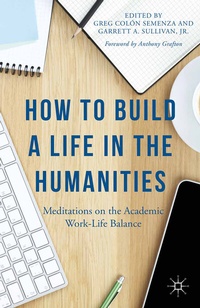
How to Build a Life in the Humanities
Beschreibung
Rezensionen / Stimmen
"One of the many good qualities of the essays in this book is that collectively they offer a panorama of humanists' lives. In them every major step in the humanist's career, from graduate school to retirement, comes in for imaginative, sympathetic, and precise description. Even if you are not a humanist especially if you are not a humanist let me urge you to read this book from end to end. Do it, and you will learn a great deal much of it the sort of thing that no polemic could teach you. This is a book I wish I could have read when I was much younger. Nothing like it existed then and nothing like it exists now." - Anthony Grafton, Henry Putnam University Professor of History, Princeton University, USA
"This collection of tart, lively essays puts the 'humanity' back into the humanities, and contributes to a robust ongoing conversation on life and lifestyle within the academy. How to Build a Life in the Humanities is an imaginative and valuable book." - Leonard Cassuto, Professor of English, Fordham University, USA and contributor to The Chronicle of Higher Education
"This valuable, deeply moving book punctures widely accepted ivory-tower notions of college and university teaching and shows that humanities professors face ongoing pressures - emotional, financial, familial, and social - that make juggling their personal and professional lives extremely complicated and yet, more often than not, unusually fulfilling. Semenza, Sullivan, and the other contributors to this wonderfully multifaceted volume put Life - with a capital 'L' - back into academe." - David S. Reynolds, Distinguished Professor, English & American Studies, CUNY Graduate Center, USA
"In an era when the humanities are widely considered dead in the water, and humanists the out-of-touch eggheads who haven't yet gotten the memo, this candid collection lets tenured (with a couple exceptions) humanities scholars describe the challenges, inspirations, and ambivalences that accompany their personal and professional lives. Humanizing the humanists, these essays open a window into the inner life of the humanities professor down the hall." - Karen Kelsky, author of The Professor Is In: The Essential Guide to Turning Your Ph.D. Into a Job
"Skip the blogs. Semenza and Sullivan have collected for us a collection of deeply engaged personal essays that explain what heretofore could seem an utter mystery: what is it like - and what could it be like - to have a life in the humanities? If you are looking to get in to the profession, are in the profession, or a bewildered family member or friend, these short pieces reveal a whole world to you, a world we all need to know better as higher education struggles to stay alive in recognizable form. I wish I could say a television mini-series on par with legal or medical drama is forthcoming; but until then this book is the next best thing." - Ken Jackson, Professor of English and Associate Dean, The Graduate School,Wayne State University, USA
"Everyone's happy to tell us all the things we need to do to gets jobs and tenure. But it took Semenza and Sullivan to compile the how-to book for the rest of our lives. The contributors to this thoughtful and remarkably upbeat collection offer advice and reflection, confession and philosophy, humor and gut-wrenching observation about life and work, but mostly life, for those of us who, despite it all, keep practicing the humanities." - Paula M. Krebs, Dean, College of Humanities and Social Sciences, Bridgewater State University, USA
