

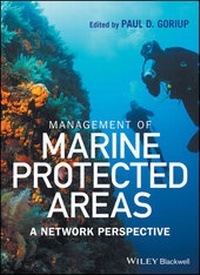
Management of Marine Protected Areas
Beschreibung

Weitere Details
Weitere Ausgaben
Andere Ausgaben
Person
Inhalt
Foreword
So much of our national and international effort to protect nature has been concentrated on terrestrial protected areas. Even the international agreements under the Convention on Biological Diversity (CBD) have accorded less prominence to protecting coastal and marine areas. Indeed, it was not until the agreement of the CBD's Aichi targets for 2020 in 2012 that marine protection began to gather real momentum with a target of 10% coverage compared with 17% for the terrestrial environment. This refocusing is a welcome recognition of the importance of looking after coastal and marine ecosystems in the longer term, especially in the light of the progressive degradation as a result of human activities at sea and on land and the relatively uncertain effects of global climate change. Now, there is a need to concentrate greater effort on strategic planning in the Mediterranean and Black Seas, including the establishment, protection and enforcement of Marine Protected Areas (MPAs) in these two naturally, culturally, economically and socially important seas. So this book is a timely reminder of what we know, what problems need to be addressed, what progress has been made, what can be learnt from other parts of the world, what actions are being taken and what more needs to be done using MPA mechanisms and processes to sustain life in and around the seas in the longer term.
It is obvious that the coastal and marine environment cannot be considered in isolation to what happens on land, especially the effects of infrastructure development on many parts of the coastline of the two seas to exploit the favourable weather conditions and shoreline situations and the delivery of water, nutrients and pollutants (and consequential eutrophication) into the seas from the surrounding rivers.
It is also obvious that looking after the marine environment of the two seas cannot just focus on nature and be a top-down process focusing on the protection of species and habitats. Both seas have a long history of human occupation and human passage in all directions and there are many internationally important cultural artefacts reflecting this long history. And there are many communities still dependent on the seas for the provision of natural resources for human survival, especially fish. The question of which comes first - nature or people - is an often-posed one in this book. The answer is both as they are really indivisible - hence the development of new approaches to looking after nature, including MPAs, which stress the importance of societal engagement throughout rather than the more traditional western approach of leaving it to the experts in nature. This does not mean that understanding and maintaining and, where necessary, restoring natural processes is not important: it is vital for the future of nature itself and for the survival of human societies.
The development of protection of the coastal and marine environment has to be seen from the perspective of nation states which have a stake. In all, 21 nations have coasts on the Mediterranean Sea, and whilst there are six on the Black Sea coast, another 10 nations make inputs through the rivers flowing into the sea.
With these points in mind, why do the Mediterranean and Black Seas require MPAs? The simple answer is that there are international and regional agreements requiring signatory states to protect the marine environment. More fundamentally, there remain many conflicts, for example, between fishermen and conservation to ensure that fish stocks are in a healthy biological state for the future, between tourism development and coastal pollution, between waste disposal through the river systems and the cleanliness of the marine environment, and between over-exploitation of key species and water pollution and their gradual loss and in some cases extinction. And, there is the potential inequality between those nations which exploit more resources and those which have a lesser environmental footprint. It is for these reasons that formal conventions have been long established for each of the seas: the Barcelona Convention for the Mediterranean and the Bucharest Convention for the Black Sea. Within these multilateral structures, many protocols for the protection of the seas have been developed, including systems of protected areas. Of particular note are the Specially Protected Areas of Mediterranean Importance and the Special Areas of Protection in the EU Member States. But protection is not just about designation of sites and areas, as there are too many so-called parks which exist only on paper. It is more fundamentally about the perpetual protection of nature and natural processes within the context of changing societal values, availability of new scientific information, and implementation of effective processes of engagement for all stakeholders. Only through these approaches can the effectiveness of protection be secured and be assured for the future.
Much good progress has been made, as the chapters in this book illustrate. Of particular note are the sanctuaries and no-take zones to allow fish stocks to recover from over-exploitation and for the spawning biomass to increase to a state of biological sustainability and therefore allow fishing to recommence. There are important 'spillovers' of young fish from these protected areas into the wider seas which indicate that fish stocks are recovering. Also of note are the interactive processes established between the nation states and also, for example, between the MPA managers under the MedPAN initiative. A great deal is known about how the seas operate naturally - the water flows and the current patterns at all levels in the water column - and therefore where there are more likely to be pollution sinks and lack of water interchange which create negative conditions for marine life. Within the territorial seas of the EU Member States the Marine Strategy Framework Directive, with its target of achieving Good Environmental Status in all EU Waters by 2020, is a testing and very welcome target to stimulate action.
But more needs to be done bearing in mind that only 0.012% of the Mediterranean Sea is fully protected with effective MPAs and only about 1.7% of the Black Sea has protected area status.
In the former, greater action over the whole sea and coastal area, rather than just within the EU Member States' jurisdiction, is needed; but this has to recognize the relatively weaker economies, especially in North Africa and the Middle East, and therefore the limited resources available to address these issues. The learning of lessons from the various EU initiatives, and the EU states continuing to help the non-EU states to do more through technical aid and financial support, would be a very worthwhile effort. Also, means of cooperation through informal networks, such as the IUCN Centre for Mediterranean Cooperation, are important for sharing knowledge and experience of what works and what is less successful.
The key issue, seen from an external perspective, is to ensure that all of the nation states around the two seas are fully committed to working together and within their own territorial seas to achieve protection and restoration of the natural environment for the benefit of their own citizens now and in the future. This requires political will which is not always forthcoming and is often placed well behind other pressing priorities. Maybe arguing for acting in the nation's own interests and at the same time acting in the interests of 'the commons of the seas' might have some effect. Certainly new laws and protocols take a long time to get agreement and implement, so softer approaches are worthwhile in the shorter term.
Taking the long view is key if the measures implemented are to be effective in safeguarding nature and natural processes and providing benefit to human communities. Inevitably, this may mean reductions in income in the short term, for example for fishermen while stocks are allowed to recover, or increases in the costs to developers to reduce environmental side effects. That surely is a price worth paying for the longer term interests of nature and society jointly.
The diversity of the seas, the challenges due to the varying depths and nature of the water columns, and the variation in the human impacts all suggest to me the need for tailor-made measures for protection within the general approaches laid down in the two conventions and in the EU Natura programme for EU Member States. There is no need, however, to reinvent the wheel as there is plenty of international experience, some of which is cited in the book, on which to base improvements in the protected mechanisms used. The work under the IUCN Marine Protected Areas Programme is a classic source for ideas and approaches and what works in different situations which would merit greater attention and use by practitioners in both seas. Adoption of protected area practices from the terrestrial sphere is, however, very unlikely to be helpful as they are less dynamic, and are rarely three dimensional - with the exception of the learning from best practice examples globally of connecting individual protected areas into networks especially in recognition that nature does not recognize site boundaries imposed upon it for administrative convenience. Clear management objectives and means of measuring effectiveness of implementation and feeding back into reviews of management are critically important; the IUCN Management Effectiveness Evaluation approach is well tried and tested around the world for this purpose.
Engagement of key stakeholders throughout the process of development,...
