

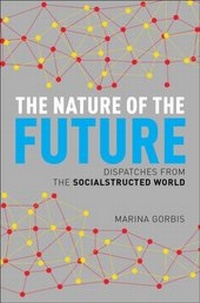
The Nature of the Future
Dispatches from the Socialstructed World
1. Auflage
Erschienen am 9. April 2013
256 Seiten
978-1-4516-4120-2 (ISBN)
Beschreibung
A renowned futurist offers a vision of a reinvented world.
Large corporations, big governments, and other centralized organizations have long determined and dominated the way we work, access healthcare, get an education, feed ourselves, and generally go about our lives. The economist Ronald Coase, in his famous 1937 paper ?The Nature of the Firm,? provided an economic explanation for this: Organizations lowered transaction costs, making the provision of goods and services cheap, efficient, and reliable. Today, this organizational advantage is rapidly disappearing. The Internet is lowering transaction costs?costs of connection, coordination, and trade?and pointing to a future that increasingly favors distributed sources and social solutions to some of our most immediate needs and our most intractable problems.
As Silicon Valley thought-leader Marina Gorbis, head of the Institute for the Future, portrays, a thriving new relationship-driven or socialstructed economy is emerging in which individuals are harnessing the powers of new technologies to join together and provide an array of products and services. Examples of this changing economy range from BioCurious, a members-run and free-to-use bio lab, to the peer-to-peer lending platform Lending Club, to the remarkable Khan Academy, a free online-teaching service. These engaged and innovative pioneers are filling gaps and doing the seemingly impossible by reinventing business, education, medicine, banking, government, and even scientific research. Based on extensive research into current trends, she travels to a socialstructed future and depicts an exciting vision of tomorrow.
Large corporations, big governments, and other centralized organizations have long determined and dominated the way we work, access healthcare, get an education, feed ourselves, and generally go about our lives. The economist Ronald Coase, in his famous 1937 paper ?The Nature of the Firm,? provided an economic explanation for this: Organizations lowered transaction costs, making the provision of goods and services cheap, efficient, and reliable. Today, this organizational advantage is rapidly disappearing. The Internet is lowering transaction costs?costs of connection, coordination, and trade?and pointing to a future that increasingly favors distributed sources and social solutions to some of our most immediate needs and our most intractable problems.
As Silicon Valley thought-leader Marina Gorbis, head of the Institute for the Future, portrays, a thriving new relationship-driven or socialstructed economy is emerging in which individuals are harnessing the powers of new technologies to join together and provide an array of products and services. Examples of this changing economy range from BioCurious, a members-run and free-to-use bio lab, to the peer-to-peer lending platform Lending Club, to the remarkable Khan Academy, a free online-teaching service. These engaged and innovative pioneers are filling gaps and doing the seemingly impossible by reinventing business, education, medicine, banking, government, and even scientific research. Based on extensive research into current trends, she travels to a socialstructed future and depicts an exciting vision of tomorrow.
Weitere Details
Weitere Ausgaben
Person
Marina Gorbis is Executive Director of Institute for the Future, a nonprofit research and consulting organization based in Silicon Valley. She has consulted to hundreds of organizations in business, education, government, and philanthropy. She has been a repeated guest blogger on BoingBoing.net and is a frequent speaker on future organizational, technology, and social issues. She holds a masters degree from the Graduate School of Public Policy at UC Berkeley.
Inhalt
- Intro
- Dedication
- Chapter 1: Putting the Social Back into Our Economy
- Chapter 2: Social Technologies, Social Economy
- Chapter 3: What about Money?
- Chapter 4: The Whole World's a Classroom
- Chapter 5: Governance Beyond Government
- Chapter 6: Everyone's a Scientist
- Chapter 7: The Era of the Amplified Patient
- Chapter 8: The Socialstructed Future: A World of Unthinkable Possibilities
- Chapter 9: Navigating the Transition
- Acknowledgments
- About the Author
- Notes
- Illustration Credits
- Index
- Copyright
