

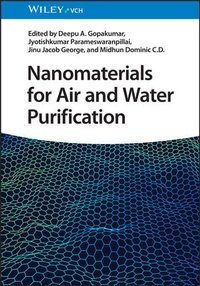
Nanomaterials for Air and Water Purification
Beschreibung

Weitere Details
Weitere Ausgaben
Andere Ausgaben
Personen
Dr. Jyotishkumar Parameswaranpillai is a prolific editor and researcher who has edited 30 books, published 120 high quality international research articles, and 40 book chapters. He is a frequent invited speaker and a consultant for multiple organizations internationally. He has received numerous prestigious awards including the prestigious DSTs INSPIRE Faculty Award (2011) (Government of India), Kerala State Young Scientist Award (2016) (Government of Kerala), and the best faculty award (2019) from King Mongkut's University of Technology North Bangkok, Thailand.
Dr. Jinu Jacob George received his PhD degree from the Indian Institute of Technology Kharagpur, India in 2009. He completed his B.Tech. from M G University, Kottayam and M.Tech. from Cochin University of Science and Technology, Kochi, India. After pursuing PhD, he moved to Leibniz Institute for Polymer Research (IPF), Dresden, Germany for his Post-Doctoral Research. In 2011 he joined the Rubber Research Institute of India, Kottayam, as a Scientist. In 2015 he joined the Department of Polymer Science and Rubber Technology, CUSAT as a faculty member. At present, he is actively involved in research in the various advance fields of Polymer Science and Rubber Technology and has co-authored more than 25 peer reviewed journal articles. He has a general research interest in the fields of Polymer micro/nano composites, Thermoplastic elastomers, Functional additives, and Shape memory polymers.
Dr. Midhun Dominic C.D completed his Ph.D. from the Department of Applied Chemistry, Cochin University of Science and Technology (CUSAT), Kochi. He is currently working as Asst. Professor in the Department of Chemistry, Sacred Heart College, Thevara Kochi since 2012. His research interest includes synthesis and characterization of nanomaterials, biopolymers, green tyres, biomass valorization, etc. He has published many papers in international journals. He is the reviewer of 30 journals including RSC Advances, Polymer Testing, and ACS Applied Materials and Interfaces. He is the recipient of the FLAIR award in 2019 by the Directorate of Collegiate Education, Govt. of Kerala. He has supervised by PhD students.
Inhalt
2. Nanomaterials :prospects for water purification and relevance of biosensing in drinking water
3. Nanomaterials for air and water purification
4. Green nanotechnology for water purification
5. Electrospun nanofibers membranes for effective air filtration
6. Nanocatalyts and Redox nanoparticles for water purification
7. Nanomaterials and water purification: opportunities for improving and protecting water
8. Use of sol-gel technology the production of nanomaterials for air and water purification
9. Graphitic carbon nitride based sustainable photocatalysts for purification of antibiotic containing wastewater
10. Microbial bioremediation as a robust process to mitigate high priority
11. Noble metal nanoparticles for water purification
12. Membrane assisted water and air purification
13. Novel carbon based nanoarchitectures for air purification
14. Bio-active nanoparticles for water purification
15. Metal/metal oxide nanoparticles modified polymeric composite membranes for water treatment
1
New-Age Nano Adsorbents for Water Purification
Subhadeep Biswas, Abhishek Johri, and Anjali Pal
Civil Engineering Department, Indian Institute of Technology Kharagpur, Kharagpur 721302, West Bengal, India
1.1 Introduction
Rapid urbanization and huge industrialization often lead to the contamination of different water bodies. Irresponsible discharge of dyes, heavy metals, and emerging contaminants into the water often causes enormous pollution. A huge and uncontrolled release of unwanted materials into the water bodies deteriorates the water quality and poses a potential threat to aquatic life. The presence of colored substances, even in a trace quantity, in water is objectionable from an aesthetic point of view. Apart from that, many dye molecules show carcinogenicity and adverse toxic effects. In addition to this, illegal disposal of heavy metal ions present in industrial effluents has worsened the situation. In recent times, many harmful compounds, such as surfactants, phenol derivatives, and pharmaceutical waste, have also been detected in surface and subsurface water. These compounds are termed as emerging pollutants.
Considering all these facts, it is obvious that water purification is one of the most urgent needs to maintain the overall ecological balance. Innovative research activities are continuously carried out all over the globe on various wastewater treatment processes like adsorption, advanced oxidation process, electrocoagulation, electrooxidation, and membrane separation. Adsorption is one of the simplest and most efficient water and wastewater treatment techniques. However, the development of environmentally congenial adsorbents with excellent removal capacity and reusability is still a challenge. For a long time, activated carbon materials have been widely used for adsorption purposes. However, regeneration incapability and high cost associated with activated carbon materials are some of the major drawbacks in their use. Pristine materials like alumina, silica, and bentonite have also been explored in the recent past for adsorption purpose. Ma et al. [1] utilized bentonite-based adsorbents for removal of anionic pollutants from water bodies. Zhu et al. [2] in their recent review article highlighted the superiority of montmorillonite-based adsorbents for pollutant removal purposes. In this regard, surface modifications, like acid modification, alkali modification, and surfactant modification, were also tried out for increasing adsorption capacity of different materials. Surfactant-modified alumina and silica have been found to be successful in removal of phenol [3], dyes [4, 5], and heavy metals [6].
In this field, nanomaterials have opened a new dimension for water treatment purpose. Nanoparticles are materials whose dimensions are less than 100 nm. In recent times, there has been a huge interest in the application of nanomaterials as adsorbents due to their excellent surface properties. Recently discovered materials like graphene and MXene have enhanced the scope of nanomaterials by forming compatible composites with them. Neha et al. [7] in their recent review article described the potential of different nanoadsorbents for the eradication of several toxic pharmaceutical compounds from water bodies. Kyzas and Matis documented in their review article the potential of various types of nanoadsorbents for wastewater treatment [8]. They highlighted the fact that the nanoadsorbents show unique physical and chemical characteristics, and the atoms that have high adsorption capacity lie on the surface of the nanomaterials. The current chapter describes the potential of different categories of nanoadsorbents such as metal-organic framework (MOF)-based nanoadsorbents, MXene-based nanoadsorbent, ZVI-based nanoadsorbent, and biochar-based nanoadsorbents for water purification purposes. Different mechanisms for pollutant removal by these nanoadsorbents have been elaborated. The next section deals with the characterization techniques commonly practiced in order to get insight into the adsorption process. Lastly, current challenges are often faced in this domain and the scope for further research has been presented before conclusion.
1.2 Different New-Age Nanoadsorbents
1.2.1 Metal-Organic Framework (MOF)-Based Nanoadsorbents
MOF-based compounds can be described as three-dimensional organic-inorganic complexes having porous structures, high specific surface area, and abundant sites exposed for adsorption [9]. In recent years, MOF-based nanocomposites have been explored by engineers and scientists worldwide for adsorption of different types of pollutants. A novel surfactant-functionalized MOF@MOF nanoadsorbent was reported by Li et al. [10] for Cr(VI) removal purposes. Thus, synthesized nanocomposite showed promising adsorption capacity and also reusability due to the presence of tunable pores along with abundant active sites on the surface. It showed good performance throughout a large pH range of 1-11, and the highest removal occurred at pH 2, with the maximum adsorption capacity being 932.1 mg g-1. He et al. [11] carried out thermal decomposition of Ce-MOF micro and nanocomposites under N2 atmosphere at a relatively lower temperature (400-500 °C). The composites thus produced after thermal treatment showed high phosphate removal efficiency. In comparison to ceria, the removal capacity was 2-4 times higher, and the maximum uptake was obtained at 189.4 mg g-1. Yan et al. [12] reported the preparation and application of various polyoxometalates-MOF nanocomposite for the removal of cationic dye methylene blue (MB). The removal occurred at 98% within five minutes for an initial MB concentration of 100 mg l-1, and the maximum adsorption capacity obtained was 371 mg g-1.
Soltani et al. [13] synthesized layered double hydroxide (LDH)-MOF nanocomposite without involvement of any toxic solvent and utilized the same for the remediation of heavy metals such as Cd(II) and Pb(II) from water. The LDH/MOF nanocomposite thus prepared showed promising performance toward heavy metal remediation, and the experimental data fitted well with the Langmuir isotherm model and pseudo-first-order kinetic model. The calculated maximum adsorption capacity of the nanocomposite was found to be 415.3 and 301.4 mg g-1 toward the removal of Cd(II) and Pb(II), respectively. Yuan et al. [14] in their recent work designed a UiO-66-F-based nanocomposite for trapping carbamazepine from aqueous media. Experimental data fit well with the Langmuir isotherm model and pseudo-second-order kinetic model.
Nguyen et al. [15] reported the feasibility of application of zirconium-organic framework-based nanocomposites for the efficient adsorption of model cationic and anionic dyes MB and methyl orange (MO). The MOF-based nanoadsorbent showed excellent reusability for up to five cycles without any significant loss in uptake capacity.
Zr-based MOF nanocomposites have been explored by different research groups for wastewater treatment purpose. Huang et al. [16] used magnetic Zr-based nanocomposite Fe3O4@SiO2@UiO-66 and its amino derivatives for the abatement of heavy metal ions and dyes from water bodies. It showed a high removal capacity for Pb2+ (102 mg g-1), MB (128 mg g-1), and MO (219 mg g-1). The nanoadsorbent has been reported to possess excellent selectivity toward anionic and cationic dyes by adjusting the solution pH. Moreover, it can completely remove both MO and MB at a neutral pH (~7). With respect to regeneration, it can be reused six times without losing efficiency. Some other MOF-based nanoadsorbents include Zr-cluster-based MOF for tetracycline removal [17], cobalt-MOF with morpholine for dye removal [18], and LDH/MOF nanocomposite for Orange II and Cr(VI) removal [19].
1.2.2 Graphene, Graphene Oxide (GO), and Reduced Graphene Oxide (rGO)-Based Nanoadsorbents
Carbon-based materials are often explored for adsorption purpose. In this regard, graphene is the latest member of the family of carbon allotropes. It is nearly one atom thick, has an excessively large surface-to- volume ratio, and is considered to be one of the most attractive new-age adsorbents. Besides graphene, graphene oxide (GO), reduced graphene oxide (rGO), and their composites also emerged as viable options of adsorbents. In one of the recent review articles, Kim et al. [20] investigated the potential of graphene-based nanocomposites for wastewater remediation. Possessing variable structure, chemical strength, and being light in density, the graphene family offers a numerous variety of nanocomposite materials for adsorption purpose. Shoushtarian et al. [21] explored the GO-based nanoadsorbent for efficient removal of Basic Red 46, a cationic dye. Under the optimized condition, the maximum removal capacity reached up to 360 mg g-1. The prepared GO was reused for four more cycles. However, the adsorption efficiency dropped with consecutive cycles. During four cycles of regeneration, the adsorption capacity dropped from 360 to 209 mg g-1. Calimli et al. [22] reported the...
