

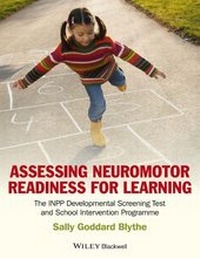
Assessing Neuromotor Readiness for Learning
Beschreibung

Rezensionen / Stimmen
"Assessing Neuromotor Readiness for Learning is not so muchbedtime reading for the lay person, as it is a beautifully producedscreening and intervention manual for practitioners andprofessionals working with young children - a substantiallyrevised and expanded edition of the long-established and rigorouslyevaluated INPP training manual." Mother Magazine 2012This book clearly identifies the importance of movement as acornerstone for learning. In particular, it highlights howtraces of early reflexes, which are usually subsumed into morecomplex and voluntary movement, can impact a child's abilityto carry out activities which crucially support a child'sability to read, write, focus and pay attention. The tests and exercises are not a diagnostic tool, but withtraining are to be used as a screening device to help teachersunderstand further the difficulties of some children in theirschool, and to re-evaluate their needs and provide an effectiveintervention programme. The programme identified in the bookshould, in my view, be part of all teacher training. --Maria Robinson, Independent Adviser inEarly Years Development Sally Goddard-Blythe has worked for many years to help youngchildren respond to the demanding tasks of school: speaking andunderstanding speech, reading and writing, and the logic of usingtools. All depend on moving with balance and versatility, and withclear sight and hearing. In this rich manual for screening anddevelopment of motor awareness, teachers and other professionalsworking with children aged 4 to 7 and upward, are offered the fruitof Sally Goddard Blythe's four decades of research andpractice. Assessing Neuromotor Readiness for Learning willhelp to give every child confidence and pleasure in moving tolearn. --Colwyn Trevarthen, Professor Emeritus ofChild Psychology and Psychobiology, University of EdinburghWeitere Details
Weitere Ausgaben
Andere Ausgaben
Person
Inhalt
1 Introduction 1
1.1 Overview 1
1.2 Rationale for Screening and Remediation of Neuromotor Immaturity 2
1.3 What is INPP? 2
1.4 The INPP Developmental Movement Programme for Schools 3
1.5 What is Neuromotor Immaturity? 4
1.6 What is the Significance of Primitive Reflexes to Education? 4
1.7 What are Primitive Reflexes? 5
1.8 What is the Significance of Neuromotor Maturity to Education? 5
1.9 What is the Purpose of Developmental Screening Tests? 7
1.10 Why Assess Posture and Balance? 7
1.11 Why Carry Out Assessments for Balance? 8
1.12 What is the Difference Between Static Balance and Dynamic Balance? 8
1.13 What is the Significance of Postural Control to Learning? 9
1.14 Primitive Reflexes: Why Have These Three Reflexes Been Selected for Evaluation? 9
1.14.1 The Asymmetrical Tonic Neck Reflex (ATNR) 9
1.14.2 The Symmetrical Tonic Neck Reflex (STNR) 10
1.14.3 The Tonic Labyrinthine Reflex (TLR) 12
1.15 What Evidence is There Linking Balance, Posture and Reflexes to Educational Achievement? 12
1.16 What Evidence is There That Intervention in the Form of Movement Programmes Aimed at the Level of Primitive Reflexes Improves Educational Outcomes? 15
1.17 How to Use The Screening Tests 16
References 16
2 Developmental Screening Tests for Use with Children Aged 4-7 Years 20
2.1 General instructions 20
2.1.1 Scoring 20
2.1.2 Tests 21
2.2 Neuromotor tests 21
2.2.1 The Romberg Test 21
2.2.2 One Leg Stand 23
2.2.3 The Crawling on Hands and Knees Test 24
2.2.4 Crossing the Midline, Test No. 1 25
2.2.5 Crossing the Midline, Test No. 2 26
2.2.6 Finger and Thumb Opposition Test 27
2.3 Tests for Primitive Reflexes 29
2.3.1 Asymmetrical Tonic Neck Reflex (ATNR) 29
2.3.2 The Symmetrical Tonic Neck Reflex (STNR) 31
2.3.3 Tonic Labyrinthine Reflex (TLR) - Erect Test 32
2.4 Tests for Visual Perception and Visual-Motor Integration 34
2.4.1 Pencil and Paper Tasks 35
2.4.2 Additional Measures 37
2.5 Score Sheets for 4-7 Year Old Test 39
2.6 Observation Sheets 40
2.7 Interpreting the Scores 41
2.7.1 Tests for Gross Muscle Coordination, Balance and Reflexes 41
2.7.2 Tests for Visual Perception and Visual-Motor Integration 41
References 41
3 Developmental Screening Tests for Use with Children from 7 Years of Age 43
3.1 General Instructions 43
3.1.1 Scoring 43
3.1.2 The Tests 44
3.2 Tests for Gross Muscle Coordination and Balance 44
3.2.1 Tandem Walk 44
3.2.2 Walking on the Outsides of the Feet (Fog Test) 46
3.3 Tests for Aberrant Primitive Reflexes 47
3.3.1 The Asymmetrical Tonic Neck Reflex (ATNR) 47
3.3.2 Symmetrical Tonic Neck Reflex (STNR) 51
3.3.3 The Tonic Labyrinthine Reflex (TLR) 52
3.4 Tests for Oculomotor Functioning 53
3.4.1 Test for Fixation, Convergence and Control of Saccades (Valett) 54
3.4.2 Test for Visual Integration 54
3.5 Tests for Visual-Speech Recognition 55
3.5.1 Sound Discrimination (Individual Sounds, Sound Blends and Syllables) 55
3.5.2 Sound Synthesis 55
3.6 Tests for Visual Perception and Visual-Motor Integration 56
3.6.1 Visual Perception 57
3.6.2 Visual-Motor Integration (VMI) 57
3.6.3 Spatial Difficulties 59
3.6.4 The Tansley Standard Visual Figures Test 59
3.6.5 Figures Based on The Bender Visual Motor Gestalt Test 59
3.6.6 Scoring the Visual-Perceptual Tests 61
3.6.7 Additional Measures 65
3.7 Score Sheets (7þ Test) 66
3.8 Observation Sheets (7þ Test) 67
3.9 How to Interpret The Scores 68
3.9.1 Tests for Gross Muscle Coordination, Balance and Reflexes 68
3.9.2 Tests for Visual Perception and Visual-Motor Integration 68
3.9.3 Tests for Auditory-Speech Recognition 68
References 69
4 The INPP Developmental Movement Programme 70
4.1 How to use the INPP Developmental Movement Programme 70
4.1.1 Developmental Movements 71
4.1.2 Why Use a Movement Programme to Improve Educational Performance? 71
4.1.3 Instructions for Use of the Exercises 72
4.1.4 Guidelines for Schedule for Exercises 72
4.2 The Developmental Movement Programme 73
4.2.1 Introduction 73
4.2.2 Windmills 73
4.2.3 Caterpillar 74
4.2.4 The Curious Caterpillar 75
4.2.5 The Sea Anemone 75
4.2.6 The Octopus (Part 1) 76
4.2.7 The Agitated Caterpillar 76
4.2.8 The Parachute 77
4.2.9 The Octopus (Part 2) 77
4.2.10 The Head Lift 79
4.2.11 The Fish 79
4.2.12 The Lizard 80
4.2.13 Hand to Foot 80
4.2.14 Hand to Knee 81
4.2.15 The Hinge 81
4.2.16 The Bracket 82
4.2.17 Lower Body Rotation 82
4.2.18 Upper Body Rotation 83
4.2.19 The Tadpole Who Turns into a Frog 84
4.2.20 The Drunken Frog 85
4.2.21 The Alligator 85
4.2.22 The Commando Crawl 86
4.2.23 The Cat 86
4.2.24 Three-Point Crawling on Hands and Knees 88
4.2.25 Cross-Pattern Crawling on Hands and Knees 89
4.3 Additional Optional Exercises for Integration of Left and Right 89
4.3.1 Differentiated Angels in the Snow 90
4.3.2 Finger Exercises 92
4.4 Post Script 93
References 93
Resources 95
Chapter 2
Developmental Screening Tests for Use with Children Aged 4-7 Years
2.1 General instructions
All tests have been adapted to comply with regulations (in the United Kingdom) that teachers should if possible avoid physical contact with children in their care.
Testing should be carried out with the child wearing loose clothing and in bare feet.
To ensure that the child has understood verbal instructions correctly, the tester should also demonstrate the beginning of each test procedure.
Additional notes of observations made during tests should be recorded on the separate observation sheets provided and attached to the score sheet.
Please note that certain tests are only developmentally appropriate from five or six years of age. Omit tests where it states that the developmental norm for the test is older than the age of the child being assessed, unless it states that the test may be used for qualitative purposes at a younger age.
Qualitative observations enable the tester to observe the quality of performance. This can be re-assessed at a later date or following intervention to observe whether there has been significant change in the quality of performance over time.
Video examples of all test positions, observations and scoring may be found at www.accessnmr.inpp.org.uk. Registration on the site will enable paid access to all material.
2.1.1 Scoring
All tests are scored using a 5-point rating scale:
0. no abnormality detected (NAD)
1. 25% dysfunction
2. 50% dysfunction
3. 75% dysfunction
4. 100% dysfunction
2.1.2 Tests
Neuromotor tests
1. The Romberg Test
2. One leg stand
3. Creeping on hands and knees
4. Crossing the midline (1)
5. Crossing the midline (2)
6. Finger and thumb opposition test
Tests for primitive reflexes
7. Quadruped test for the Asymmetrical Tonic Neck Reflex (ATNR)
8. Quadruped test for the Symmetrical Tonic Neck Reflex (STNR)
9. Erect test for the Tonic Labyrinthine Reflex (TLR)
Tests for visual perception and visual-motor integration
10. Paper and pencil tests
11. Additional measures
2.2 Neuromotor tests
2.2.1 The Romberg Test
A test developed by German physician Moritz H. Romberg (1795-1873) to assess proprioception and control of static balance. It provides an indication of loss of the sense of position if the patient loses balance when standing erect, feet together, and eyes closed. By the age of four years a child is expected to be able to perform the Romberg Test without loss of balance for eight seconds with the eyes open and closed.
While a 'positive' Romberg sign is generally considered to be loss of balance on this test, qualitative assessment of a child's stability when standing in this position can also be useful in providing indications of immature balance and/or proprioception.
The ability to perform the Romberg Test has been considered an important milestone in postural maturation, and links with another developmental marker, the suppression of synkinetic* movements in the hands and fingers of the contralateral hand when the child is asked to carry out the thumb and finger opposition test.(1)
2.2.1.1 Test Procedure - Romberg Test
Test position - standing.
Standing up straight, feet together, arms and hands to the side, looking straight ahead (Figure 2.1).
Eyes open
Figure 2.1 Test position for the Romberg Test
The child is instructed to continue looking straight ahead without moving. This position should be maintained for approximately eight seconds.
Eyes closed
He or she is then asked to maintain the position, but to close the eyes and 'imagine' - pretend - that he/she is looking straight ahead. Hold that position for approximately eight seconds.
2.2.1.2 Observations
Eyes open
- Does the child sway?
- If so, in which direction - backwards, forwards, to the left or right side, or in a circular movement?
- How much does he/she sway?
- Do one or both arms move out and away from the body?
- Does the child's face become contorted or is there 'tongue thrust'?
- Does the child lose his/her balance?
Eyes closed
Note all of the above, paying particular attention to the degree of difficulty outlined above.
2.2.1.3 Scoring for Eyes Open and Eyes Closed
0. None of the observations are noted.
1. Slight sway in any direction: slight movement of the arms away from the body, slight face or tongue involvement.
2. More marked sway: more marked movement of the arms away from the body, and a more marked facial or tongue involvement.
3. Near loss of balance: need to extend the arms to maintain balance.
4. Body involvement led to loss of balance: facial grimaces.
(Please note that a positive score is referred to as a positive Romberg sign. A score of 0 is referred to as a negative Romberg sign).
2.2.2 One Leg Stand
The one leg stand test assesses control of static balance and the ability to control balance using one side of the body independently of the other.
In addition to maintaining control of balance while standing on one leg, Schrager(2) demonstrated that observations of both timing and body position while carrying out the one leg stand can provide additional information about maturity of the central nervous system. He found significant differences in the performance of language impaired individuals compared with a group with normal language ability on this test, surmising that the ability to control balance when standing on one leg and language ability may be linked.(3)
2.2.2.1 Test Procedure - One Leg Stand
Test position - standing.
Instruct the child to stand on one leg and to, 'maintain this position as long as you can'. Time (in seconds) the length of time the child can maintain the position without loss of balance or placing the other foot on the ground. This test is performed with eyes open (Figure 2.2).
Figure 2.2 Test position for the one leg stand test
2.2.2.2 Developmental Norms(4)
Developmental norms for this test vary between different sources. Some sources state 15 seconds at six years of age and 20 seconds at seven years of age. Others list the scale shown below.
3 years 2 seconds 4 years 4-8 seconds 5 years 8 seconds using either foot 6 years 20 seconds left or right (8 years 30 seconds right or left)2.2.2.3 Observations
Inability to stand on one leg for the age appropriate number of seconds may suggest underlying vestibular/postural immaturity, in presenting difficulties and/or difficulty in controlling one side of the body independently from the other.
Also note any marked compensatory or 'overflow' movements of the arms, opposite leg, mouth or hands when carrying out this test.
2.2.2.4 Scoring
0. No abnormality detected.
1. 2 seconds less than normal time in seconds for age of child.
2. 4 seconds less than normal time in seconds for age of child.
3. 6 seconds less than normal time for age of child.
4. 8 seconds or more less than normal time for age of child.
2.2.3 The Crawling on Hands and Knees Test
There are four stages a child might pass through in learning to crawl on hands and knees in the first year of life:
1. Homologous - using upper and lower body only; no left/right involvement.
2. Homolateral - reaching with the arm and pushing with the leg on the same side.
3. Unsynchronized cross pattern - using the opposite arm and leg but with no synchrony in the timing of movements in the upper and lower sections of the body.
4. Synchronized cross pattern - opposite arm and leg with movements of the upper and lower body synchronized.
2.2.3.1 Test Procedure - Crawling on Hands and Knees
Test position - hands and knees, as in Figure 2.3.
Figure 2.3 Test position for crawling on hands and knees test (quadruped 'table'position).
Ask the child to lift his/her head up and look at a sighting object at eye level, followed by the instruction:
'I would like you to slowly creep (crawl) forwards on your hands and knees, whilst looking straight ahead all the time, until you reach me. Then turn around and slowly creep back to where you started.'
2.2.3.2 Observations
- Does the child go forward using small 'bunny-rabbit' jumps (homologous)?
- Does the child creep forward...
