

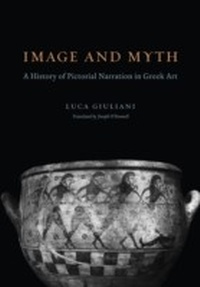
Image and Myth
A History of Pictorial Narration in Greek Art
1. Auflage
Erschienen am 31. Mai 2024
630 Seiten
978-0-226-02590-2 (ISBN)
Beschreibung

On museum visits, we pass by beautiful, well-preserved vases from ancient Greece-but how often do we understand what the images on them depict? In
Image and Myth, Luca Giuliani tells the stories behind the pictures, exploring how artists of antiquity had to determine which motifs or historical and mythic events to use to tell an underlying story while also keeping in mind the tastes and expectations of paying clients.
Covering the range of Greek style and its growth between the early Archaic and Hellenistic periods, Giuliani describes the intellectual, social, and artistic contexts in which the images were created. He reveals that developments in Greek vase painting were driven as much by the times as they were by tradition-the better-known the story, the less leeway the artists had in interpreting it. As literary culture transformed from an oral tradition, in which stories were always in flux, to the stability of written texts, the images produced by artists eventually became nothing more than illustrations of canonical works. At once a work of cultural and art history, Image and Myth builds a new way of understanding the visual culture of ancient Greece.
Covering the range of Greek style and its growth between the early Archaic and Hellenistic periods, Giuliani describes the intellectual, social, and artistic contexts in which the images were created. He reveals that developments in Greek vase painting were driven as much by the times as they were by tradition-the better-known the story, the less leeway the artists had in interpreting it. As literary culture transformed from an oral tradition, in which stories were always in flux, to the stability of written texts, the images produced by artists eventually became nothing more than illustrations of canonical works. At once a work of cultural and art history, Image and Myth builds a new way of understanding the visual culture of ancient Greece.
Alle Preise
Weitere Details
Weitere Ausgaben
Andere Ausgaben
Buch
09/2013
University of Chicago Press
74,08 €
Artikel z.Zt. nicht lieferbar
Personen
Luca Giuliani is the Rector of the Institute for Advanced Study in Berlin and professor of classical archaeology at the Humboldt University of Berlin. Joseph O'Donnell is a professional translator based in Berlin.
Inhalt
- Intro
- Title Page
- Copyright
- Contents
- Epigraph
- Preface: The Pictorial Deluge and the Study of Visual Culture
- 1. Images and Texts Compared: A Diagnosis of Contrasts
- Revisiting Lessing's Laocoon
- Taking Lessing beyond Lessing
- 2. Images of the World: The Eighth Century
- The Shield of Achilles: Description and Narration
- Fighting Lions
- Seafarer's Farewell
- Siamese Twins
- Aristocratic Life and Aristocratic Death
- Warriors to Sea
- 3. The Advent of Pictorial Narratives in the Seventh Century
- The Horse on Wheels
- Polyphemos, the Defenseless Giant
- Epic or Folktale?
- 4. Playing with Writing in the Eighth, Seventh, and Sixth Centuries
- Painters Learn to Write
- Name Inscriptions Confirming Narrative Content
- Name Inscriptions Generating Narrative Content
- Everyman's Armor-Achilles' Armor
- Kleitias and the Muses
- 5. Directing the Gaze in the Sixth and Fifth Centuries
- Polyphemos Again: The Synchronization of Narrative Images
- Hektor's Corpse: The Surprise at Dinner
- The Hero and the Sorceress: Moments of Suspense
- The Murder of Priam: Unparalleled Barbarity
- The Fall of Troy: Combining Multiple Scenes
- Victor and Vanquished: The Limits of Narration and the Possibilities of Description
- 6. Images in the Pull of Text: From the Fifth to the Fourth Century
- Achilles' Wrath and Achilles' Lyre
- From Oraliture to Literature: The Emergence of a Culture of Reading
- Hastening Furies-Sleeping Furies
- 7. Pictures for Readers: The Birth of the Illustration in the Second Century
- Splendor and Misery of an Odyssey Picture Cycle
- The Triumph of Texts and the Fidelity of Images
- 8. Looking Back: Pitfalls and Nodes
- Appendix
- Excursus 1: On the Interpretation of the Theseus and Ariadne Scene on the Kleitias Krater
- Excursus 2: On the Reconstruction of the Brygos Painter's Kirke Cup (Athens, Acr. 293)
- Notes
- Bibliography
- Name and Subject Index
- Index of Ancient Greek Artworks

