

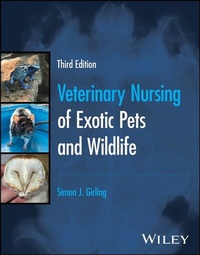
Veterinary Nursing of Exotic Pets and Wildlife
Beschreibung

Learn the principles and practice of veterinary nursing for exotic pets and wildlife
The third edition of Veterinary Nursing of Exotic Pets and Wildlife is a revised and expanded update of the essential text for veterinary nurses caring for exotic pets and wildlife species.
Organised into logical sections, the text covers the anatomy and physiology, housing, husbandry, handling, nutrition, diseases, therapeutics, diagnostic imaging, and critical care medicine of a wide variety of exotic species, as well as a an entirely new section on wildlife treatment and rehabilitation.
From small mammals like rabbits and mice to avian species, reptiles, amphibians, and Eurasian wildlife species, the author includes everything you need to succeed as a veterinary nurse studying for the RCVS nursing syllabus, as well as postgraduate and advanced programs in Veterinary Nursing of Zoo, Exotics, and Wildlife species.
Readers will find:
- Information on common exotic pet species, such as rabbits, rodents, African pygmy hedgehogs, lizards, snakes, tortoises and cage birds
- An entirely new section on wildlife species, including chemical restraints, therapeutics, and rehabilitation
- A focus on evidence-based care practice and the latest guidance for veterinary nursing
- Appendices, including nursing care plans for exotic pets and wildlife with filled out example cases
Veterinary Nursing of Exotic Pets and Wildlife is essential reading for both students and practitioners, and the new edition remains the gold standard in the field of veterinary nursing.
Weitere Details
Weitere Ausgaben
Andere Ausgaben
Person
Simon J. Girling is Director of Girling & Fraser Ltd., as well as Head of Veterinary Services at the Royal Zoological Society of Scotland, a Visiting Professor at the University of the Highlands and Islands, Honorary Clinical Associate Professor at the University of Glasgow and Honorary Professorial Fellow at the University of Edinburgh, in Scotland, UK.
Inhalt
Foreword vii
Abbreviations viii
Part I Small Mammals 1
Chapter 1 Basic Small Mammal Anatomy and Physiology 2
Chapter 2 Small Mammal Housing,
Husbandry and Rearing 28
Chapter 3 Small Mammal Handling and Chemical Restraint 38
Chapter 4 Small Mammal Nutrition 52
Chapter 5 Common Diseases of Small Mammals 61
Chapter 6 An Overview of Small Mammal Therapeutics 99
Chapter 7 Small Mammal Diagnostic Imaging 119
Chapter 8 Small Mammal Emergency and Critical Care Medicine 131
Part II Avian Species 141
Chapter 9 Basic Avian Anatomy and Physiology 142
Chapter 10 Avian Housing and Husbandry 164
Chapter 11 Avian Handling and Chemical Restraint 171
Chapter 12 Avian Nutrition 186
Chapter 13 Common Avian Diseases 201
Chapter 14 An Overview of Avian Therapeutics 226
Chapter 15 Avian Diagnostic Imaging 240
Chapter 16 Avian Emergency and Critical Care Medicine 250
Part III Reptiles and Amphibians 261
Chapter 17 Basic Reptile and Amphibian Anatomy and Physiology 262
Chapter 18 Reptile and Amphibian Housing, Husbandry and Rearing 284
Chapter 19 Reptile and Amphibian Handling and Chemical Restraint 290
Chapter 20 Reptile and Amphibian Nutrition 304
Chapter 21 Common Reptile and Amphibian Diseases 315
Chapter 22 An Overview of Reptile and Amphibian Therapeutics 334
Chapter 23 Reptile and Amphibian Diagnostic Imaging 350
Chapter 24 Reptile and Amphibian Emergency and Critical Care Medicine 360
Part IV Wildlife 369
Chapter 25 Common Mammalian Wildlife Species Biology, Anatomy and Physiology 370
Chapter 26 Wildlife Species Temporary Captive Husbandry and Nutrition 392
Chapter 27 Wildlife Handling and Chemical Restraint 410
Chapter 28 Common Wildlife Disease 424
Chapter 29 An Overview of Wildlife Therapeutics 452
Chapter 30 Wildlife Emergency and Critical Care Medicine 466
Chapter 31 Wildlife Rehabilitation and Release Considerations 474
Appendix 1 Utilising Nursing Care Plans in the Care of Exotic Pets and Wildlife 479
Appendix 2 Legislation Affecting Exotic Pets and Wildlife in the UK 484
Appendix 3 Useful Resources 486
Index 487
Chapter 1
Basic Small Mammal Anatomyand Physiology
Classification of small mammals
The commonly seen species of small mammals in veterinary practice are classified in Table 1.1.
RABBIT
Biological average values for the domestic rabbit
Table 1.2 gives the biological parameters for domestic rabbits.
Musculoskeletal system
The skeletal system of rabbits is light. As a percentage of body weight, the rabbit's skeleton is 7-8%, whereas the domestic cat's skeleton is 12-13%. This makes rabbits prone to fractures, especially of the spine and the hindlimbs.
Skull
Unlike many rodents the mandible is narrower than the maxilla, and the temporomandibular joint has a wide surface area, allowing lateral movement of the mandible in relation to the maxilla. The hemimandibles are fused rostrally with a fibrocartilaginous ligament which is also unusual for many rodents.
Axial skeleton
The spinal formula is generally C7, T12, L7, S4, Ca16 (where C represents cervical vertebrae; T, thoracic vertebrae; L, lumbar vertebrae; S, sacral vertebrae; Ca, coccygeal vertebrae). However, many rabbits have 13 thoracic and 6 lumbar while some have 13 thoracic and 7 lumbar vertebrae so there is considerable breed and individual variation. The cervical vertebrae are box-like and small and give mobility. The thoracic vertebrae possess attachments to the 12 (usually) paired ribs, which are flattened in comparison to cat's ribs. The first seven pairs of ribs articulate directly with the sternum. The last five pairs do not, with the most caudal three pairs being unconnected to the rest and so are free floating. The pelvis is narrow and positioned vertically. The iliac wings meet the ischium and pubis at the acetabulum, where an accessory bone unique to rabbits, called the os acetabuli, lies. The pubis forms the floor of the pelvis and borders the obturator foramen which is oval in rabbits.
Appendicular skeleton
The scapula is slender and there is a hooked supra-hamate process projecting caudally from the hamate process. The scapula articulates with the humerus which in turn articulates with the radius and ulna. In rabbits, the ulna fuses to the radius in older animals and the two bones are deeply bowed. The radius and ulna articulate with the carpal bones, which in turn articulate with the metacarpals and the five digits.
The femur is flatter than a cat's ventrodorsally, and the tibia and fibula are fused in the rabbit. The tibia articulates distally with the tarsal bones where there is a prominent calcaneus bone. The tarsals articulate with the metatarsals which articulate with the four hindlimb digits.
The hindlimbs are well muscled and powerful.
Respiratory anatomy
Upper respiratory tract
Rabbits, like horses, are nasal breathers, with the nasopharynx permanently locked around the epiglottis. For this reason, upper respiratory disease or evidence of mouth breathing is particularly problematic. The nasolacrimal ducts open onto the rostral floor of the nasal passage. The epiglottis is not visible easily from the oral cavity, making direct intubation difficult. It is narrow and elongated and leads into the larynx which has limited vocal fold development. The larynx leads into the trachea which has incomplete C-shaped cartilage rings for support.
Lower respiratory tract
The trachea bifurcates into two primary bronchi. There are two lungs, which are relatively small in proportion to the overall rabbit's body size. This means that even minor lung disease may cause serious problems. Each lung has three lobes (although the right lung caudal lobe is subdivided into medial and lateral segments), with the cranial ones being the smallest (see Figure 1.1). Rabbits do not have respiratory bronchioles leading to alveoli rather they have so-called vestibules that contain the alveoli (Cruise and Brewer, 1994).
Respiratory physiology
The main impetus for inspiration derives from the muscular contraction and flattening of the diaphragm. The lung parenchyma possesses a cellular population that is well supplied with anaphylactic mediating chemicals. These are strong enough to cause fluid extravasation and blood pooling, as well as spasms within the walls of the main pulmonary arterial supply, leading to rapid right-sided heart failure when their release is triggered.
Digestive system
Oral cavity
The dental formula is:
Table 1.1 Classification of commonly seen small mammals.
Order Lagomorpha Rodentia Eulipotyphyla Didelphimorphia Diprotodontia Carnivora Suborder Myomorpha Hystricomorpha Sciuromorpha Caniformia Family Leporidae Muridae Cricetidae Caviidae Chinchillidae Octodontidae Sciuridae Erinaceidae Didelphidae Petauridae Mustelidae Species Domestic rabbit (Oryctolagus cuniculus) Rat (Rattus norvegicus) Mouse (Mus musculus) Gerbil (Meriones unguiculatus) Syrian hamster (Mesocricetus auratus) Russian hamster (Phodopus sungorus) Chinese hamster (Cricetulus griseus) Guinea pig (Cavia porcellus) Chinchilla (Chinchilla lanigera) Degu (Octodon degus) Siberian chipmunk (Eutamias sibiricus) Eastern chipmunk (Tamias striatus) Black-tailed prairie dog (Cynomys ludovicianus) African pygmy hedgehog (Atelerix albiventris) Virginia opossum (Didelphis virginiana) Sugar glider (Petaurus breviceps) Domestic ferret (Mustela putorius furo)Table 1.2 Biological parameters for the domestic rabbit.
Biological parameter Domestic rabbit Weight (kg) 1.5 (Netherland dwarf) to 10 (New Zealand whites and Belgian hares) Rectal body temperature (°C) 38.5-40 Respiratory rate at rest (breaths per minute) 30-60 Heart rate at rest (beats per minute) 130 (New Zealand whites) to 325 (Netherland dwarf) Gestation length (days) 29-35 (average 31) Litter size Typically 5-8 Birth weight (g) 30-100 Weaning age (weeks) 4-6 Age at sexual maturity (months) Male 5-8 Female 4-7 Lifespan (years) 6-13The premolars and molars look physically similar and are often referred to simply as 'cheek teeth'. It should be noted that some breeds of rabbit, particularly the lop breeds, may have fewer cheek teeth in the maxilla (five instead of six on each side).
All rabbit teeth are elodont, growing continuously throughout life and the root apices are open (aradicular) with germinal tissue located at the apices producing the new tooth enamel and dentine. The premolar/molar enamel is folded providing an uneven occlusal surface with the ipsilateral jaw which allows interlocking (so-called interlocking lophs). Wear is kept even by the lateral movement of the mandible across the maxilla, allowing independent left and right arcades to engage in mastication. The incisors help differentiate Lagomorpha from Rodentia as rabbits, pikas and hares have two smaller incisors, or 'peg teeth', behind the maxillary incisors, whereas rodents have only two upper incisors. The larger (rostral) incisors only have enamel on the labial surface, whereas the smaller (caudal) maxillary peg teeth have enamel on the labial and lingual sides. This creates a wedge-shaped bite-plane where the lower incisors close immediately behind the upper large incisors and fit into a groove made by the peg teeth. The permanent rostral incisors are present at birth, although the peg teeth are replaced by permanent peg teeth at around the second week of life. The deciduous premolars present at birth are replaced and joined by permanent molars by the fourth week of life. There are no canines; instead, there is a gap, or diastema, between the incisors and premolars (see...
