

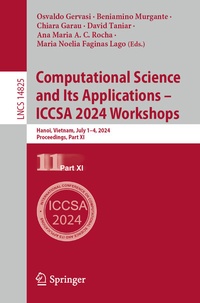
Computational Science and Its Applications - ICCSA 2024 Workshops
Beschreibung

This eleven-volume set LNCS 14815 - 14825 constitutes the refereed workshop proceedings of the 24th International Conference on Computational Science and Its Applications, ICCSA 2024, held at Hanoi, Vietnam, during July 1-4, 2024.
The 281 full papers, 17 short papers and 2 PHD showcase papers included in this volume were carefully reviewed and selected from a total of 450 submissions.
In addition, the conference consisted of 55 workshops, focusing on very topical issues of importance to science, technology and society: from new mathematical approaches for solving complex computational systems, to information and knowledge in the Internet of Things, new statistical and optimization methods, several Artificial Intelligence approaches, sustainability issues, smart cities and related technologies.
Weitere Details
Weitere Ausgaben
Andere Ausgaben
Inhalt
- Intro
- Preface
- Welcome Message from Organizers
- Organization
- Plenary Lectures
- Harnessing Artificial Intelligence for Enhanced Spatial Analysis of Natural Hazard Assessments
- Software Engineering Research in a New Situation
- Interpretability and Privacy Preservation in Large Language Models (LLMs)
- Contents - Part XI
- Urban Space Accessibility and Mobilities (USAM 2024)
- Criteria to Identify Streets to Be Pedestrianised Near Major Commercial Attractors: The Case Study of the San Benedetto Market in Cagliari (Italy)
- 1 Introduction
- 2 State of Art on Pedestrianisation
- 3 Case Study and Selection of Applied Criteria
- 3.1 San Benedetto Market in Cagliari
- 4 Results
- 5 Discussion
- 6 Conclusions
- References
- Leveraging e-Surveys for Investigating Sustainable Urban Mobility: A Case Study in Small Community
- 1 Introduction
- 2 Methodology
- 3 Case Study
- 3.1 Survey's Layout
- 3.2 Survey's Validity Check and Error Correction
- 3.3 Data Analysis
- 4 Conclusions
- References
- Fostering Urban Soft Mobility by Means of Pedestrian Areas: Tentative Criteria for Evaluation of Impacts on Traffic
- 1 Introduction
- 2 Description of the Methodology
- 2.1 General Framework
- 2.2 Travel Demand Model
- 2.3 Combination of Basic Solutions to Find a More Complex Design Solution
- 2.4 Time-Saving Assessment
- 3 Case Study
- 3.1 Description of the Study Area and Critical Issues
- 3.2 Description of the Basic Design Solutions
- 4 Results
- 5 Conclusions
- References
- A GIS-Based Approach to Enhance Safety and Accessibility of Shared Mobility Services
- 1 Introduction
- 2 Methodological Approach
- 2.1 Accessibility Score
- 2.2 Safety Score
- 3 Case Study
- 3.1 Territorial Framework
- 3.2 Data on the Use of Bikesharing in Palermo
- 3.3 Accident Data
- 4 Results Ad Discussions
- 4.1 Accessibility and Safety Evaluation
- 5 Conclusions
- References
- Best Practices in Integrated Demand-Responsive Transport Services for People and Freight
- 1 Introduction
- 2 Integration in the People-Freight Transport: Planning Levels and Their Implications
- 2.1 Planning Strategic, Tactical and Operational Planning: Some Definitions
- 2.2 Key Factors for Strategic Planning
- 2.3 Key Factors for Tactical Planning
- 2.4 Key Factors for Operational Planning
- 3 Evaluation of Key Readings for Future Logistics: Challenges, Strategies, and Perspectives
- 4 Conclusion
- References
- Evaluating Accessibility Within a Multimodal Transport Network: The Case Study of the City of Catania
- 1 Introduction
- 2 Methodological Framework
- 2.1 First Phase: Study Area and Transport Supply
- 2.2 Second Phase: Multimodal Transport Network Accessibility Indicators
- 3 Case Study
- 3.1 Territorial Framework and Current Transport Supply
- 3.2 Methodology Implementation to the Case Study
- 4 Results and Discussion
- 5 Conclusions
- References
- Virtual Reality and Augmented Reality and Applications (VRA 2024)
- TeTieuVR: An Immersive VR Application Introducing the Captivating Art of TeTieu Puppetry
- 1 Introduction
- 2 Background and Related Works
- 2.1 TeTieu Puppetry
- 2.2 Related Works
- 3 TeTieuVR
- 3.1 Overview of TeTieuVR
- 3.2 Database Building
- 4 Museum Design
- 5 Navigation and Interaction
- 5.1 Navigation
- 5.2 Interaction
- 5.3 Interactive Game
- 6 Experiment and Evaluation
- 7 Conclusion
- References
- Drawing and Geometrical Interpretation of Historical Constructive Elements for Conservation Activities: The Sixteenth Century Coffered Wooden Ceilings and the "camorcanna" Vaults of the Villa Cicogna Mozzoni
- 1 From "casino di caccia" to "villa di delizia": Historical Notes About the Transformation Along the Centuries of Villa Cicogna Mozzoni in Bisuschio (Varese, Italy)
- 2 3D Survey and Geometric Modeling of the Villa for the Analysis and Interpretation of the Transformations
- 3 Geometries and Construction Techniques of Coffered, Lacunar Wooden Floors
- 4 Geometries and Construction Techniques of Lightweight Frescoed "camorcanna" Vaults
- 5 Conclusion: The Interpretation of 2D and 3D Geometrical Model to Understand the State of the Structures and to Plan Conservation Activities
- References
- Exploring the Metaverse: Opportunities for Tourism and Territorial Development
- 1 Introduction
- 2 Related Works
- 3 The Proposed Strategy from Implementing Metaverses
- 3.1 Highlights of the Development of the Virtual World
- 3.2 Description of the Preliminary Experience
- 3.3 Usability Questionnaire
- 4 Conclusions
- References
- Testing Anchors, User Experience and Usability Among 4 Game Elements in a Kindy Immersive Augmented Reality Game
- 1 Introduction
- 1.1 Problems
- 1.2 Objectives
- 1.3 Hypotheses
- 1.4 Research Questions
- 1.5 Significance
- 2 Related Work
- 2.1 Cognitive Development Stages
- 2.2 Metaverse, Technology Acceptance, Self-efficacy, Self-directed Learning
- 2.3 Open-Ended Challenges/Surprise
- 2.4 Augmented Reality (AR)
- 2.5 Human-Computer Interaction (HCI)
- 3 Methodology
- 3.1 Software Development Life Cycle
- 3.2 Participants
- 3.3 System Concept
- 3.4 Methods, Tools and Technologies
- 3.5 System Evaluation
- 4 Results
- 4.1 User Acceptance Testing Results
- 5 Discussion
- 6 Conclusion
- References
- Assessment Contribution of an Architectural Indoor Healthy Status via Biosensors Particles Spatial Simulation
- 1 Introduction
- 2 Objectives and Innovation
- 2.1 Objectives of the Research Proposal
- 2.2 Innovation of the Research Proposal
- 3 Low-Cost Sensors for Human Health
- 4 Comfort and Air Quality Studies - Discussions
- 5 Research Methodology
- 5.1 Introduction
- 5.2 Sensors Implementation and Comfort Conditions Measurements
- 5.3 Simulation System and Techniques
- 5.4 3D Building Geometry Modelling Process
- 5.5 Air Quality Values 3D Representation
- 5.6 Advantages/Limitations of Simulation and Modelling Processes
- 6 Conclusions
- References
- PhD Showcase Papers
- Bayesian Geostatistics Modeling of Maritime Surveillance Data
- 1 Introduction
- 2 Geostatistics for Binary Data
- 2.1 Geostatistical Model
- 2.2 Hierarchical Models
- 2.3 Geostatistical Model for Binary Data
- 2.4 INLA and SPDE Approaches for Bayesian Estimation and Prediction
- 3 Modelling Maritime Fisheries Surveillance Data
- 3.1 Data
- 3.2 Spatial Model for Maritime Presumed Fisheries Infractions
- 3.3 Spatio-Temporal Model for Maritime Presumed Infractions
- 4 Discussion
- References
- Evaluation of Reinforcement Learning Algorithms Applied to an Autonomous Car Model for Educational Purposes
- 1 Introduction
- 2 Methodology
- 2.1 Agent-Based Modelling
- 2.2 Reinforcement Learning
- 2.3 Markov Decision Process
- 2.4 Bellman Equation
- 2.5 Optimal Policy
- 2.6 Q-learning Algorithm
- 3 Implementation of Reinforcement Learning in Autonomous Car Model
- 3.1 Components of the Autonomous Car Model
- 3.2 Implementation of the Q-learning Algorithm on the Car Model
- 4 Preliminary Results and Discussions
- 5 Conclusions
- References
- Short Papers
- Post-disaster Analysis Using GIS and a Composite Index to Assess the Vulnerability of Human Settlements: Earthquake of Al Haouz, Morocco
- 1 Introduction
- 2 Study Site and Data
- 2.1 Study Site
- 3 Data
- 4 Methodology and Results
- 4.1 Visualization of the Post-disaster Using MAXAR Satellite Imagery
- 5 Vulnerability Study Using the Composite Index
- 5.1 Index Calculation Method
- 5.2 Results and Mapping of the Vulnerability Index
- 5.3 Overlaying the Epicenter Map on the Resilience Map to Target Restructuring Actions
- 6 Conclusion
- References
- GARMENTO - A Modular Virtual Clothes Try-On System for Fashion Manufacturers
- 1 Introduction
- 2 System Design
- 3 Implementation and Results
- 3.1 Try-On Module
- 3.2 MLOps and Microservice Implementation
- 3.3 Result and Analysis
- 4 Conclusion and Future Works
- References
- Solving Maximum Cut Problem with Multi-objective Enhance Quantum Approximate Optimization Algorithm
- 1 Introduction
- 2 Preliminary
- 2.1 Quantum Approximate Optimization Algorithm
- 2.2 The Maximum Cut Problem
- 3 Multiobjective Optimization for QAOA
- 4 Numerical Simulation
- 5 Conclusion and Future Work
- References
- Seismic Resilience Study for a Prioritization Plan in a High Seismic Hazard Area
- 1 Introduction
- 2 Methodology
- 3 Case Study Description
- 4 Seismic Damage Scenario
- 5 Quantification of Resilience and Prioritization
- 6 Conclusions
- References
- On the Dynamics of a Family of 2D Finite Cellular Automata
- 1 Introduction
- 2 A Family of Two-Dimensional Finite Cellular Automata
- 3 On the Dynamics for This Family of Cellular Automata
- 4 Final Remarks
- References
- Theoretical Insights on the S(1D) + H2O Reaction and Implications on the Chemistry at the Surface of Ice in Extraterrestrial Environments
- 1 Introduction
- 2 Theoretical Methods
- 3 Results and Discussion
- 3.1 Isolated System
- 3.2 Cluster of Four Water Molecules
- 4 Conclusion
- References
- Will the Metaverse Be a New Working Platform for Real Estate Investors and Professionals?
- 1 Introduction
- 1.1 The Research Scope and Contribution
- 2 Materials and Method
- 2.1 AHP Criteria
- 2.2 AHP Alternatives
- 2.3 AHP Decision
- 3 Results
- 4 Discussion and Conclusions
- References
- Ethical Boundaries in AI-Generated Imagery: Analysis of Controversial Content Constraints
- 1 Introduction
- 1.1 Ethics
- 1.2 Child Sexual Abuse Material (CSAM)
- 1.3 Aim and Focus of the Paper
- 2 Controversies in AI-Generated Content
- 3 Virtual CSAM: Discussing Criticalities and Applications Starting from the Italian Law on Pedophilia
- 3.1 VCSAM Definition
- 3.2 The Italian Case
- 3.3 VCSAM Hazardousness as Perceived in Other Countries
- 4 Conclusions
- References
- Optimizing Agrivoltaic Integration: Spatial Analysis and AHP Assessment
- 1 Introduction
- 2 Materials and Methods
- 3 Spatial Multi-criteria Analysis
- 4 Conclusion
- References
- Automated Parcel Machines Innovation
- 1 Introduction
- 2 Methods
- 3 Parcel Lockers Market in EU
- 4 The Population of Poland
- 5 Case Study: InPost in Poland
- 6 Discussion
- 7 Conclusions
- References
- Metaverse and Agriculture Sustainability
- 1 Introduction
- 2 Evolution of Agriculture Technology
- 3 Metaverse and Agriculture
- 4 Conclusions
- References
- The Impact of Cultural Heritage on Economic Growth in the Example of Museum Development in Uzbekistan
- 1 Introduction
- 2 Literature Review
- 3 Methodology
- 4 Analysis and Results
- 5 Conclusion
- References
- Shortest Path Search Method on a Graph with Cycles
- 1 Introduction
- 2 Related Works
- 3 Method for Finding the Shortest Path on a Graph with Cycles
- 3.1 Description of the Method
- 3.2 Results of Method Testing
- 4 Conclusion
- References
- Tourism Asset and Spatial Complexity Analyzed Through Graph-Structured Data Analysis
- 1 Introduction
- 2 Bipartite Network Approach to Analyze Tourism DA
- 3 Discussion and Conclusion
- References
- Omonatopoeia Architecture as a Place-Making Tool for Sustainable Smart Cities- Learning from Kengo Kuma's Projects
- 1 Introduction
- 2 Kengo Kuma Design Philosophy and Omonatopoeia Architecture
- 3 Interview with Kengo Kuma
- 4 Other Projects of Kengo Kuma [5, 6]
- 5 Workshop, Exhibition and Lecture in Sofia, Bulgaria
- 6 Implications for Design of Sustainable Smart Cities
- References
- An MCA Proposal with ANP and Veto Thresholds to Support Decision-Making in Former Railway Track Regeneration Initiatives
- 1 Introduction
- 2 Literature Review
- 2.1 Regeneration of Disused Railway Lines
- 2.2 Multicriteria Analysis Integrations
- 3 MCA Methodology Proposal
- 3.1 Criteria Set Definition
- 3.2 Methodological Structure
- 3.3 Socio-Technical Compatibility
- 3.4 Environmental Sustainability
- 3.5 Economic Sustainability
- 3.6 Social Benefit
- 4 Conclusions and Future Developments
- References
- 3D Human Model Reconstruction Based on Implicit Representation
- 1 Introduction
- 2 Related Work
- 2.1 Explicit Representation
- 2.2 Implicit Representation
- 2.3 Rebuilding 3D Human Body Model for Software Development
- 3 Proposed Method
- 3.1 Loss Function
- 3.2 Model Sampling
- 3.3 Evaluation Method
- 4 Experimental Results
- 5 Conclusion
- References
- Author Index
