

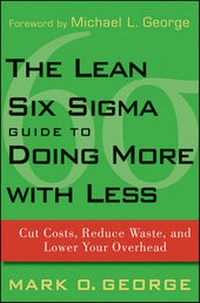
The Lean Six Sigma Guide to Doing More With Less
Cut Costs, Reduce Waste, and Lower Your Overhead
Erschienen am 4. Februar 2010
352 Seiten
978-0-470-60656-8 (ISBN)
Beschreibung

Praise for The Lean Six Sigma guide to Doing More with Less
"At Frito Lay, we have applied many of the concepts and tools inthis book, and we are realizing a five to seven times return on ourannual Lean Six Sigma investment."
--Tony Mattei, Lean Six Sigma Director, Frito Lay
"Ecolab has experienced a sustainable, competitive advantagethrough Lean Six Sigma. The principles in this book are helping usdrive greater value for our share-holders, better service for ourcustomers, and talent development opportunities for ourassociates."
--Jeffrey E. Burt, Vice President and Global DeploymentLeader, Lean Six Sigma, Ecolab
"This book gives excellent insights into Lean Six Sigma and itsstrong impact within different industries. We used Lean Six Sigmain numerous process improvement projects, which, in turn, helped tocreate momentum and set up a process improvement culture. Amid achallenging economic environment, we are accelerating thisinitiative globally."
--Satheesh Mahadevan, Directeur des Processus,Société Générale
"Our Lean Six Sigma deployment of the concepts and toolsdescribed in this book is transforming our business--withtangible benefits for our employees, customers, suppliers, andshareholders."
--Jeffrey Herzfeld, Sr. Vice President and General Manager,Teva Pharmaceuticals USA
"We have deployed the holistic Lean Six Sigma strategy describedby Mark George across our enterprise. It is providing remarkablereturns for Unum."
--Bob Best, Chief Operating Officer, Unum
"The Lean Six Sigma Guide to Doing More with Lesspresents a comprehensive view of operations transformation, theapproaches required for success, leadership's role, and thecompetitive advantage that results. Transformational changes areenabling us to do more with less, by investing and workingsmarter."
--Ted Doheny, President and COO, Joy Mining Machinery
Weitere Details
Weitere Ausgaben
Andere Ausgaben
Mark O. George
The Lean Six Sigma Guide to Doing More With Less
Cut Costs, Reduce Waste, and Lower Your Overhead
Buch
02/2010
1. Auflage
Wiley
33,00 €
Versand in 10-20 Tagen
Person
Mark O. George is a Senior Executive at Accenture and is the Global Offering Group leader for Operations Consulting in the Process and Innovation Performance service line. Mark has designed and supported dozens of enterprise transformation initiatives for Fortune 500 and 1000 companies that have delivered hundreds of millions in economic profit. Accenture is a global management consulting, technology services, and outsourcing company with more than 186,000 people serving clients in over 120 countries, the company generated net revenues of $23.39 billion for the fiscal year ended August 31, 2008. Its home page is www.accenture.com.
Inhalt
- The Lean Six Sigma Guide to Doing More With Less: Cut Costs, Reduce Waste, and Lower Your Overhead
- Contents
- Foreword
- Preface
- Acknowledgments
- CHAPTER 1: Why Use Lean Six Sigma to Reduce Cost?
- Transactional Example: Lean Six Sigma Transforming Our Government
- The Alloy of High Performance: Why Choose Lean Six Sigma to Reduce Cost
- Lean Six Sigma versus Traditional Cost-Cutting Tactics
- Emerging Stronger Than Ever
- SPOTLIGHT #1: How to Use This Book
- Overview of Part I : Process Cost Reduction-a Focus on the Tools of Waste Elimination
- Overview of Part I I : Enterprise Cost Reduction-a Focus on Value, Speed, Agility, and Competitive Advantage
- Overview of Part I I I : Accelerating Deployment Returns-Getting More, Faster, from a Lean Six Sigma Deployment
- PART I: Process Cost Reduction: A Focus on Waste Elimination
- CHAPTER 2: Find Cost Reduction Opportunities in Waste
- The Seven Common Faces of Waste: TIMWOOD
- Using the Full LSS Toolkit to Drive Cost Reduction
- SPOTLIGHT #2: Special Tips for Nonmanufacturing Processes
- Key Success Factors in Reducing Costs in Services and Retail
- SPOTLIGHT #3: Design a Successful Lean Six Sigma Project or Pilot
- Which Methodology Is Right for Your Project?
- Identifying the Players and Their Roles
- CHAPTER 3: Use the Voice of the Customer to Identify Cost-Cutting Opportunities
- Customer Types and Their Needs
- Collecting Data on Customer Needs
- Getting Specific about Customer Needs
- Avoiding Misinterpretations
- Conclusion
- CHAPTER 4: Make Processes Transparent to Expose Waste
- How to Define the Boundaries through SIPOC Diagrams
- Using Value Stream Maps to Achieve Transparency
- Conclusion
- CHAPTER 5: Measure Process Efficiency
- Process Cycle Efficiency: The Key Metric of Process Time and Process Cost
- Little's Law: Understanding the Levers for Improving Process Speed
- The WIP Cap Method: How Limiting WIP Can Increase Process Speed and Reduce Costs
- Using PCE and Little's Law to Drive Cost Reduction
- CHAPTER 6: Improve Your Analysis Skills
- Analysis Skill #1: Learning to "Read" Variation
- Analysis Skill #2: Digging Out Root Causes
- Analysis Skill #3: Establishing Relationships between Factors
- Conclusion
- CHAPTER 7: Make Rapid Improvements through Kaizens
- Quick Overview: The Kaizen Approach
- When Should You Use Kaizens in Cost Reduction Projects?
- Seven Keys to Kaizen Success
- Conclusion
- PART II: Raising the Stakes: Reducing Costs at an Enterprise Level
- CHAPTER 8: Think Transformation, Not Just Improvement
- Attain a Proper Understanding of the Extent of the Opportunity
- Consciously Choose a Path to Capture the Opportunity
- Plan for a Transformation Journey
- Leadership Challenges in Leading a Transformation
- Conclusion
- SPOTLIGHT #4: Transformation at Owens-Illinois
- CHAPTER 9: Unlock the Secrets to Speed and Flexibility
- Alignment and Analytics
- A Model of Speed and Agility
- Economic Order Quantity (EOQ)-The First 100 Years
- Augmenting EOQ with Lean Analytics
- The Equations in Action
- Conclusion
- CHAPTER 10: Reduce the Cost of Complexity
- The Hidden Cost of Added Offerings on Processes
- Assessing Complexity in Your Business: A Holistic View
- Highlights of the Complexity Analysis Process
- Complexity Reduction as the Gateway to Transformation
- Conclusion
- CHAPTER 11: Look Outside Your Four Walls to Lower Costs Inside
- What Is an Extended Enterprise?
- Working on the Supplier End of the Extended Enterprise
- What to Do When You're the Supplier: Extending Your Enterprise Downstream
- Conclusion
- PART III: Speeding Up Deployment Returns: Strategies for Getting More, Faster, from a Lean Six Sigma Deployment
- CHAPTER 12: Create a Pipeline of Cost Improvement Projects
- Developing Rigor in Project Identification and Selection
- From First-Time to All the Time: Shifting from a One-Time Event to an Ongoing System of Pipeline Management
- Conclusion: Maintaining a Dynamic Pipeline
- SPOTLIGHT #5: Link Projects to Value Drivers
- Option 1: Value Driver Trees
- Option 2: Financial Analysis Decision Tree
- Option 3: Economic Profit
- Option 4: EP Sensitivity Analyses
- Value Driver Example
- CHAPTER 13: Smooth the Path through Change
- Change Readiness Assessments
- Leading versus Managing the Change
- Upgrading Your Communication Plan
- Process Ownership and Cost Accountability
- Conclusion: Restoring Faith, Hope, and Belief
- CHAPTER 14: Establishing a Center of Excellence
- What Is a CoE and What Does It Do?
- Focus #1: Performance Management
- Focus #2: Replication: Copy and Paste Your Cost Savings
- How Can a CoE Fit into an Organization?
- Weaving the CoE into Strategic Planning
- Conclusion
- CHAPTER 15: Gaining New Perspectives on Deployment Cost and Speed Opportunities
- Looking for Focus and Flexibility in Deployment
- Focusing Deployments on Business Issues
- Flexibility in Building Skills
- Conclusion
- CHAPTER 16: Reenergizing a Legacy Program
- Why Deployments Lose Steam
- Building a Steam Engine: Performance Management
- Process Ownership: The Partner of Performance Management
- How to Reenergize a Deployment
- Conclusion
- Index
