

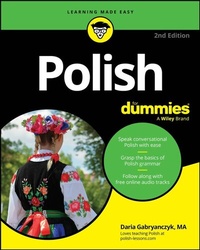
Polish For Dummies
Beschreibung

Everything you need to speak Polish quickly and confidently
Polish For Dummies gets you started with Polish language basics, so you can communicate with friends and loved ones, work and travel in Poland, or just enjoy the excitement of learning a new language. You'll learn the foundations of Polish grammar and how to engage in basic conversations. With the tried-and-true Dummies language learning method, you'll start speaking authentically right away, so you can interact in everyday situations. You'll also learn about social and cultural references that will help you keep up in Polish conversations. With access to audio files for dialogs in the book, you can improve your listening and pronunciation, too. This book makes it easy and practical to become a Polish speaker.
- Learn tips and tricks for improving your Polish language skills
- Access helpful verb conjugation tables, essential vocabulary lists, and straightforward pronunciation guides
- Master everyday words and phrases
- Discover Polish history, culture, and common colloquial expressions
Polish For Dummies is perfect for anyone who wants to learn the basics of the Polish language or brush up on what they already know-no previous experience needed.
Weitere Details
Weitere Ausgaben
Andere Ausgaben
Person
Daria Gabryanczyk is the Founder and CEO of polish-lessons.com, an online Polish Language Centre. She is a lecturer, writer, examiner, and entrepreneur with over two decades of teaching experience in UK universities, government institutions and private organizations.
Inhalt
Introduction 1
Part 1: Getting Started with Polish 7
Chapter 1: Introducing Polish 9
Chapter 2: Getting Down to Essential Polish Grammar 23
Part 2: Polish in Action 49
Chapter 3: Dzien dobry! Czesc! Greetings and Introductions 51
Chapter 4: Getting to Know You: Making Small Talk 73
Chapter 5: Dining Out and Going to the Market 89
Chapter 6: Shopping and Servicing Made Easy 119
Chapter 7: Going Out on the Town 139
Chapter 8: Enjoying Yourself: Recreation 159
Chapter 9: Talking on the Phone 177
Part 3: Polish on the Go 189
Chapter 10: Money, Money, Money 191
Chapter 11: Planning a Trip 201
Chapter 12: Checking into a Hotel or Renting an Apartment 213
Chapter 13: Getting Around: Planes, Trains, Taxis, and More 229
Chapter 14: Asking Directions 245
Chapter 15: Help! Handling Emergencies 263
Part 4: Polish in the Modern World 283
Chapter 16: Using Polish in the Office 285
Chapter 17: Polish for Professionals and Public Servants 303
Chapter 18: Polish on the Worksite 323
Chapter 19: Polishing the New Polish 337
Part 5: The Part of Tens 355
Chapter 20: Ten Everyday Polish Expressions 357
Chapter 21: Ten Phrases That Make You Sound Fluent in Polish 361
Part 6: Appendixes 365
Appendix A: Mini-Dictionaries 367
Appendix B: Verb Tables 389
Appendix C: Answer Key 401
Index 405
Introduction
Society is becoming increasingly international. Low-cost airfares make traveling or moving abroad a more realistic option, global business environments require overseas travel, and friends and neighbors often speak another language. Knowing how to say at least a few words in other languages becomes more and more useful. Additionally, you may want to connect with your heritage by learning a little bit of the language that your ancestors spoke.
Whatever your reason for acquiring some Polish, this book can help. Polish For Dummies gives you the skills you need for basic communication in Polish. I'm not promising fluency, but if you want to greet someone, purchase a ticket, or order something from a menu in Polish, you need look no further than Polish For Dummies.
Recognizing that language exposes you to every aspect of the human condition - allowing you to explore the past, understand the present, and contemplate the future - is important. Language sometimes alters how people express various emotions and conditions. Although people are connected through their ability to speak, you can take it one step further (toward understanding) by being able to communicate in another language. Few things are as exciting as that!
The best way to discover a new language is to immerse yourself in it. Listen to the sounds of Polish, focus on pronunciation, and observe its written form. By listening and repeating, you enter a new world of ideas and cultures. Acquiring Polish through immersion truly feels like a form of magic.
About This Book
This book isn't like a class that you have to attend twice a week for ten weeks without missing any. You can use Polish For Dummies however you want, whether you're aiming to pick up some words and phrases for your trip to Poland or you just want to greet your Polish-speaking friend in their language. This book can help you reach moments of genuine understanding in a new language. Use the text as a language and cultural guide for those moments when you truly need to understand how and why things are done.
Take your time going through this book, reading as much or as little as you want at a time. You don't have to follow the chapters in order; feel free to read only the sections that interest you.
The best way to understand and appreciate a language is to speak it. Throughout the book, you can find plenty of words, phrases, and dialogues (along with pronunciations) for you to practice the language. The audio tracks offer a wide range of spoken dialogues, which you can use to enhance your pronunciation and intonation.
Keep in mind that you don't have to go through this book all at once or from cover to cover. Simply choose a chapter that interests you, and you can find cross-references to other parts of the book.
Conventions Used in This Book
To make this book easy for you to navigate, I set up a few conventions:
- Polish terms are set in boldface to make them stand out.
- Pronunciations, set in parentheses in italics, follow the Polish terms. I underline the emphasized syllables in the pronunciations. The translations, again in parentheses, follow the pronunciations. I occasionally change up the order of the items, but the Polish is always bolded, the pronunciation italicized, and the translation in normal (roman) text.
Verb conjugation tables (lists that show you the forms of a verb) follow this order:
- ja: the I form
- ty: the singular, informal you form
- on, ona, ono: the he, she, it forms
- my: the we form
- wy: the plural, informal you form
- oni, one: the they form for a group with at least one man; the they form for a group with no man
A typical verb conjugation table has columns for the pronoun forms, the Polish verb, the pronunciation, and the translation, as in the following table:
Form
Polish
Pronunciation
Translation
(ja)
czyta-m
(chih-tam)
I read/am reading
(ty)
czyta-sz
(chih-tash)
you read/are reading
on/ona/ono
czyta-ø
(chih-ta)
he/she/it reads/is reading
(my)
czyta-my
(chih-ta-mih)
we read/are reading
(wy)
czyta-cie
(chih-ta-ch'ye)
you read/are reading
oni/one
czyta-ja
(chih-ta-yohN)
they read/are reading
As you may notice, the personal pronouns ja, ty, my, wy (ya, tih, mih, vih) are in parentheses here and in all conjugation tables in this book. That's because you don't actually say those pronouns when you're speaking Polish. I explain the pronoun issue in detail in Chapter 3.
Unlike English, Polish uses special formal forms to address people in official situations. (I write more about how to address people in Chapter 3.) So the you form has the following formal equivalents in Polish:
- pan, pani: pan (pan) is the formal you to address a man and pani (pa-n'ee) the formal you to address a woman (singular).
- panstwo, panowie, panie: These terms are the formal, plural you form to address a mixed group, a group of men, and a group of women, respectively. Panstwo (pan'-stfo) also means "ladies and gentlemen"; panowie (pa-no-v'ye) means "gentlemen"; and panie (pa-n'ye) translates as "ladies" (plural).
When reading verb tables or conjugating verbs, remember that pan takes on the same verb form as on (he) and pani the same verb form as ona (she) - the third-person singular. In the present tense, the plural panstwo, panowie, and panie take on a verb in the third-person plural (the same as oni [they male or mixed] and one [they female]). However, in the past tense and the future that uses past tense forms, panstwo and panowie follow oni, while panie follows one in the choice of a verb form. Chapter 2 explains verbs in more detail.
Studying a language is a unique endeavor, so this book includes a few elements that other For Dummies books don't:
- Talkin' the Talk dialogues: The most effective way to improve in a language is to see and hear how it's used in conversation. That's why I include dialogues throughout the book under the heading "Talkin' the Talk." These dialogues present Polish words, their pronunciations, and their English translations.
- Words to Know tables: Memorizing key words and phrases is also crucial in picking up a language. Therefore, I gather the important words that appear in a dialogue (and sometimes the nearby text) and list them under the heading "Words to Know."
- Fun & Games activities: If you don't have Polish speakers to practice your new language skills with, you can use the Fun & Games activities to reinforce what you're working on. These word games are enjoyable ways to assess your progress.
Also, because each language has its own ways of expressing ideas, the English translations I provide for the Polish terms may not be literal. I want you to understand the essence of what's being said, not just the words themselves. For example, you can translate the Polish phrase wszystko w porzadku (fshih-stko fpo-zhon-tkoo) literally as "everything in order", but the phrase really means "fine." This book gives the "fine" translations.
Foolish Assumptions
To write this book, I had to make some assumptions about you and what you want from a book called Polish For Dummies:
- You have no knowledge of Polish.
- You're not looking for a book to make you fluent in Polish; you simply want to pick up some words, phrases, and sentence constructions to communicate basic information.
- You don't want to have to memorize long lists of vocabulary words or boring grammar rules.
- You want to have fun while discovering a bit of Polish.
If these statements apply to you, then you've found the right book!
Icons Used in This Book
If you're looking for specific information while reading this book, I've made finding it easier for you by placing the following icons in the left-hand margins throughout the book:
I use this icon to indicate crucial pieces of information that you need to bear in...
