

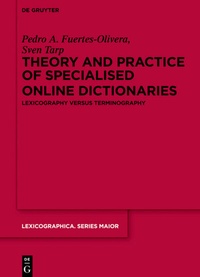
Theory and Practice of Specialised Online Dictionaries
Beschreibung

This book is the first comprehensive monograph on the Function Theory of Lexicography, which originated at the Aarhus School of Business (Aarhus University). Function Theory considers dictionaries to be tools that are constructed for assisting specific users with punctual needs in specific usage situations, e.g. communicative-oriented situations and cognitive-oriented situations. The book's main focus is on defending the independent academic status of lexicography and its corollary: The process of designing, compiling and updating (specialised) online dictionaries needs a theoretical framework that addresses general and specific aspects. The former are common to all types of information tools, the latter are mainly dependent on the media for which the information tool is constructed and their specific target users. This books offers both aspects and moves from the highest level of abstraction to very detailed aspects of lexicographic work, e.g. how to convert an originally-conceived polyfunctional online dictionary into several monofunctional usage-based ones.
The book illustrates that the theory and the methodology currently used by advocates of the Function Theory of Lexicography offers better results than other approaches and therefore makes its case for proposing the Function Theory for terminological/terminographical work.
Weitere Details
Weitere Ausgaben
Andere Ausgaben
Personen
Inhalt
- Intro
- Contents
- 1 Introduction
- 2 What is Specialised Lexicography?
- 2.1 Definitions
- 2.2 Dictionaries versus encyclopaedias
- 2.3 Typology of specialised online dictionaries
- 3 Academic Status of Specialised Lexicography
- 3.1 A discipline with its own subject field
- 3.2 Relation to linguistics
- 3.3 Relation to terminology and terminography
- 3.4 Relation to information science
- 4 Concept of Lexicographical Theory
- 4.1 Is lexicography a science?
- 4.2 A lexicographical theory is possible
- 4.3 Additional remarks on the concept of lexicographical theory
- 5 General Theory of Specialised Dictionaries
- 5.1 Utility tools and user needs
- 5.2 Concept of user needs
- 5.3 Data and information
- 5.4 Lexicographical functions
- 5.5 General methodology: an example
- 5.6 Prescription, description or proscription?
- 5.7 The lexicographical process: the lexicographer's perspective
- 5.8 The lexicographical process: the user's perspective
- 6 Special Problems Related to Online Dictionaries
- 6.1 Data filtering
- 6.2 The type and the individual
- 6.3 Access to supplementary data
- 6.4 The use of corpora and the Internet
- 6.5 Online communication with the user
- 6.6 Shortening the access route
- 7 A Critical View of Terminography
- 7.1 Theories of terminology
- 7.2 Traditional terminology: The General Theory of Terminology
- 7.3 Terminology and linguistics
- 7.3.1 Cabré and the Communicative Theory of Terminology
- 7.3.2 Temmerman and the Sociocognitive Approach
- 7.3.3 Martin, Faber and frame-based terminology
- 7.4 Terminology and knowledge engineering
- 7.5 Summary
- 8 An Analysis of Specialised Online Dictionaries
- 8.1 A functional framework to dictionary criticism: A list of criteria for reviewing specialised online dictionaries
- 8.2 The Dictionary of Business and Management
- 8.3 The New Palgrave Dictionary of Economics Online
- 8.4 The Musikordbogen
- 8.5 The Glossary of Mortgage and Home Equity Terms
- 8.6 The Cambridge Business English Dictionary
- 8.7 TermFinder
- 8.8 The Business English-Spanish Glossary by A.D. Miles
- 8.9 The Glossary of FAO Database and Information Systems
- 8.10 Kicktionary
- 8.11 IATE, CercaTerm and UNTERM
- 8.11.1 Inter-Active Terminology for Europe (IATE)
- 8.11.2 CercaTerm
- 8.11.3 The United Nations Multilingual Terminology Database (UNTERM)
- 8.12 The Multilingual Glossary of Technical and Popular Medical Terms in Nine European Languages
- 8.13 The European Dictionary of Skills and Competences (Disco)
- 8.14 Genoma and EcoLexicon
- 8.14.1 Genoma
- 8.14.2 EcoLexicon
- 8.15 Summary and The Work Ahead: Working with the Function Theory of Lexicography
- 9 Designing, Making and Updating Specialised Online Dictionaries
- 9.1 A Multidisciplinary Activity
- 9.2 Pre-compilation phase
- 9.3 Compilation Phase
- 9.3.1 Lemma Selection
- 9.3.2 Explanation of meaning
- 9.3.3 Restricting Meaning
- 9.3.4 Contextualising Meaning
- 9.3.5 Offering More Choices
- 9.4 The Post-Compilation Phase: A Process of Continuous Updating
- 9.5 Summary and Conclusion
- 10 Conclusions
- References
- Index
