

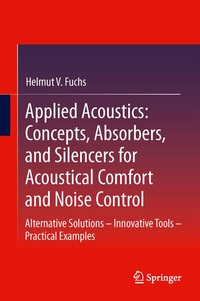
Applied Acoustics: Concepts, Absorbers, and Silencers for Acoustical Comfort and Noise Control
Beschreibung

The author gives a comprehensive overview of materials and components for noise control and acoustical comfort. Sound absorbers must meet acoustical and architectural requirements, which fibrous or porous material alone can meet. Basics and applications are demonstrated, with representative examples for spatial acoustics, free-field test facilities and canal linings. Acoustic engineers and construction professionals will find some new basic concepts and tools for developments in order to improve acoustical comfort. Interference absorbers, active resonators and micro-perforated absorbers of different materials and designs complete the list of applications.
Rezensionen / Stimmen
From the reviews:
"This book is a valuable and practical reference for experienced professionals working in the fields of architectural acoustics and noise control. . this is a long needed reference that goes well beyond handbooks that are merely a summary of equations, lacking examples and practical application of the theory. Thus, it is highly recommended." (Daniel J. Kato, Noise Control Engineering Journal, Vol. 62 (1), January-February, 2014)
Weitere Details
Weitere Ausgaben
Andere Ausgaben
Person
Prof. Helmut V. Fuchs studied electrical engineering at the Technical University of Berlin obtaining his doctorate under L. Cremer and R. Wille. After working in fundamental research at institutes of the Deutsche Luft- und Raumfahrt in Berlin and Oberpfaffenhofen, Sound and Vibration of the University of Southampton and Aeroacoustics at Standford University, he founded the Department of Technical Acoustics and the FhG Institut für Bauphysik IBP in Stuttgart, where he worked from 1997 until soo5 on applied research and development in diverse areas of noise control. As of 1986 he was professor for architectural acoustics and emission protection at the University of Applied Sciences in Stuttgart, and as of 1995 deputy head of the IBP and head of the Department of Architectural Acoustics/Technical Acoustics of the IBP. Since retirement from FhG, he has been devoting his efforts with Forschungsgesellschaft für angewandte Systemsicherheit und Arbeitsmedizin FSA to implementing his innovations for noise reduction and better acoustic design described in this book.
Inhalt
Introduction.- The Low Frequency Problem.- Sound Absorption for Noise Control and Room-acoustical Design.- Passive Absorbers.- Panel Absorbers.- Helmholtz Resonators.- Interference Silencers.- Absorbers with Active Components.- Micro perforated Absorbers.- Integrated and Integrating Sound Absorbers.
