

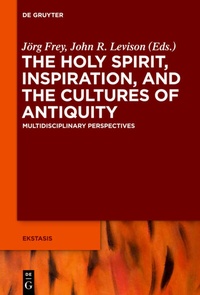
The Holy Spirit, Inspiration, and the Cultures of Antiquity
Multidisciplinary Perspectives
1. Auflage
Erschienen am 29. Oktober 2014
XVI, 413 Seiten
978-3-11-031025-2 (ISBN)
Beschreibung

Early Christian claims to the Holy Spirit arose in a vibrant cultural matrix that included Stoicism, Jewish mysticism, the Dead Sea Scrolls, Greco-Roman medicine, and the perspectives of Plutarch. In a range of articles, this multidisciplinary volume discovers in these texts rich cultural connections related to inspiration and the Holy Spirit. Essential reading for scholars of Judaism and the New Testament, as well as classicists and theologians.
Rezensionen / Stimmen
"All too often scholars pursue their research in isolation, and the interdisciplinary study and collaboration portrayed in this volume can be an example for other projects."Cornelis Bennema in: Theologische Literaturzeitung 5/2016
Weitere Details
Weitere Ausgaben
Andere Ausgaben
Jörg Frey | John Levison
The Holy Spirit, Inspiration, and the Cultures of Antiquity
Multidisciplinary Perspectives
Buch
06/2017
1. Auflage
De Gruyter
24,95 €
Versand in 7-9 Tagen
Jörg Frey | John Levison
The Holy Spirit, Inspiration, and the Cultures of Antiquity
Multidisciplinary Perspectives
E-Book
10/2014
1. Auflage
De Gruyter
189,95 €
Als Download verfügbar
Jörg Frey | John Levison
The Holy Spirit, Inspiration, and the Cultures of Antiquity
Multidisciplinary Perspectives
Buch
09/2014
1. Auflage
De Gruyter
189,95 €
Versand in 7-9 Tagen
Personen
Jörg Frey, University of Zurich, Switzerland; John R. Levison, Southern Methodist University, Dallas, Texas, USA.
Inhalt
- Intro
- Preface
- Table of Contents
- Abbreviations
- The Origins of Early Christian Pneumatology: On the Rediscovery and Reshaping of the History of Religions Quest
- The Spirit of Stoicism
- Plutarch and Pentecost: An Exploration in Interdisciplinary Collaboration
- "Even before his birth he will be filled with the Holy Spirit"-Luke 1:15 in the Spectrum of Theological and Medical Discourses of Early Christianity
- The Infusion of the Spirit: The Meaning of ?µf?s?? in John 20:22-23
- Rua? and the Beholding of God- From Ezekiel's Vision of the Divine Chariot to Merkaba Mysticism
- Historical Origins of the Early Christian Concept of the Holy Spirit
- Speech and Spirit: Paul and the Maskil as Inspired Interpreters of Scripture
- Philo of Alexandria's Understanding of p?e?µa in Deus 33-50
- Pneuma and the Beholding of God: Reading Paul in the Context of Philonic Mystical Traditions
- Spirit in Relationship-Pneumatology in the Gospel of John
- How did the Spirit become a Person?
- Index: Ancient Texts
- Index: Modern Authors
- Index of Subjects and Ancient Names
