

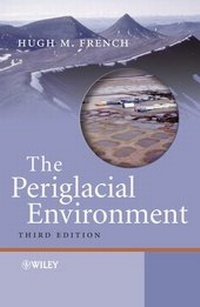
The Periglacial Environment
Beschreibung

The Third Edition continues to be a personal interpretation ofthe frost-induced conditions, geomorphic processes, and landformsthat typify periglacial environments. The text is divided into fourparts. Part One discusses the periglacial concept and itsinteractions with geomorphology, geocryology and Quaternaryscience. It also outlines the range and variability of periglacialclimates and the degree to which landscapes are ingeomorphic equilibrium with prevailing periglacial conditions. PartTwo describes present-day terrain that is either underlain bypermafrost or experiencing intense frost action. The roles playedby cryogenic weathering, ground ice, mass wasting, running water,wind action, snow and ice, and coastal processes are systematicallyanalysed. Part Three summarizes evidence for the existence ofperiglacial conditions during the cold periods of the Pleistocene,with special reference to the mid-latitudes of Europe and NorthAmerica. Part Four illustrates the geotechnical problems associatedwith human activity and resource development in periglacialenvironments, and discusses the potential impact of global climatechange in the northern high latitudes.
This excellent textbook is an invaluable resource for second andthird year undergraduate students of Physical Geography, Geology,Environmental Science and Earth Science. The PeriglacialEnvironment, Third Edition is also an informativereading for professionals, researchers and lecturers working andteaching in the field.
Weitere Details
Weitere Ausgaben
Andere Ausgaben
Person
Inhalt
1. INTRODUCTION.
1.1. The periglacial concept.
1.2. Disciplinary considerations.
1.3. The growth of periglacial knowledge.
1.4. The periglacial domain.
1.5. The scope of periglacial geomorphology.
Advanced reading.
Discussion topics.
2. PERIGLACIAL LANDSCAPES?
2. 1 Introduction.
2. 2 Proglacial, paraglacial or periglacial?
2. 3 Unglaciated periglacial terrain.
2. 4 Relict periglacial landscapes.
2. 5. Conclusions.
Advanced reading.
Discussion topics.
3. PERIGLACIAL CLIMATES.
3.1 Boundary conditions.
3.2 Regional climates.
3.3 Ground climates.
3.4. Periglacial climates and the cryosphere..
Advanced reading.
Discussion topics.
PART TWO: PRESENT-DAY PERIGLACIAL ENVIRONMENTS.
4. COLD-CLIMATE WEATHERING.
4. 1 Introduction.
4. 2 Ground freezing.
4. 3 Freezing and thawing.
4. 4. The ground temperature regime.
4. 5. Rock (frost?) shattering.
4. 6. Chemical weathering.
4. 7. Cryogenic weathering.
4. 8. Cryobiological weathering.
4. 9. Cryopedology.
Advanced reading.
Discussion topics.
5. PERMAFROST.
5. 1. Introduction.
5. 2. Thermal and physical properties.
5. 3. How does permafrost aggrade?
5. 4. Distribution of permafrost.
5. 5. Relict permafrost.
5. 6. Permafrost hydrology.
5. 7 Permafrost and terrain conditions.
5. 8. The active layer.
Advanced reading.
Discussion topics.
6. SURFACE FEATURES OF PERMAFROST.
6. 1. Introduction.
6. 2. Thermal-contraction-crack polygons.
6. 3. Organic terrain.
6. 4. Rock glaciers and permafrost creep.
6. 5. Frost mounds.
6. 6. Active-layer phenomena.
Advanced reading.
Discussion topics.
7. GROUND ICE.
7. 1. Definition and description.
7. 2. Classification.
7. 3. Ice distribution.
7. 4. Cryolithology and cryostratigraphy.
7.5 Ice wedges.
7. 6. Massive ice and massive-icy bodies.
8. THERMOKARST.
8. 1 Introduction.
8. 2. Causes of thermokarst.
8. 3. Thaw-related processes.
8. 4. Thermokarst sediments and structures.
8.5. Ice-wedge thermokarst relief.
8. 6. Thaw lakes and depressions.
8. 7. Thermokarst-affected terrain.
8. 8. Man-Induced thermokarst
Advanced reading.
Discussion topics.
9. HILLSLOPE PROCESSES AND SLOPE EVOLUTION.
9. 1. Introduction.
9. 2. Slope morphology.
9. 3. Mass wasting.
9. 4. Slow mass-wasting.
9. 5. Rapid mass-wasting.
9.6 Slopewash.
9.7. Frozen and thawing slopes.
9. 8. Cold-climate slope evolution.
Advanced reading.
Discussion topics.
10. AZONAL PROCESSES AND LANDFORMS.
10. 1. Introduction.
10. 2. Fluvial processes and landforms.
10.3. Aeolian processes and sediments.
10.4 Coastal processes and landforms.
PART THREE: WUATERNARY AND LATE-PLEISTOCENE PERIGLACIAL ENVIRONMENTS.
11. QUATERNARY PERIGLACIAL CONDITIONS.
11. 1. Introduction.
11. 2. The time scale and climatic fluctuations.
11. 3. Global (eustatic) considerations.
11. 4. Pleistocene periglacial environments of high latitude.
11. 5. Pleistocene periglacial environments of mid-latitude.
11. 6. Conclusions.
Advanced reading.
Discussion topics.
12. EVIDENCE FOR PAST PERMAFROST.
12. 1. Introduction.
12. 2. Past permafrost aggradation.
12. 3. Past permafrost degradation.
12. 4. Summary.
Advanced reading.
Discussion topics.
13. PERIGLACIAL LANDSCAPE MODIFICATION.
13. 1. Introduction.
13. 2. Intense frost action.
13. 3. Intense wind action.
13. 4. Fluvial activity.
13. 5. Slope modification.
Advanced reading.
Discussion topics.
PART FOUR: APPLIED PERIGLACIAL GEOMORPHOLOGY.
14. GEOTECHNICAL AND ENGINEERING ASPECTS.
14. 1. Introduction.
14. 2. Cold-regions engineering.
14. 3. Provision of municipal services and urban infrastructure.
14. 4. Construction of buildings and houses.
14. 5. Problems of water supply.
14. 6. Roads, bridges, railways and airstrips.
14. 7. Oil and gas development.
14. 8. Mining activities.
Advanced reading.
Discussion topics
15. CLIMATE CHANGE AND PERIGLACIAL ENVIRONMENTS.
15. 1. Global change and cold regions.
15. 2. Climate change and permafrost.
15. 3. Future responses.
15. 4. The urban infrastructure.
15. 5. Conclusions.
Advanced reading.
Discussion topics.
References.
Index.
