

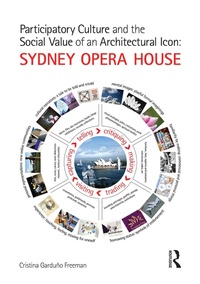
Participatory Culture and the Social Value of an Architectural Icon: Sydney Opera House
Erschienen am 22. September 2017
234 Seiten
978-1-317-08386-3 (ISBN)
Beschreibung

This book develops new and innovative methods for understanding the cultural significance of places such as the World Heritage listed Sydney Opera House. By connecting participatory media, visual culture and social value, Cristina Garduno Freeman contributes to a fast-growing body of scholarship on digital heritage and the popular reception of architecture.
In this, her first book, she opens up a fresh perspective on heritage, as well as the ways in which people relate to architecture via participation on social media. Social media sites such as YouTube, Pinterest, Wikipedia, Facebook and Flickr, as well as others, become places for people to express their connections with places, for example, the Sydney Opera House. Garduno Freeman analyses real-world examples, from souvenirs to opera-house-shaped cakes, and untangles the tangible and intangible ways in which the significance of heritage is created, disseminated and maintained.
As people's encounters with World Heritage become increasingly mediated by the digital sphere there is a growing imperative for academics, professionals and policy-makers to understand the social value of significant places. This book is beneficial to academics, students and professionals of architecture.
In this, her first book, she opens up a fresh perspective on heritage, as well as the ways in which people relate to architecture via participation on social media. Social media sites such as YouTube, Pinterest, Wikipedia, Facebook and Flickr, as well as others, become places for people to express their connections with places, for example, the Sydney Opera House. Garduno Freeman analyses real-world examples, from souvenirs to opera-house-shaped cakes, and untangles the tangible and intangible ways in which the significance of heritage is created, disseminated and maintained.
As people's encounters with World Heritage become increasingly mediated by the digital sphere there is a growing imperative for academics, professionals and policy-makers to understand the social value of significant places. This book is beneficial to academics, students and professionals of architecture.
Rezensionen / Stimmen
"This is an important and timely book that proposes novel ways of understanding social value, identity and engagement with world heritage sites in the digitally mediated age. It will undoubtedly progress thinking and practice on the conception, representation and management of heritage."Hannah Lewi, Professor Architecture, University of Melbourne, Australia
"Focusing on the Sydney Opera House, Cristina Garduno Freeman's first monograph explores the persistent issue of 'social value'. In addition to providing a sustained exploration of heritage engagements within the context of the Opera House, her book also makes astute observations that are transferable well beyond those specifics, offering fresh empirical evidence and insight into the emerging relationships between heritage, online technologies and their associated modes of communication. The result is a strongly theorized monograph that will no doubt make an impactful and important contribution to the literatures supporting heritage and conservation studies."
Emma Waterton, Associate Professor, Western Sydney University, Australia
"In this ground-breaking study, Cristina Garduno Freeman builds on thousands of images of homewares, toys, jewellery, drawings, paintings, cartoons, logos, souvenirs, maps, films, performances, events, visual analogies, archival material and even other buildings, all associated in some way with the Sydney Opera House. In doing this she produces an absorbing and visually exciting account of the impact of the Opera House in Australia and globally, and adds an important new dimension to the rapidly growing literatures on iconic architecture and the heritage industry."
Leslie Sklair, Emeritus Professor of Sociology, London School of Economics, UK
"Participatory Culture and the Social Value of an Architectural Icon is, quite simply, groundbreaking. Rigorously incorporating media, cultural and memory studies' approaches, Cristina Garduno Freeman explores the socio-visual value of Sydney Opera House as it circulates through the participatory media and practices of varied audience-communities. Addressing relational, temporal and embodied aspects of architecture's global 'iconomy', Garduno Freeman critically challenges established definitions of World Heritage. What does it really mean to be a 'world-famous iconic building' in the age of social media? This book will tell you."
Professor Matt Hills, co-director of the Centre for Participatory Culture, University of Huddersfield, UK
Weitere Details
Sprache
Englisch
Verlagsort
London
Großbritannien
Verlagsgruppe
Taylor & Francis Ltd
Zielgruppe
Für höhere Schule und Studium
Illustrationen
10 Line drawings, black and white; 71 Halftones, black and white
Dateigröße
9,38 MB
ISBN-13
978-1-317-08386-3 (9781317083863)
Copyright in bibliographic data and cover images is held by Nielsen Book Services Limited or by the publishers or by their respective licensors: all rights reserved.
Schweitzer Klassifikation
Weitere Ausgaben
Andere Ausgaben
Cristina Garduno Freeman
Participatory Culture and the Social Value of an Architectural Icon: Sydney Opera House
Sydney Opera House
Buch
02/2019
1. Auflage
Routledge
65,30 €
Versand in 15-20 Tagen
Cristina Garduno Freeman
Participatory Culture and the Social Value of an Architectural Icon: Sydney Opera House
Buch
09/2017
1. Auflage
Routledge
214,82 €
Versand in 10-20 Tagen
Person
Cristina Garduno Freeman is emerging as a leader in the participatory culture and social value of iconic architecture. Her interdisciplinary work sits at the intersection of heritage, architecture and digital media. Currently, she is a Postdoctoral Research Fellow in the Australian Centre for Architectural History, Urban and Cultural Heritage (ACAHUCH) at the University of Melbourne, Australia. This is her first book.
Inhalt
Introduction, 1. World Heritage Inscription and Social Value, 2. Social Value and Iconicity, 3. Participatory Culture and Socio-Visual Value, 4. Mediating Identity: Telling and Critiquing, 5. Mediating Experience: Making and Trading, 6. Mediating Time: Visiting and Capturing, 7. Entangled Significance: Personal Tributes, 8. Recognising Networked Significance in Heritage
