

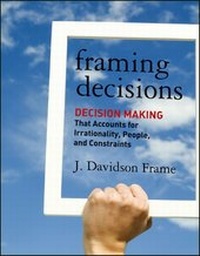
Framing Decisions
Beschreibung

Weitere Details
Weitere Ausgaben
Andere Ausgaben
Person
Inhalt
Preface
I'm a "self-pincher," meaning that I pinch myself from time to time. The pinching is not a product of masochism or a symptom of an exotic neurological disorder (I hope). Rather, it is driven by a desire to determine whether I am awake or dreaming when I come across things that many people accept as true but don't make sense to me.
My self-pinching proclivity is not new. Following are examples of events that triggered self-pinching actions over the years:
- As a child, when my parents told me about the activities of the tooth fairy, Easter Bunny, and Santa Claus
- As a young adult living in Washington, D.C., in the 1970s, when for two years I witnessed a large portion of the American public embrace Nixon's story that he had nothing to do with the Watergate break-in
- In the autumn of 2008, shortly before the implosion of the global economy, when I heard Federal Reserve chairman Ben Bernanke assure the public that the U.S. financial system was on solid footing
- During the spring of 2010 as I watched the Congress and news media foment hysteria by accusing Toyota of producing defective cars that accelerate out of control-this without solid evidence to support their claims
The conventional word for self-pincher is, of course, skeptic. I am a skeptic. I may have a genetic predisposition toward skepticism, since my earliest memories have a skeptical flavor to them. My mother jokes that the first time I used the word mom when addressing her, I placed a question mark after it, as in, "Mom?" I enjoy standing conventional wisdom on its head, which sometimes makes me curmudgeonesque. I don't do this to be ornery. It comes naturally to me. If something doesn't make sense, this bothers me, and I strive to figure out what's going on.
Recently I turned my skeptic's eye toward decision-making theory and practice. I have taught this subject for more than thirty years, and as a practicing manager and consultant, I have personally contributed to significant decision-making efforts in academia, business, and government. I approached the subject uncritically for many years, but I now believe that the great majority of decision-making courses and books view decision making too narrowly. Works that fall under the umbrella of decision science often concentrate on decision-making tools that typically focus on optimizing an objective function, prioritizing alternatives in a logical and consistent fashion, or building models to carry out what-if analyses.
Works that approach decision making more broadly go beyond mere tool use and may suggest useful heuristics and good-sense nostrums to follow, but they still adhere to the underlying precepts of traditional decision science: decisions should be based on logical and rational thinking, should seek to maximize benefits and minimize costs, should focus on core issues and push nonpertinent distractions to the side, and so on. On the surface, these precepts sound 100 percent compelling, but a bit of skeptical reflection raises questions on this matter.
In my view, works directed at "how to be a better decision-maker" are especially off-target, because they promote the view that if readers assume the right perspective and do the right things, they will be better decision-makers, making smart, high-impact decisions. What is bothersome here is that these works implicitly assume the reader is in a position to make decisions in isolation from the rest of the world. The fact is that nontrivial decision making occurs in a social environment that requires decision-makers to recognize that the viability of their individual decisions is often shaped by forces that lie outside their direct control. How useful is a book titled How to Be a Better Decision-Maker to a committee of senior managers of a company trying to determine whether to acquire a new company, or to a field commander pondering whether to launch an attack against enemies entrenched in civilian homes? Can anyone seriously believe that the president of the United States will improve his decision-making skills by reading the hypothetical How to Be a Better Decision-Maker?
What is missing in these traditional perspectives is conscious consideration of a host of factors that have a significant impact on how decisions are actually made but are not usually covered in decision-making courses and books. I am referring here to things like politics, legacy, competence, honesty, selfishness, altruism, personality, cognition, and acts of God. No one would deny that these factors can strongly affect decision making, yet they are seldom discussed in formal treatments of decision-making theory and practice. People routinely discover the importance of these factors in the school of hard knocks, but they are unlikely to encounter them in a university classroom. These factors should not be viewed as interesting sidelines in the business of decision making but as part of the core process.
Consider, for example, the reality of dissimulation. How often do decision-making courses and books address lying and liars? Informed decisions require acquiring facts. When the facts are consciously twisted, decisions based on these facts will be poor ones. At the risk of sounding overly cynical, I would argue that there are plenty of times that the facts going into a decision-making equation have been consciously distorted, with distortions ranging from small white lies to the Big Lie. It seems obvious that smart decision making should accommodate the possibility that the facts decision-makers work with are not truthful. Ordinary car buyers bargaining with a salesperson on the showroom floor know this and factor it into their purchasing decision. TV viewers watching late-night advertisements describing miracle wrinkle-removing creams know this as well, and they too factor it into their purchasing decision. Yet you do not come across much treatment of lying and liars in traditional decision-making books and courses. Is this an important topic that decision-makers should highlight? Certainly! Consider how the lies of Bernard Madoff, Enron's Kenneth Lay, and WorldCom's Bernard Ebbers distorted the decision processes of countless investors, causing them collectively to lose billions of dollars.
Another example of the narrow outlook of conventional decision science thinking can be found by examining its approach to decision making under conditions of uncertainty. While this topic is routinely covered in decision-making courses and books, the treatment of the nature of uncertainty is largely mechanical and shallow. Generally in decision science, it refers to making decisions with incomplete data. For example, when conducting a market research study for a new product, market researchers can only guess at potential market size and the price at which the new product will sell. The lack of information on market size and product price defines uncertainty from the viewpoint of traditional decision science. Decision scientists attack the problem of uncertainty by computing probabilities of events and employing clever statistical techniques to fill in the blanks. They tend to deal with it mechanically. Researchers affiliated with the sixteen-university Decision-Making Under Uncertainty Multi-University Research Initiative have developed a detailed list of worthwhile research topics, such as "basic methods based on probability, decision and utility theories," "real-time inference algorithms," and "fusing uncertain information of different kinds." (For a full list of suggested topics, go to http://www.cs.berkeley.edu/~jordan/muri/.)
Personally I love this stuff. When I get stuck at a central Nebraska airport during a snowstorm or after missing a connection to Yunnan province in southwestern China, I work on problems like these to pass the time and maintain my sanity. I also use them to guide decisions in well-defined, highly structured circumstances. But although these are interesting and valuable topics worthy of study, none touches on a more profound aspect of uncertainty that scientists and philosophers regularly address: uncertainty rooted in the limits of what humans can know.
The most famous treatment of this subject is Heisenberg's uncertainty principle, which holds that you can know a particle's location or its momentum, but you cannot know both at the same time. To the nonphysicist, this revelation is too abstruse to have meaning, so let's ignore its physical interpretation and focus on its deeper, nontechnical implication: it tells us that no matter how smart you are and no matter how powerful and precise your instruments are, there are things you simply are incapable of knowing. There are absolute limits to your knowledge. The emergence of quantum physics in the early twentieth century was a humbling experience for science. After Newton's revelations of his amazing laws of motion, scientists saw no limits to their mastery of knowledge. It seemed that through the gradual accretion of knowledge, they could ultimately have a full understanding of all natural phenomena. Quantum physics dashed this vision.
While we have no clear mathematical demonstration of the limits of knowledge in the arena of human behavior that is comparable to the uncertainty principle, it is evident that there are many things that we are unsure of-often profoundly so-despite our efforts to study them diligently. To see this, consider the lives of nine of the most significant decision-makers in the United States: the justices of the U.S. Supreme Court. Their principal mission is to...
