

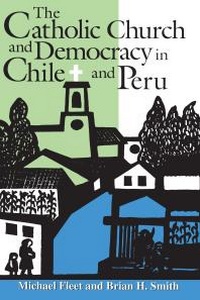
The Catholic Church and Democracy in Chile and Peru
1. Auflage
Erschienen am 15. November 2015
392 Seiten
978-0-268-07982-6 (ISBN)
Beschreibung
Recent changes imposed by the Vatican may redefine the Chilean and Peruvian Church's involvement in politics and social issues. Fleet and Smith argue that the Vatican has been moving to restrict the Chilean and Peruvian Church's social and political activities. Fleet and Smith have gathered documentary evidence, conducted interviews with Catholic elites, and compiled surveys of lay Catholics in the region. The result will help chart the future of the Church and Chile and Peru.
Rezensionen / Stimmen
"Michael Fleet and Brian Smith have produced an interesting comparison of the roles played by the Catholic Church in Chile and Peru during the transition from military to civilian government. They show why the Church in Chile was an important influence in the movement toward a quasi-democracy whereas the Peruvian Church was not. Their analysis has significance beyone these two cases, for similar transitions have recently occurred in several Latin American countries." -Journal for the Scientific Study of Religion"[A] major comparative historical analysis of Catholicism and politics in Latin America . . . . It is a work of extraordinary depth. Highly recommended to anyone interested in a fresh analysis of Church-state relationships in Latin America." -Choice
"Michael Fleet and Brian H. Smith's excellent new book . . . demonstrates how far social science scholarship on the church has come in three decades. Fleet and Smith's study of the Chilean and Peruvian Catholic churches is theoretically sophisticated, richly informed with empirical and historical detail, carefully and systematically comparative, and well written. In short, for research scholars and teachers alike, the book will be profitable to study and a pleasure to read." -Journal of Interamerican Studies and World Affairs
"A thorough analysis of the Catholic Church in the twentieth century in Chile and Peru and its role in the political process by two professors, one of political science at Marquette University, and the other of religion at Ripon College. The methodology used is historical and sociological. Fleet and Smith used field research with interviews and surveys of parishes in both countries to analyze the Church's political role. The authors propose that the present Pope's appointment of conservative bishops in Chile and Peru has reinforced the institutional model and slowed movements toward social and political reform despite Vatican II, Medellin and the idea of Gustavo Gutierrez in Peru and other liberation theologians. . . . A basic assumption underlying this complex analysis is the unstated view that the Church has a definite role to play in the political process beyond that of preaching the Gospel and yet the authors state that the Church's teachings and liberal democracy are often irreconcilable ideologies. This assumption is the philosophical leap one takes when feeding the hungry, clothing the naked, and confronting structural injustice in the modern world. Except for occasional lapses ("faithful Catholics must follow Church teachings, not their own consciences, whenever the two conflict") the theology is sound, the scholarship painstaking, and the conclusions valid and provocative." -Catholic Library World
"...an important and welcome comparative contribution to the subject under consideration. Those interested in, and concerned with, recent times in Chile and Peru... will find a great deal of information in this book."-Iberoamericana
"[A] remarkably thorough study of Chile and Peru. The book lays out a coherent narrative of the evolution of ecclesiastical and church-sponsored politics in these countries since the early days of Christian Democracy, with an emphasis on the recent period leading up to the transition to democracy. This is no mean feat, as anyone familiar with the alternately tendentious and spotty nature of the sources can attest. Fleet and Smith advance the agenda of research on the politics of Catholicism. They are especially good at delineating the tension between the church's intramural absolutism, notably but not exclusively with regard to questions of sexual morality, and its pragmatic but not quite principled dedication to liberal democracy and procedural pluralism." -The Journal of Religion
Weitere Details
Reihe
Sprache
Englisch
Verlagsort
Notre Dame IN
USA
Zielgruppe
Für Beruf und Forschung
ISBN-13
978-0-268-07982-6 (9780268079826)
Copyright in bibliographic data and cover images is held by Nielsen Book Services Limited or by the publishers or by their respective licensors: all rights reserved.
Schweitzer Klassifikation
Weitere Ausgaben
Personen
Michael Fleet is Associate Professor of Political Science at Marquette University and the author of The Rise and Fall of Chilean Christian Democracy (1985).
Brian H. Smith holds the Charles and Joan Van Zoeren Chair in Religion, Ethics, and Values at Ripon College. He is the author of More Than Altruism: The Politics of Private Foreign Aid(1990) and Religious Politics in Latin America, Pentecostal vs. Catholic (1998).
Brian H. Smith holds the Charles and Joan Van Zoeren Chair in Religion, Ethics, and Values at Ripon College. He is the author of More Than Altruism: The Politics of Private Foreign Aid(1990) and Religious Politics in Latin America, Pentecostal vs. Catholic (1998).
Inhalt
- Intro
- Contents
- Preface
- Introduction
- Chapter 1: Church and Society in Theoretical Perspective
- Chapter 2: The Chilean Church: A Historical Overview
- Chapter 3: The Peruvian Church: A Historical Overview
- Chapter 4: The Chilean Church and the Transition to Democracy
- Chapter 5: Chile's Consolidation of Democracy
- Chapter 6: The Church and the Transition to Civilian Rule in Peru
- Chapter 7: The Church and the Consolidation of Democracy in Peru
- Chapter 8: Conclusions
- Appendix
- Notes
- Bibliography
- Index
