

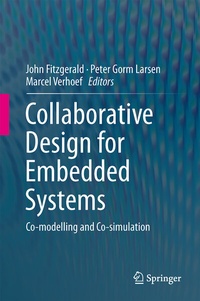
Collaborative Design for Embedded Systems
Beschreibung

One of the most significant challenges in the development of embedded and cyber-physical systems is the gap between the disciplines of software and control engineering. In a marketplace, where rapid innovation is essential, engineers from both disciplines need to be able to explore system designs collaboratively, allocating responsibilities to software and physical elements, and analyzing trade-offs between them.
To this end, this book presents a framework that allows the very different kinds of design models - discrete-event (DE) models of software and continuous time (CT) models of the physical environment - to be analyzed and simulated jointly, based on common scenarios. The individual chapters provide introductions to both sides of this co-simulation technology, and give a step-by-step guide to the methodology for designing and analyzing co-models. They are grouped into three parts: Part I introduces the technical basis for collaborative modeling and simulation with the Crescendo technology. Part II continues with different methodological guidelines for creating co-models and analyzing them in different ways using case studies. Part III then delves into more advanced topics and looks into the potential future of this technology in the area of cyber-physical systems. Finally various appendices provide summaries of the VDM and 20-sim technologies, a number of valuable design patterns applicable for co-models, and an acronym list along with indices and references to other literature. By combining descriptions of the underlying theory with records of real engineers' experience in using the framework on a series of case studies the book appeals to scientists and practitioners alike. It is complemented by tools, examples, videos, and other material on www.crescendotool.org.
Scientists/researchers and graduate students working in embedded and cyber-physical systems will learn the semantic foundations for collaborative modeling and simulation,as well as the current capabilities and limitations of methods and tools in this field. Practitioners will be able to develop an appreciation of the capabilities of the co-modeling techniques, to assess the benefits of more collaborative approaches to modeling and simulation, and will benefit from the included guidelines and modeling patterns.Rezensionen / Stimmen
"The book gives a good overview of the DESTECS approach to co-simulation. The clarity of the examples, in particular, make it a good entry point for getting to grips with this design technique." (Richard Banach, Formal Aspects of Computing, Vol. 31, 2019)Weitere Details
Weitere Ausgaben
Andere Ausgaben
Personen
John Fitzgerald is a specialist in the engineering of embedded systems and systems-of-systems. He has worked in and with the aerospace and embedded processor industries to develop formal model-based methods for software development that are supported by tools and deployed in commercial practice, notably the VDM and Overture framework. He is now Professor of Computing Science at Newcastle University, where he is Director of the Centre for Software Reliability.
Peter Gorm Larsen has been a specialist in the development of tool support for VDM for more than twenty years. He was the main architect behind the commercial VDMTools and is now Convener of the Overture open source initiative, and has experience of applying VDM in many different industrial contexts. He is now a professor at the Department of Engineering at Aarhus University in Denmark, where he leads the Software Engineering group.
Marcel Verhoef is an embedded systems architect at Chess EmbeddedTechnology International B.V. (Haarlem, The Netherlands) where has worked on the development of complex mission-critical embedded systems for clients in the aerospace and automotive industries. He holds a PhD from the Radboud University Nijmegen on multi-disciplinary design methodologies for systems engineering.