

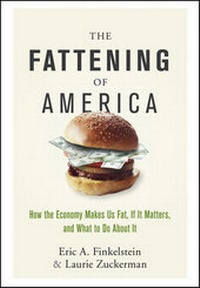
The Fattening of America
How The Economy Makes Us Fat, If It Matters, and What To Do About It
Erschienen am 4. Januar 2011
274 Seiten
978-1-118-04503-9 (ISBN)
Beschreibung

In The Fattening of America, renowned health economist Eric Finkelstein, along with business writer Laurie Zuckerman, reveal how the U.S. economy has become the driving force behind our expanding waistlines. Blending theory, research, and engaging personal anecdotes the authors discuss how declining food costs--especially for high-calorie, low-nutrient foods--and an increasing usage of technology, which make Americans more sedentary, has essentially led us to eat more calories than we burn off.
Rezensionen / Stimmen
"Fatty, fat, fat, fat," chants Bart Simpson. He has apoint. Americans are getting fatter. But health economistFinkelstein (public health economics program, Research TriangleInst.; coauthor, with Phaedra S. Corso and Ted R. Miller, TheIncidence and Economic Burden of Injuries in the United States)and business writer Zuckerman (coauthor with Mary Cantando, NineLives: Stories of Women Business Owners Landing on Their Feet)analyze the finances behind the fat. They trace some of thefamiliar causes of the bulging American waistline that Greg Critzeridentified in Fat Land: How Americans Became the Fattest Peoplein the World. They weigh in on the economics of obesity, whichthey trace back to predictable sources such as school lunch rooms,fast food, television, commuting, and working moms. Then theytarget some surprising causes, including health insurance. On theflip side, they detail the economic consequences of obesity. Forinstance, obese employees take more sick days than do normal-weightemployees-and their paychecks are slimmer. The authors highlightfascinating new scientific research into the causes of obesity andoffer tips on lightening your load over the long haul. This bookserves up a healthy selection for public and academic librarybusiness collections.--Carol J. Elsen, Univ. of Wisconsin,Whitewater (Library Journal, January 2008) Everyone knows Americans are growing fatter, but healtheconomist Finkelstein crunches the economic figures behind thenation's obesity epidemic and the results aren't pretty. Along withhealth-care writer Zuckerman, researcher Finkelstein delves intohow modern technology reduces the cost of producing higher-calorieprocessed goods, decreases our activity level and puts our healthin danger. Finkelstein debunks myths about the long-range cost offood production and consumption and scrutinizes the impact ofgenetics and U.S. fiscal policy on the nation's waistline,frequently using economics metrics in his analysis. Generous withsummaries of major points, Finkelstein simplifies current stats toexplain how the country's thunderous weight gain is strainingMedicare and Medicaid and hurting our military readiness. The onlypositive effect he sees from the obesity epidemic is the creationof the "ObesEconomy"--a market sustained by gyms,diet drugs and other products and services designed to curb weightgain. Horrified by studies that reveal that obese children have aquality of life similar to children with cancer, the investigatoryeconomist even throws in some health tips on dropping pounds.Despite a frequent reliance on economic tools and indicators, thiscombination study/motivational guide makes for a pleasanteducational read, comparable to a vegetable puree snuck into adessert. (Jan.) (Publishers Weekly, December 3,2007) "Finkelstein's tone is chatty andaccessible...obesity is ultimately bad economics."(Financial Times, Saturday 16th February 2008) "The authors show there is a casual relationship betweenthe growth of the waistline and the changing shape of theeconomy." (Securities & Investment Review,March 2008)Weitere Details
Weitere Ausgaben
Andere Ausgaben
Eric A. Finkelstein | Laurie Zuckerman
The Fattening of America
How The Economy Makes Us Fat, If It Matters, and What To Do About It
Buch
01/2008
Wiley
35,50 €
Versand in 10-20 Tagen
Personen
Eric A. Finkelstein, PhD, MHA, is a nationally acclaimedexpert on the subject of economics and obesity. He is a healtheconomist with the research organization RTI International inResearch Triangle Park, North Carolina, and teaches healtheconomics at Duke University. His work focuses on the economiccauses and consequences of health-related behaviors, with a primaryemphasis on obesity. Finkelstein has published over thirtypeer-reviewed articles on the economics of obesity and relatedbehaviors. His research has been featured on the front page ofUSA Today and has been covered in the Economist, theNew York Times, Forbes, the Washington Post,and many other newspaper, radio, and television outlets.
Laurie Zuckerman left her corporate PR job in 1999 tomake writing her full-time career. She contributes columns andfeature articles to a number of business journals and lifestylemagazines, and writes for businesses ranging from Fortune 500s tostartups, with a focus on health care, high tech, and business.
Inhalt
Introduction: Answering the Age-Old Question: Why Is Uncle Al SoFat?
Chapter 1 Craze or Crisis?
So Why Now?
My Soccer Team Eats Oranges.
So How about Adults? Are We Gaining, Too?
A Growing Waistline Can Be Bad for Your Health.
But Are We the Only Ones Gaining Weight?
The Longer You Stay, the Bigger You Get.
Chapter 2 I'll Take a Deep-Fried Coca-Cola.
First Things First.
Cheap Food Gets Cheaper.
The Rise of French-Fried Potatoes.
Please Pass the High-Fructose Corn Syrup.
A Full Pound of Sausage, Bacon, and Ham: Have a MeatyMorning.
Too Much of a Good Thing.
Kids Are Also Drinking the Kool-Aid.
When Is Enough Enough?
Chapter 3 Why We're Moving Less (Hint:It's Not Just the La-Z-Boy).
But I Don't Have Time!
Not Quite the Jetsons, But . . . .
Just Be a Marathon Runner.
We're Not Farmers Anymore.
Sprawling Out.
Our Kids Are Also Slowing Down.
Wrapping It Up.
Chapter 4 So Where Else Can We Lay the Blame?
Blame Mom and Dad.
Then Just Blame Mom (You Know You Will Anyway).
Blame the Meds.
Blame the Cigs (One More Theory Goes Up in Smoke).
Blame the All-Nighter.
Blame the Air Conditioner (Not Cool).
Blame Pollution (It's a Dirty Business).
Blame That Nasty "Fat Bug".
It's the Economy, Stupid.
Chapter 5 Beware: Moral Hazard.
Just Bill My Health Insurance.
Is Obesity as Bad as It Used to Be?
Just Take a Pill or Get a Procedure.
Chapter 6 So We're Fat--Who Cares?
Is Uncle Al Overweight?
C'mon Now, We're Only Utility Maximizing.
Now, Let's Tear This Argument Apart (and Put It BackTogether).
So Should Dad (and the Government) Care that Uncle Al IsObese?
Just Follow the Money.
Chapter 7 The Role of Government.
Market Failures.
Externalities.
Market Power.
Public Goods.
Obesity and National Defense.
Imperfect (Asymmetric) Information.
Is There a Role for Government?
Chapter 8 Weighing the Public Policy Issues (forAdults).
Equity.
Irrationality.
Compelling Public Need.
Revisiting Past Policy.
The Road Ahead.
Summing Up.
Chapter 9 Weighing the Public Policy Issues (forKids).
First, a Step Back.
Child Abuse?
School-Based Regulations.
Your Mouth Will Really Groove.
In Closing.
Chapter 10 The Employer's Dilemma.
Why Don't Businesses Invest More in the Health of TheirWorkforce?
The Dirty Secret about Employee Wellness Programs.
So What's an Employer to Do?
Could These Programs Get Me in Legal Hot Water?
Chapter 11 The ObesEconomy.
Just How Big Is the Weight-Loss Industry?
Just Take a Pill.
Bigger and Better.
Invest in New Technology.
In the Name of Progress.
Chapter 12 How to Lose Weight Like an Economist.
Economic Weight-Loss Techniques.
A Few More Secrets to Success.
Conclusion.
Notes.
About the Authors.
Index.
Introduction Answering the Age-Old Question: Why Is Uncle Al So Fat? Ever notice that as your parents get older, you tend to have the same conversation with them over and over? For me, the conversation typically begins at baggage claim when I pick them up for a weekend visit. Mom will whisper, much louder than I would like: "There are a lot of people here who could participate in your study." She is referring to a paper I published a few years back that quantified the increase in medical expenditures resulting from obesity in the United States.Translation: "There are a lot of fat people here." At this point in the conversation, my dad proclaims, with no effort to keep his voice down: "You know who's fat? Uncle Al. Uncle Al is fat and getting fatter!" And we're off and running. On the one hand, I should be flattered that my parents have taken an interest in my work. As a health economist, I have spent the past seven years studying economic issues related to obesity. On the other hand, the rift between my dad and Uncle Al (my dad's half brother) is well known in the family circle, and Dad rarely misses an opportunity to take a jab at Uncle Al regardless of the conversation topic. But I have to admit, Dad has some interesting points. First, he notes, with some reluctance, that Uncle Al is no dummy. Clearly, he must know that his excess weight increases the risk of a host of medical problems, some of which Uncle Al has already developed. Second, he points out that Uncle Al is a partner in a successful law firm and is in the top income bracket in the country. Surely, he can afford to buy the healthiest foods, join the best gym, and pay whatever price is required to maintain a healthy weight.Why then, is he still fat and, according to Dad, getting fatter? Usually, we are in the car and heading to my house when I ask the same question I pose every other time we've had this conversation: "Why do you care whether or not Uncle Al is fat?" "I don't care," he answers immediately. "As far as I'm concerned, Uncle Al can do whatever the hell he wants." But as it turns out, maybe we should care. For Uncle Al is not the only one who's fat. As Dad often points out, Mom could stand to lose a few pounds herself, as could one of my sisters. Uncle Al's son, my cousin Carl, is at least 20 pounds heavier than he was in his early 20s, although as we discuss in Chapter 2, the father and son have gained weight for very different reasons. In fact, if you were to weigh in the entire Finkelstein family, you would find that my family is pretty typical of the U.S. population. About one third of us are fat and another third are on the brink. The government, by the way, refers to fat adults as obese and fat kids as overweight. We'll stick with their terminology, although I'm not convinced these terms truly lessen the blow. In total, including Uncle Al, Cousin Carl, my mom, and my sister, there are over 62 million adults in the United States who are obese.An additional 12.5 million kids are overweight. So maybe you should care. For the rise in obesity rates is having a profound impact on the U.S. economy-and on our wallets. There is a nearly endless barrage of news stories describing how obesity is making our businesses less competitive, pushing good jobs overseas, hurting our military readiness, increasing our taxes, and helping to bankrupt the Medicare and Medicaid programs. And, by the way, it also turns out to be pretty bad for your health. Usually, by the time we reach our house, either Mom has forbidden us to continue talking about Uncle Al or Dad and I are no longer on speaking terms. Since we never get to finish the conversation, and because your family has an Uncle Al too, it seems appropriate to put my thoughts into writing and finally explain to Dad why Uncle Al is fat, just why we might care about that, and what should (or shouldn't) be done to address rising rates of obesity. America's Growing Waistline Two thirds of Americans are overweight or obese. Over the past three decades, the number of obese individuals has more than doubled. The increase occurred for all population subsets, including children, the elderly, and all racial/ethnic groups up and down the socioeconomic spectrum.
Chapter 1 gives you the lay of the obesity landscape. It describes how America-and the world, for that matter-has seen a significant growth spurt in obesity rates over the past several decades. The chapter then briefly discusses the adverse health consequences of obesity. Chapter 2 begins to hone in on the causes behind the obesity epidemic, concentrating on "calories in." Chapter 3, which focuses on "calories out," continues the argument that economic forces, which have simultaneously lowered the cost of food consumption and increased the cost of physical activity, have largely driven the sudden obesity rise. In Chapter 4 we take the discussion beyond the calories in/calories out equation to evaluate other factors that may (or may not) be contributing to an obesity-inducing environment. We continue this discussion in Chapter 5, and look at the role that health insurance and medical technology play in reducing the costs associated with obesity. When considering costs, we focus not only on the monetary costs, but also on the time and other opportunity costs associated with undertaking certain activities. Chapter 6 switches gears from causes to consequences. We ask and answer the key question: So we're fat-who cares? The chapter explores the implications of obesity for taxpayers, for the U.S. government, and for employers whose business model does not involve selling products and services to obese consumers. In Chapter 7 we look at the government's role in response to the obesity epidemic from an economic standpoint, and actually question whether they should have any role at all. Chapter 8 specifically addresses the pros and cons of proposed government strategies aimed at reducing obesity rates in adults, and Chapter 9 presents a similar analysis for strategies that target youth. Chapter 10 then lays out some groundwork for how businesses can respond to problems related to obesity. It presents private-sector strategies for reducing rates of obesity and gauges their likelihood of success. Chapter 11 goes on to examine the flip side, what we call the ObesEconomy, the multibillion-dollar market that America's ballooning waistline has created for obesity-related products and services. Finally, even though this is decidedly not a "how to lose weight book" (God knows, there are enough of those out there already), we couldn't resist the temptation to offer some advice on how to lose weight like an economist. That's served up to you with a portion-controlled grain of salt in Chapter 12.
Before you begin reading this book in earnest, it's important to get one thing straight. Contrary to what "Mary" (I prefer not to disclose her real name) recently implied after I gave a presentation on the economics of obesity at the National Institutes of Health, I am not a "fattist."That is to say, I have nothing against obese people. Mary, a member of the Medical Advocacy Project of the Council on Size & Weight Discrimination, a self-proclaimed "size acceptance" group, told an audience of several dozen obesity researchers that my presentation sounded like "fat people are bad for business, fat people are bad for government, fat people are just plain bad...." She then began to cry. Needless to say, it was not a good scene. I never got a chance to mount a rebuttal. If I had, I would have told her that while not everyone can be skinny, I believe the vast majority of overweight people could weigh less than they currently do if the environment were more conducive to weight loss. What do I mean by that? America's obesity epidemic has been shaped by economics. A basic tenet of economics is that people respond to their environment in predictable ways. If the cost of a particular product or activity decreases, or the benefits of that product or activity increase, then people will consume more of that product and spend more time doing that activity, and vice versa. As we discuss throughout this book, obesity is a product of our economic and technological success.Thanks to declining food costs and the ever-increasing usage of technology, we're eating more calories and burning off fewer. As a result, we are gaining weight-lots of it-a consequence that any economist worth his weight would predict. However-and this may come as a shock to many of you-to economists, it is not entirely clear that obesity is a problem worth fighting (certainly not the way we've been attacking it). Sure, obesity is bad for your health, but the fact remains that good diet and exercise are extremely difficult to sustain, especially in today's environment. In fact, as the world now stands, many, including my Uncle Al, may prefer to be "fat and happy" (as my dad puts it) rather than make the sacrifices necessary to be thin. And isn't it their choice? Moreover, even if we are convinced that obesity is worth fighting, we are not going to significantly reduce rates of obesity solely through public health or media campaigns.These programs often do a good job of raising awareness, but they fail to address the core issue. If we are to reverse the rising tide of obesity,...
How This Book Is Organized
Chapter 1 gives you the lay of the obesity landscape. It describes how America-and the world, for that matter-has seen a significant growth spurt in obesity rates over the past several decades. The chapter then briefly discusses the adverse health consequences of obesity. Chapter 2 begins to hone in on the causes behind the obesity epidemic, concentrating on "calories in." Chapter 3, which focuses on "calories out," continues the argument that economic forces, which have simultaneously lowered the cost of food consumption and increased the cost of physical activity, have largely driven the sudden obesity rise. In Chapter 4 we take the discussion beyond the calories in/calories out equation to evaluate other factors that may (or may not) be contributing to an obesity-inducing environment. We continue this discussion in Chapter 5, and look at the role that health insurance and medical technology play in reducing the costs associated with obesity. When considering costs, we focus not only on the monetary costs, but also on the time and other opportunity costs associated with undertaking certain activities. Chapter 6 switches gears from causes to consequences. We ask and answer the key question: So we're fat-who cares? The chapter explores the implications of obesity for taxpayers, for the U.S. government, and for employers whose business model does not involve selling products and services to obese consumers. In Chapter 7 we look at the government's role in response to the obesity epidemic from an economic standpoint, and actually question whether they should have any role at all. Chapter 8 specifically addresses the pros and cons of proposed government strategies aimed at reducing obesity rates in adults, and Chapter 9 presents a similar analysis for strategies that target youth. Chapter 10 then lays out some groundwork for how businesses can respond to problems related to obesity. It presents private-sector strategies for reducing rates of obesity and gauges their likelihood of success. Chapter 11 goes on to examine the flip side, what we call the ObesEconomy, the multibillion-dollar market that America's ballooning waistline has created for obesity-related products and services. Finally, even though this is decidedly not a "how to lose weight book" (God knows, there are enough of those out there already), we couldn't resist the temptation to offer some advice on how to lose weight like an economist. That's served up to you with a portion-controlled grain of salt in Chapter 12.
Is Obesity a Problem Worth Fighting?
Before you begin reading this book in earnest, it's important to get one thing straight. Contrary to what "Mary" (I prefer not to disclose her real name) recently implied after I gave a presentation on the economics of obesity at the National Institutes of Health, I am not a "fattist."That is to say, I have nothing against obese people. Mary, a member of the Medical Advocacy Project of the Council on Size & Weight Discrimination, a self-proclaimed "size acceptance" group, told an audience of several dozen obesity researchers that my presentation sounded like "fat people are bad for business, fat people are bad for government, fat people are just plain bad...." She then began to cry. Needless to say, it was not a good scene. I never got a chance to mount a rebuttal. If I had, I would have told her that while not everyone can be skinny, I believe the vast majority of overweight people could weigh less than they currently do if the environment were more conducive to weight loss. What do I mean by that? America's obesity epidemic has been shaped by economics. A basic tenet of economics is that people respond to their environment in predictable ways. If the cost of a particular product or activity decreases, or the benefits of that product or activity increase, then people will consume more of that product and spend more time doing that activity, and vice versa. As we discuss throughout this book, obesity is a product of our economic and technological success.Thanks to declining food costs and the ever-increasing usage of technology, we're eating more calories and burning off fewer. As a result, we are gaining weight-lots of it-a consequence that any economist worth his weight would predict. However-and this may come as a shock to many of you-to economists, it is not entirely clear that obesity is a problem worth fighting (certainly not the way we've been attacking it). Sure, obesity is bad for your health, but the fact remains that good diet and exercise are extremely difficult to sustain, especially in today's environment. In fact, as the world now stands, many, including my Uncle Al, may prefer to be "fat and happy" (as my dad puts it) rather than make the sacrifices necessary to be thin. And isn't it their choice? Moreover, even if we are convinced that obesity is worth fighting, we are not going to significantly reduce rates of obesity solely through public health or media campaigns.These programs often do a good job of raising awareness, but they fail to address the core issue. If we are to reverse the rising tide of obesity,...
