

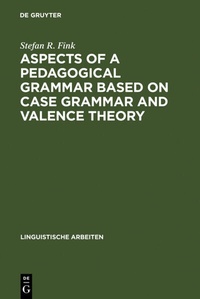
Aspects of a pedagogical grammar based on case grammar and valence theory
Levinas, Marcel, and the Contemporary Debate
1. Auflage
Erschienen am 2. Mai 2011
IX, 180 Seiten
978-3-11-134539-0 (ISBN)
Beschreibung

No detailed description available for "Aspects of a pedagogical grammar based on case grammar and valence theory".
Weitere Details
Weitere Ausgaben
Andere Ausgaben
Buch
01/1977
1. Auflage
De Gruyter
169,95 €
Artikel ist vergriffen; siehe andere Ausgabe
Buch
01/1977
1. Auflage
De Gruyter
119,95 €
Versand in 7-9 Tagen
Inhalt
- Intro
- ACKNOWLEDGEMENTS
- 1. SOME REFLECTIONS ON THE RELATIONSHIP BETWEEN LINGUISTIC THEORIES AND PEDAGOGICAL GRAMMARS
- 1.1 On the concept of 'pedagogical grammar'
- 1.2 Which linguistic theory?
- 1.3 The universality of a pedagogical grammar
- 2. THEORETICAL BACKGROUND
- 2.1 Linguistic valence - a first approximation
- 2.2 Thoughts on the isolation of morpho-syntactic units and their relation to semantic concepts
- morpho-syntactic valence versus logico-semantic valence
- 3. CONTRIBUTIONS TO A PEDAGOGICAL GRAMMAR - THE APPLICATION OF THEORETICAL CONSIDERATIONS
- 3.1 The experimental language test in German as a research tool in the investigation of errors in the realization of logico-semantic valence
- 3.2 Discussion of selected verbs based on presented theoretical considerations - possible application in a pedagogical grammar
- 3.2.1 On the Agent-Object-Experiencer relation
- 3.2.2 On the Benefactive notion
- 3.2.3 Application of logico-semantic valence to locative verb types
- 3.2.4 Observations on reflexivity
- 3.2.5 On reciprocal verbs
- 3.2.6 Verbs implying time relations
- 3.2.7 On predicates of the type 'be hungry', 'get tired of'
- 3.2.8 Some thoughts on verbal prefixes like German be-, er-, ver-, zer-, and the holistic/partitive/resultative distinction
- 3.2.9 A new look at 'function verb constructs' (Funktionsverbgefüge) of the type come to a conclusion - relevance of logico-semantic valence
- 4. OUTLOOK
- 4.1 The psychological validity of the concept of a 'conceptual composition plan' for sentences and discourse
- 4.2 The 'cyclic approach' for the introduction of related verbs (predicates) based on logico-semantic valence
- 5. SUMMARY
- Zusammenfassung
- APPENDIX A: EXPERIMENTAL LANGUAGE TEST IN GERMAN
- APPENDIX B: ALPHABETICAL LIST OF VERBS (PREDICATES) ANALYZED AND DISCUSSED IN CHAPTER 3
- BIBLIOGRAPHY
- ABBREVIATIONS AND SYMBOLS
