

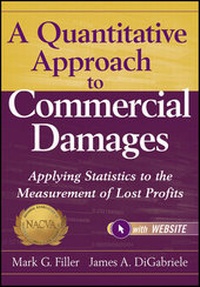
A Quantitative Approach to Commercial Damages
Applying Statistics to the Measurement of Lost Profits
Erschienen am 1. Mai 2012
256 Seiten
978-1-118-22244-7 (ISBN)
Beschreibung

How-to guidance for measuring lost profits due to businessinterruption damages
A Quantitative Approach to Commercial Damages explainsthe complicated process of measuring business interruption damages,whether they are losses are from natural or man-made disasters, orwhether the performance of one company adversely affects theperformance of another. Using a methodology built around casestudies integrated with solution tools, this book is presented stepby step from the analysis damages perspective to aid in preparing adamage claim. Over 250 screen shots are included and key cellformulas that show how to construct a formula and lay it out on thespreadsheet.
* Includes Excel spreadsheet applications and key cell formulasfor those who wish to construct their own spreadsheets
* Offers a step-by-step approach to computing damages using casestudies and over 250 screen shots
Often in the course of business, a firm will be damaged by theactions of another individual or company, such as a fire that shutsdown a restaurant for two months. Often, this results in the filingof a business interruption claim. Discover how to measure businesslosses with the proven guidance found in A Quantitative Approachto Commercial Damages.
Weitere Details
Weitere Ausgaben
Andere Ausgaben
Mark G. Filler | James A. DiGabriele
A Quantitative Approach to Commercial Damages
Applying Statistics to the Measurement of Lost Profits. + Website
Buch
05/2012
Wiley
115,50 €
Versand in 15-20 Tagen
Personen
Mark G. Filler, CPA/ABV, CBA, AM, CVA, is President of Filler & Associates, a valuation and litigation support practice. He recently was also chair of the editorial board of NACVA's The Valuation Examiner and coauthor of NACVA's quarterly marketing newsletter Insights on Valuation. Filler has published various articles and is recognized as a qualified expert witness, testifying frequently on business valuation, commercial damages, and personal injury matters at depositions and in state and federal courts.
James A. DiGabriele, PhD/DPS, CPA/ABV, CFF, CFE, CFSA, CR.FA, CVA, is a professor of accounting at Montclair State University and has been published in various journals, including Journal of Forensic Accounting, Journal of Business Valuation and Economic Loss Analysis, and The Value Examiner. Dr. DiGabriele is also Managing Director of DiGabriele, McNulty, Campanella & Co., LLC, an accounting firm specializing in forensic/investigative accounting and litigation support.
Inhalt
- Intro
- A Quantitative Approach to Commercial Damages
- Contents
- Preface
- Is This a Course in Statistics?
- How This Book Is Set Up
- The Job of the Testifying Expert
- About the Companion Web Site-Spreadsheet Availability
- Note
- Acknowledgments
- INTRODUCTION The Application of Statistics to the Measurement of Damages for Lost Profits
- The Three Big Statistical Ideas
- Variation
- Correlation
- Rejection Region or Area
- Introduction to the Idea of Lost Profits
- Stage 1. Calculating the Difference Between Those Revenues That Should Have Been Earned and What Was Actually Earned During the Period of Interruption
- Stage 2. Analyzing Costs and Expenses to Separate Continuing from Noncontinuing
- Stage 3. Examining Continuing Expenses Patterns for Extra Expense
- Stage 4. Computing the Actual Loss Sustained or Lost Profits
- Choosing a Forecasting Model
- Type of Interruption
- Length of Period of Interruption
- Availability of Historical Data
- Regularity of Sales Trends and Patterns
- Ease of Explanation
- Conventional Forecasting Models
- Simple Arithmetic Models
- More Complex Arithmetic Models
- Trendline and Curve-Fitting Models
- Seasonal Factor Models
- Smoothing Methods
- Multiple Regression Models
- Other Applications of Statistical Models
- Conclusion
- Notes
- CHAPTER 1 Case Study 1-Uses of the Standard Deviation
- The Steps of Data Analysis
- Shape
- Spread
- Conclusion
- Notes
- CHAPTER 2 Case Study 2-Trend and Seasonality Analysis
- Claim Submitted
- Claim Review
- Occupancy Percentages
- Trend, Seasonality, and Noise
- Trendline Test
- Cycle Testing
- Conclusion
- Note
- CHAPTER 3 Case Study 3-An Introduction to Regression Analysis and Its Application to the Measurement of Economic Damages
- What Is Regression Analysis and Where Have I Seen It Before?
- A Brief Introduction to Simple Linear Regression
- I Get Good Results with Average or Median Ratios-Why Should I Switch to Regression Analysis?
- How Does One Perform a Regression Analysis Using Microsoft Excel?
- Why Does Simple Linear Regression Rarely Give Us the Right Answer, and What Can We Do about It?
- Should We Treat the Value Driver Annual Revenue in the Same Manner as We Have Seller's Discretionary Earnings?
- What Are the Meaning and Function of the Regression Tool's Summary Output?
- Regression Statistics
- Tests and Analysis of Residuals
- Testing the Linearity Assumption
- Testing the Normality Assumption
- Testing the Constant Variance Assumption
- Testing the Independence Assumption
- Testing the No Errors-in-Variables Assumption
- Testing the No Multicollinearity Assumption
- Conclusion
- Note
- CHAPTER 4 Case Study 4-Choosing a Sales Forecasting Model: A Trial and Error Process
- Correlation with Industry Sales
- Conversion to Quarterly Data
- Quadratic Regression Model
- Problems with the Quarterly Quadratic Model
- Substituting a Monthly Quadratic Model
- Conclusion
- Note
- CHAPTER 5 Case Study 5-Time Series Analysis with Seasonal Adjustment
- Exploratory Data Analysis
- Seasonal Indexes versus Dummy Variables
- Creation of the Optimized Seasonal Indexes
- Creation of the Monthly Time Series Model
- Creation of the Composite Model
- Conclusion
- Notes
- CHAPTER 6 Case Study 6-Cross-Sectional Regression Combined with Seasonal Indexes to Determine Lost Profits
- Outline of the Case
- Testing for Noise in the Data
- Converting to Quarterly Data
- Optimizing Seasonal Indexes
- Exogenous Predictor Variable
- Interrupted Time Series Analysis
- "But For" Sales Forecast
- Transforming the Dependent Variable
- Dealing with Mitigation
- Computing Saved Costs and Expenses
- Conclusion
- Note
- CHAPTER 7 Case Study 7-Measuring Differences in Pre- and Postincident Sales Using Two Sample t-Tests versus Regression Models
- Preliminary Tests of the Data
- Using the t-Test Two Sample Assuming Unequal Variances Tool
- Regression Approach to the Problem
- A New Data Set-Different Results
- Selecting the Appropriate Regression Model
- Finding the Facts Behind the Figures
- Conclusion
- Notes
- CHAPTER 8 Case Study 8-Interrupted Time Series Analysis, Holdback Forecasting, and Variable Transformation
- Graph Your Data
- Industry Comparisons
- Accounting for Seasonality
- Accounting for Trend
- Accounting for Interventions
- Forecasting "Should Be" Sales
- Testing the Model
- Final Sales Forecast
- Conclusion
- CHAPTER 9 Case Study 9-An Exercise in Cost Estimation to Determine Saved Expenses
- Classifying Cost Behavior
- An Arbitrary Classification
- Graph Your Data
- Testing the Assumption of Significance
- Expense Drivers
- Conclusion
- CHAPTER 10 Case Study 10-Saved Expenses, Bivariate Model Inadequacy, and Multiple Regression Models
- Graph Your Data
- Regression Summary Output of the First Model
- Search for Other Independent Variables
- Regression Summary Output of the Second Model
- Conclusion
- CHAPTER 11 Case Study 11-Analysis of and Modification to Opposing Experts' Reports
- Background Information
- Stipulated Facts and Data
- The Flaw Common to Both Experts
- Defendant's Expert's Report
- Plaintiff's Expert's Report
- The Modified-Exponential Growth Curve
- Four Damages Models
- Conclusion
- CHAPTER 12 Case Study 12-Further Considerations in the Determination of Lost Profits
- A Review of Methods of Loss Calculation
- A Case Study: Dunlap Drive-In Diner
- Skeptical Analysis Using the Fraud Theory Approach
- Revenue Adjustment
- Officer's Compensation Adjustment
- Continuing Salaries and Wages (Payroll) Adjustment
- Rent Adjustment
- Employee Bonus
- Discussion
- Conclusion
- CHAPTER 13 Case Study 13-A Simple Approach to Forecasting Sales
- Month Length Adjustment
- Graph Your Data
- Worksheet Setup
- First Forecasting Method
- Second Forecasting Method
- Selection of Length of Prior Period
- Reasonableness Test
- Conclusion
- CHAPTER 14 Case Study 14-Data Analysis Tools for Forecasting Sales
- Need for Analytical Tests
- Graph Your Data
- Statistical Procedures
- Tests for Randomness
- Tests for Trend and Seasonality
- Testing for Seasonality and Trend with a Regression Model
- Conclusion
- Notes
- CHAPTER 15 Case Study 15-Determining Lost Sales with Stationary Time Series Data
- Prediction Errors and Their Measurement
- Moving Averages
- Array Formulas
- Weighted Moving Averages
- Simple Exponential Smoothing
- Seasonality with Additive Effects
- Seasonality with Multiplicative Effects
- Conclusion
- CHAPTER 16 Case Study 16-Determining Lost Sales Using Nonregression Trend Models
- When Averaging Techniques Are Not Appropriate
- Double Moving Average
- Double Exponential Smoothing (Holt's Method)
- Triple Exponential Smoothing (Holt-Winter's Method) for Additive Seasonal Effects
- Triple Exponential Smoothing (Holt-Winter's Method) for Multiplicative Seasonal Effects
- Conclusion
- APPENDIX The Next Frontier in the Application of Statistics
- The Technology
- EViews
- Minitab
- NCSS
- The R Project for Statistical Computing
- SAS
- SPSS
- Stata
- WINKS SDA 7 Professional
- Conclusion
- Bibliography of Suggested Statistics Textbooks
- Glossary of Statistical Terms
- About the Authors
- Index
