

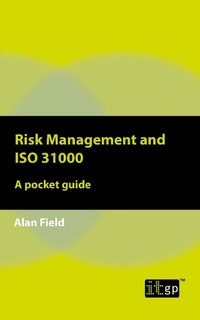
Risk Management and ISO 31000
A pocket guide
1. Auflage
Erschienen am 14. März 2023
51 Seiten
978-1-78778-416-1 (ISBN)
Beschreibung
Risk management is a primary concern for any organisation. Its significance has only increased since the start of the COVID-19 pandemic. Organisations need to prepare for all types of threats, both probable (a server breaking down) and improbable (the office being flooded), to ensure that their operations can survive and adapt to continue with BAU (business as usual) in the face of a disaster.
Yet risk management isn't solely about preventing negative outcomes, it is also about an organisation taking a known risk to uncover new opportunities to improve the organisation. For example, the transition of employees to remote working could risk an organisation's security as an employee could connect their laptop to an unsecure Wi-Fi connection. However, as demonstrated in the pandemic, remote working helped protect employees as the risk of infecting one another with COVID-19 was reduced.
Read this pocket guide to understand how:
Risk-based management can prepare your organisation for future threats and therefore help the success of a BCP (business continuity plan);
To identify whether the opportunities gained from a 'risky' decision can outweigh the perceived threat;
The principles of ISO 31000 can help your organisation develop a framework for its approach to risk management;
The guidelines of ISO 31000 can be interwoven with controls in other standards such as ISO 27001 and ISO 9001; and
The organisation must continually review its approach to risk management to stay prepared for the latest threats.
Yet risk management isn't solely about preventing negative outcomes, it is also about an organisation taking a known risk to uncover new opportunities to improve the organisation. For example, the transition of employees to remote working could risk an organisation's security as an employee could connect their laptop to an unsecure Wi-Fi connection. However, as demonstrated in the pandemic, remote working helped protect employees as the risk of infecting one another with COVID-19 was reduced.
Read this pocket guide to understand how:
Risk-based management can prepare your organisation for future threats and therefore help the success of a BCP (business continuity plan);
To identify whether the opportunities gained from a 'risky' decision can outweigh the perceived threat;
The principles of ISO 31000 can help your organisation develop a framework for its approach to risk management;
The guidelines of ISO 31000 can be interwoven with controls in other standards such as ISO 27001 and ISO 9001; and
The organisation must continually review its approach to risk management to stay prepared for the latest threats.
Weitere Details
Sprache
Englisch
Verlagsort
Ely
Großbritannien
Zielgruppe
Für Beruf und Forschung
Dateigröße
0,66 MB
ISBN-13
978-1-78778-416-1 (9781787784161)
Copyright in bibliographic data and cover images is held by Nielsen Book Services Limited or by the publishers or by their respective licensors: all rights reserved.
Schweitzer Klassifikation
Weitere Ausgaben
Personen
Alan Field, LL.B (Hons), PgC, MCQI CQP, GIFireE is a Chartered Quality Professional and Member of The Society of Authors.
Alan has particular expertise in auditing and third-party assessing of ABMSs (anti-bribery management systems) to ISO 37001, and IMSs (integrated management systems) to ISO 9001 and ISO 14001 requirements. Alan has many years' experience with quality and IMSs in the legal, financial, property services and project management sectors, working in auditing, assessment and gap analysis roles.
Alan has particular expertise in auditing and third-party assessing of ABMSs (anti-bribery management systems) to ISO 37001, and IMSs (integrated management systems) to ISO 9001 and ISO 14001 requirements. Alan has many years' experience with quality and IMSs in the legal, financial, property services and project management sectors, working in auditing, assessment and gap analysis roles.
Inhalt
Introduction
Chapter 1: What is risk?
Chapter 2: What is ISO 31000:2018?
Chapter 3: Before you read ISO 31000, read this!
Chapter 4: Using ISO 31000 to assist risk-based thinking
Chapter 5: Reading ISO 31000 within wider risk concepts
Conclusion
Further reading
Chapter 1: What is risk?
Chapter 2: What is ISO 31000:2018?
Chapter 3: Before you read ISO 31000, read this!
Chapter 4: Using ISO 31000 to assist risk-based thinking
Chapter 5: Reading ISO 31000 within wider risk concepts
Conclusion
Further reading
